




Fleets Find Benefits in EOBRs
In the first year after adopting electronic logs, Cargo Transporters, Claremont, N.C., had not only reduced out-of-service violations related to hours of service, but it also had improved its CSA "Driver Fatigue" BASIC score and was able to cut its compliance staff by 50%

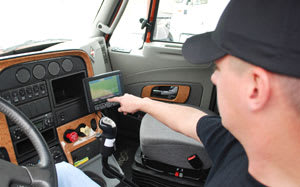
While the federal government's efforts to require electronic logging devices have suffered a setback, many in the industry are working to get ahead of an expected mandate.
In the first year after adopting electronic logs, Cargo Transporters, Claremont, N.C., had not only reduced out-of-service violations related to hours of service, but it also had improved its CSA "Driver Fatigue" BASIC score and was able to cut its compliance staff by 50%.
Speaking at a recent industry conference, Chairman John Pope said his company wanted to address a number of challenges with regards to hours of service in its 500-truck fleet. Among these were drivers being placed out-of-service for not having current logs, lack of real-time visibility into available hours and after-the-fact analysis of logbooks.
Pope's company added an hours-of-service app to its existing mobile communications system. After starting with a test on 50 trucks, within 45 days the company decided to implement the system fleetwide.
"We haven't had a driver put out-of-service for a log violation in some time," he said. In addition, the company saved significant money from not having to use third-party log auditing.
While the federal government's efforts to require electronic logging devices have suffered a setback, many in the industry are working to get ahead of an expected mandate. Others, such as Cargo Transporters, are finding that electronic onboard computers offer many benefits beyond e-logs.
Tom Cuthberson, vice president, regulatory compliance at Xata, Eden Prairie, Minn., says some fleets, seeing a mandate down the road, say they want to get ahead of the curve. "Others say they value what the devices can do in terms of reducing paperwork, providing better visibility of available hours and the other byproducts of using the things."
Norman Thomas, general manager of CarrierWeb, Atlanta, explains that "it's both the specter of future regulations and the productivity gains that are moving fleets to adopt the technology." Some, he says, "see it as a necessary evil."
Others see it as a way to become safer. Thomas says he sees a mindset change among smaller fleets from, "I have to have this because I'm forced to have it" to "I've got to have it because I need it."
Not all e-logs, or automated logging devices, are EOBRs as defined in FMCSA rules. With some e-logs, drivers keep track of their duty status by recording information into a program on a laptop computer or smartphone app rather than filling out a paper log.
EOBRs, however, as defined by the FMCSA, must link into the truck's central computer to record odometer readings and other information and must provide GPS data to track vehicle movement, among other technical requirements (many of which are still being hashed out for the upcoming new rules).
The fact that an EOBR must be linked to the vehicle's computer means fleets can take advantage of the devices beyond keeping driver logs, and a number of fleets are doing just that.
Qualcomm Enterprise Services announced last month that its QHOS hours-of-service application now has 140,000 users. Fleets are discovering that the technologies have other benefits, which gives them a "huge advantage over their peers," that don't have the technology, says Norm Ellis, vice president sales, service and marketing for the San Diego-based company.
Many fleets report discovering an extra one to 2.5 hours a week of driving time per driver - time they didn't know they had before because the fleet managers had to wait until paper logs got back to the office to find out. When tied into a back office dispatch system, an automated log allows dispatchers to know which drivers have the most hours in real-time.
"When the paper log is in the truck, you have no way of knowing which driver actually has the hours left to pick up a load," Ellis says.
"There's more beyond this than logs," CarrierWeb's Thomas says. "You get data you can use to make better decisions regarding driver behavior, vehicle behavior and fuel consumption."
Xata's Cuthberson agrees. "When you hook to the engine, there is a lot of byproduct information that you get for fuel management, idle time, driver performance scorecards and vehicle performance score cards, for instance," he says. "They've seen improvement in these areas because they can measure these things now."
As Cargo Transporters discovered, many trucking management systems feature an hours-of-service option that integrates data from the fleet's mobile communications systems, or vice versa. Some of the companies offering these systems include Qualcomm, PeopleNet, Xata and CarrierWeb.
However, fleets don't have to already have a TMS or mobile communications system to use EOBRs. There are stand-alone products that offer EOBR functionality plus other features, and Continental Commercial Vehicle and Rand McNally recently introduced two such products.
Continental, Allentown, Pa., introduced its VDO RoadLog EOBR into the U.S. market. The company has been selling EOBRs in Europe and other areas for 30 years and currently has 6 million units on the road, according to Alexis Capelle, segment leader, tachograph, telematics and services for the company.
The device records more than hours of service, as it comes with a suite of applications including an automated vehicle inspection report function and fuel tax and mileage reporting for IRP purposes.
The RoadLog is mounted on the cab and connects to the engine's ECU via an engine diagnostic port. The unit features integrated GPS and a printer that can print out hard copies of a driver's log or the VIR. When a driver logs on to the unit via a USB key, his current status and available hours are displayed.
The relatively low price of the unit, combined with the fact there is no monthly service charge, makes the unit attractive to small fleets and owner-operators, says Continental Sales Manager Jeff Waterstreet. "We've seen large fleets interested in the product for their owner-operators."
Chicago-based mapmaker Rand McNally has been producing an in-cab navigation device for the trucking industry since 2009. The company introduced an EOBR application for its TND 760 in-cab device in May. According to Mason Meadows, product manager for the EOBR group, e-logs seemed a natural progression for their product line, and the new unit includes features beyond automated logging.
"Based on the fact we have a device in the cab, we have GPS data. We have data from the vehicle's engine computer coming back to us, we can look at how a driver actually drives a truck - is he speeding, braking too hard, using the cruise control, how his fuel economy compares to other drivers?" Meadows says. That data can be combined to develop driver performance scorecards.
Meadows says few of Rand McNally's customers are interested in only logging. "There is far more interest in the full capabilities of our products," he says. "Probably less than 10% have interest in just logs." Meadows says another 30%, typically small- to medium-sized fleets that don't have integration with a fleet management system, are after logs plus driver performance information.
Driver acceptance is a key concern for many fleets contemplating automated logs, yet the pushback many expected has turned into broad acceptance.
"Drivers were concerned about the 'Big Brother' aspect of mobile comm technology when it was introduced in the early '90s," says Xata's Cuthberson. "But then drivers started seeing they were getting more loads, their revenue was more consistent, and the Big Brother thing faded. I've seen the same thing over the last few years with respect to a
More Fleet Management

Geotab Links Fleet Card to Vehicle Data
The new card combines fuel discounts with telematics-based purchase controls. Geotab’s analysis also points to potential savings from choosing lower-priced fuel stops.
Read More →
How MFA Helps Protect Trucking Fleets
Multi-factor authentication adds protection when passwords are stolen. Here’s how it works and where fleets should start.
Read More →
How Better Freight Data Helps Trucking Teams Get Ahead of Disruption
Trucking and logistics teams have plenty of data. The problem is getting the right information in front of the right people soon enough to act. Better-connected data can help teams spot trouble earlier and make smarter decisions before small problems become big ones.
Read More →

Trimble: Taking Artificial Intelligence in Trucking Beyond Faster Tasks
At Insight 2026, Trimble executives argued that fleets may need to redesign workflows to get more from AI as it introduced new products and enhancements. AI’s value will depend on how fleets combine automation with their people's knowledge.
Read More →
Build a bulletproof fleet: Uniting ELDs and dash cams for total compliance
An ELD can prove compliance, but it cannot always prove what happened on the road. Discover how uniting accurate ELD data with AI-powered dash cam video can help your fleet strengthen compliance, defend against liability, protect drivers and reduce operational costs.
Read More →
Nominations Open for HDT Emerging Leaders
Heavy Duty Trucking is looking for accomplished trucking fleet professionals under 40 who are making an impact and helping lead the industry forward.
Read More →
Why Private Fleets Are Taking More Freight
Private fleets are putting their own trucks on demanding customers and high-cost lanes as companies seek greater control over service, costs, and capacity.
Read More →
Color Match Smarter: Tools That Restore & Perform
For fleet managers and collision repair professionals keeping heavy-duty trucks on the road, getting the color right the first time isn't just about appearance — it's about efficiency, turnaround time, and bottom-line results. Discover how today's digital color tools are transforming the repair process from guesswork to precision.
Read More →
FMCSA Pauses Biennial-Update Enforcement Amid Motus Transition
Carriers whose updates were due on or after June 1 have more time, while FMCSA works to stabilize its new registration system and warns of phishing sites impersonating its new carrier registration system, Motus.
Read More →
2026 Blueprint for Countering Smarter Supply Chain Theft
Cargo theft is no longer just the cost of doing business. It's a multi-billion-dollar criminal enterprise exploiting vulnerabilities across your fleet, drivers, and supply chain.
Read More →