




FLD-SD: Aging But Rugged
Severe Duty version of Freightliner's FLD proves a joy to drive, but get one while you can, because production stops in late 2009.

Severe Duty version of Freightliner's FLD proves a joy to drive, but get one while you can, because production stops in late 2009.
Freightliner's FLD road tractors were once among the most populous on the highways, but they're disappearing as they wear out and newer models take their places. There's one FLD left, though, and that's the SD, for severe duty, model. It retains its '80s-era styling, including right-angle lines and an upright two-piece windshield that fleet managers used to prefer for ease of replacing glass, and which still makes sense in vocational duties where speeds are slower and stationary time at work sites is greater.
Most FLD-SDs are dump and mixer trucks, but this one was a tractor. Its gloss-black paint was complemented by chrome and polished metal trim that combined to remind me of a ruggedly handsome man who's no longer young but is aging well, thanks in part to a healthy heart. Over the years the FLD-SD series has gotten modern, electronically controlled diesels that deliver top performance. This one had a powerful and strong-sounding Detroit Series 60 and a smooth shifting Eaton Fuller 13-speed transmission. It turned out to be one of those trucks that I wanted to take home.
The tractor's setback steer axle results in a forward-thrusting nose that seems to underscore its workaday purpose. Compared to FLD road tractors with their rounded and sloped hoods, the SD's hood is is higher and more squared in front, suggesting the tougher frame and other components that qualify it for rough service. There's plenty of room under it for the big-bore engine, a big 1,750-square-inch radiator, and all other accessories needed to keep the vehicle on the job.
The interior is straight out of the highway-type FLD, with a high two-piece instrument panel whose right wing cants toward the driver. It has an array of switches and gauges that complement the speedometer, tachometer and engine-condition and air-pressure gauges directly ahead on the main panel. Yeah, the headlight switches are at the base of the wing panel, almost hidden behind the steering wheel, but they didn't bother me as they have in the past because I knew where they were - and besides, it was a sunny day and I seldom needed them.
The panels were laid over with a handsome faux-wood facing that contrasted nicely with the chrome bezels circling the gauges. I don't recall ever thinking of an FLD's instrument panel as attractive, but I immediately became fond of this one. Freightliner has long since built the more modern Century and Columbia, and even they have a replacement in the new Cascadia. All have wider, smoothly sculpted cabs with more graceful instrument panels, and all come in non-sleeper daycab versions. But for construction and other heavy vocational duties, the FLD-SD is still the main offering.
One reason it's still in production is that Freightliner builds them for the U.S. Army, which since 1989 has bought thousands of olive-drab and desert-tan units for use as road tractors. They are 6x4 daycabs, like this vehicle. The Army also buys 6x6 tractors and dump trucks for engineer use, and has bought glider kits that were usually powered by Cummins N14s taken from older vehicles.
The more recent units have Detroit Series 60s, but with pre-'07 specs. Overseas, including war zones, the military feeds most trucks and aircraft with JP8 fuel, which is closer to kerosene and has too much sulfur for civilian engines' diesel particulate filters. So military versions don't meet current emissions limits, but that becomes less important when bullets are flying and bombs are exploding.
Back to the civilian world, the Series 60 in this tractor was '07-legal, so its fuel and combustion systems were high-tech and its stack was dominated by a burly DPF. Much testing accompanied development to its current configuration, but meeting still tougher exhaust emissions limits in 2010 requires new approaches. So the Series 60, which originated in 1987, will be phased out by the end of '09 while the new "DD" series is phased in. But you won't see the DD in the FLD-SD, as its days are numbered, too (more on that in a bit).
The Series 60 remains a capable engine, and in '07 form has a muted snarl that's pleasing to the ear. It's standard in this chassis, while the lighter Mercedes MBE 4000 and the heavier Caterpillar C15 are optional. This Detroit had 450 horsepower and 1,650 pounds-feet of torque seemingly eager to get to work.
In the back lot of Freightliner's test center in Portland, Ore., I fired it up and backed the tractor under the nose of a 48-foot Transcraft Eagle aluminum-and-steel flatbed trailer. A crew had loaded it with big ol' concrete blocks that weighed it down and gave us a gross combination weight of about 72,000 pounds.
I gave the rig a visual once-over and got on the road, or streets, as is the case in Portland's Swan Island industrial section, where Freightliner is headquartered. Leaving there involves a short but steep upgrade on Channel Avenue until the exit onto International Drive; the big Detroit pulled strongly in 6th and 7th gears, which I split to keep revs below 1,600 to 1,700. I watched the right-hand mirror while on the ramp to be sure I was keeping the trailer's tires away from the curb as I downshifted to 5th and again played with the splitter (what fun!). Then it was downhill on the four-lane street until the on-ramp to I-405, and within a mile or so I swung eastward on I-84.
While making any appreciable amount of power the Detroit emitted a mellow bellow that was reminiscent of the old, less muffled days. Every other '07-spec diesel I've driven is rather quiet. In some truck models the engines are further isolated with cab soundproofing so that a driver can barely hear one at all.
Not so the Series 60 in an FLD-SD. You know it's a big diesel and, if you like mechanical sounds, you'll find joy in the decibels it's making. Its low-frequency growling makes it the nicest-sounding engine you can buy right now. In fact, it's the next best thing to a 4- or 5-inch-diameter straight pipe, if you could have one (which you legally cannot because that would require removing the particulate filter.)
Ash from motor oil accumulates in DPFs, which are periodically cleaned out by active regenerations requiring the injection of some fuel into the exhaust stream. Detroit engineers have found that they had set the electronics to initiate more regens than were needed, which used extra fuel. New control software orders fewer regens, and fuel economy should improve.
Leaving the city on I-84, I gradually built up speed as I upshifted through 7th and 8th gears, again splitting through direct and overdrive as the Detroit willingly picked up the pace. I had noticed the speedometer needle seemed to be stuck down at 35 and 40 mph, but at an indicated 60 mph I was passing everything and it occurred to me that I was moving a lot faster than 60. Slow 'er down, boy, I told myself, and eased up on the accelerator to go with the traffic flow. Obviously the speedo was miscalibrated, and I wrote it up later.
I proceeded up the wide Columbia River Gorge - a masterpiece of scenery that everyone should see at least once - and after an enjoyable 40 miles I pulled into the Multnomah Falls rest area, which sits between the east- and westbound lanes. Here I have a routine: I proceed to a turn-around at the area's east end and put the tractor through a brief maneuvering test. If I can make the sharp left-hand U-turn without doing a back-up and jackknife, and without dragging the trailer's tires over the curb, the tractor "passes."
This time I made the U-turn in one sweep and the tires' sidewalls didn't even kiss the curb - pretty good, as the trailer had a wide-spread tandem whose second axle was at the vehicle's rear. The tractor's setback steer axle allows room for the wheels to cut tightly toward the frame, allowing a sharp cut le
More Equipment
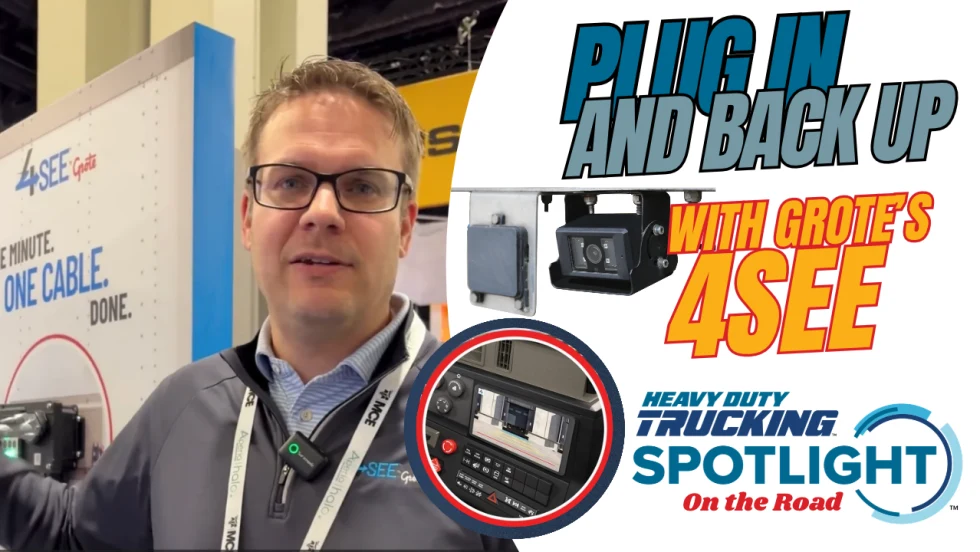
More Trailer Data Through the Same Seven-Way [Video]
Can trucking’s standard seven-way connector handle more cameras and trailer data? Grote’s Adam Slade shows HDT how the company is using new technology with its 4See trailer system, not only to add a new backup camera but also to expand other capabilities — without adding another connection.
Read More →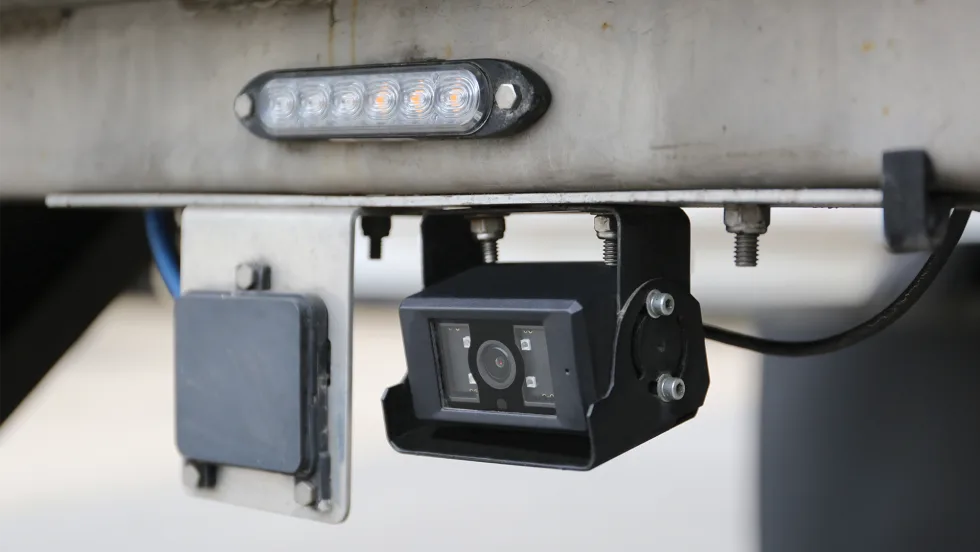
Grote: More Cameras, Same Seven-Way Connector
The next-generation 4See rear-view backup camera from Grote uses the standard seven-way connector and supports additional cameras and other trailer data.
Read More →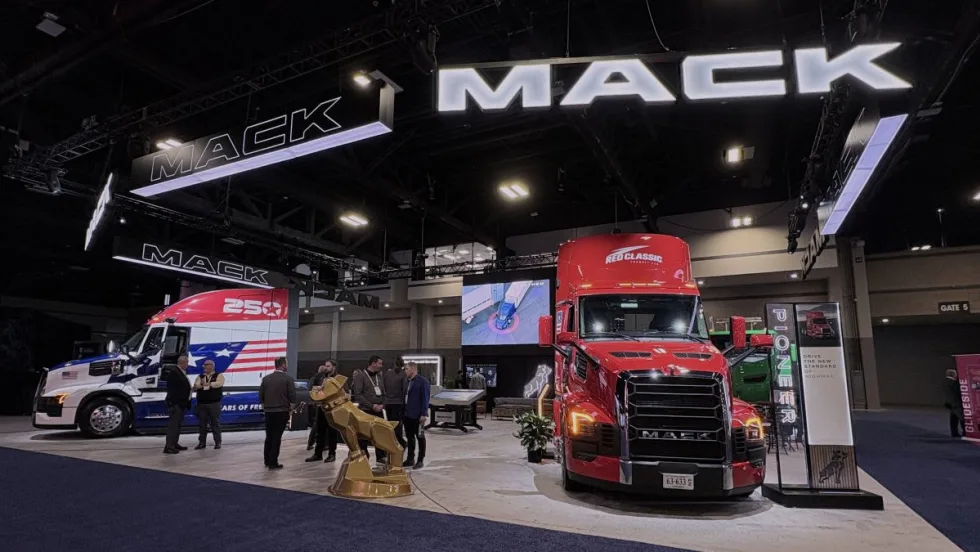
Trucks at ATA's 2026 MC&E in Charlotte, North Carolina [Photos]
From rigs decked out in patriotic America's 250 paint schemes to autonomous trucks and more, check out these photos from ATA's 2026 Management Conference & Exhibition.
Read More →
Help HDT Find Trucking’s Top Products
Have you come across a new product that could make a difference for trucking fleets? Nominate it for HDT’s 2027 Top 20 Products Awards by November 9.
Read More →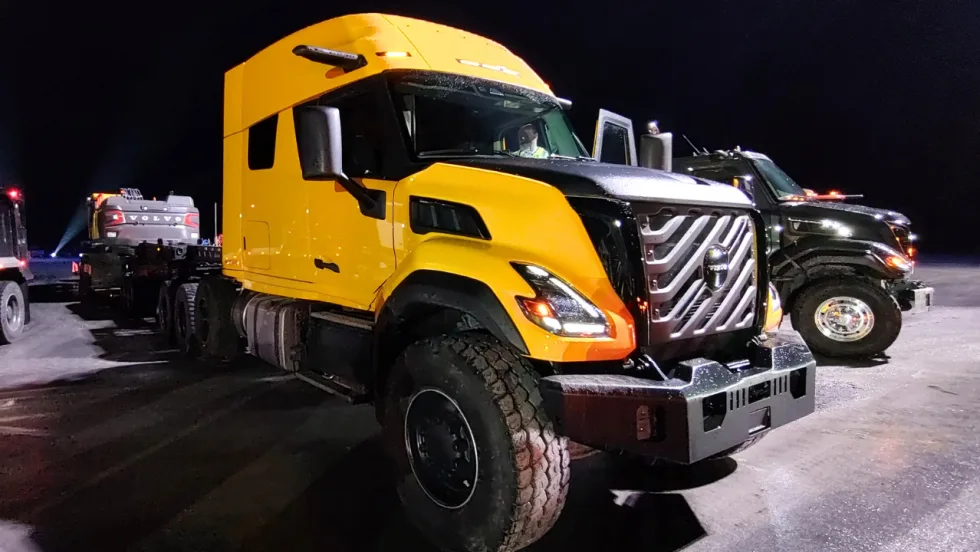
Volvo Unveils New VNX Heavy-Haul and Vocational Truck
Volvo Trucks has launched the VNX, a new vocational truck also available as a tractor in day cab and two sleeper configurations, with one heavy-haul model. The Volvo VNX is powered by Volvo's D13 platform, which delivers up to 540 horsepower and 1,950 pound-feet of torque and is EPA 2027-compliant.
Read More →
How GP Transco Cuts Trucking Fuel Costs, a Tenth of a Gallon at a Time
What’s another tenth of a mile per gallon worth? GP Transco shares how equipment upgrades and driver coaching turn small gains into meaningful fuel savings.
Read More →
Electric Yard Tractors Move Beyond Pilots
Operating-cost savings have overtaken sustainability goals as the leading reason surveyed fleets are adopting battery-electric terminal tractors, according to new NACFE research.
Read More →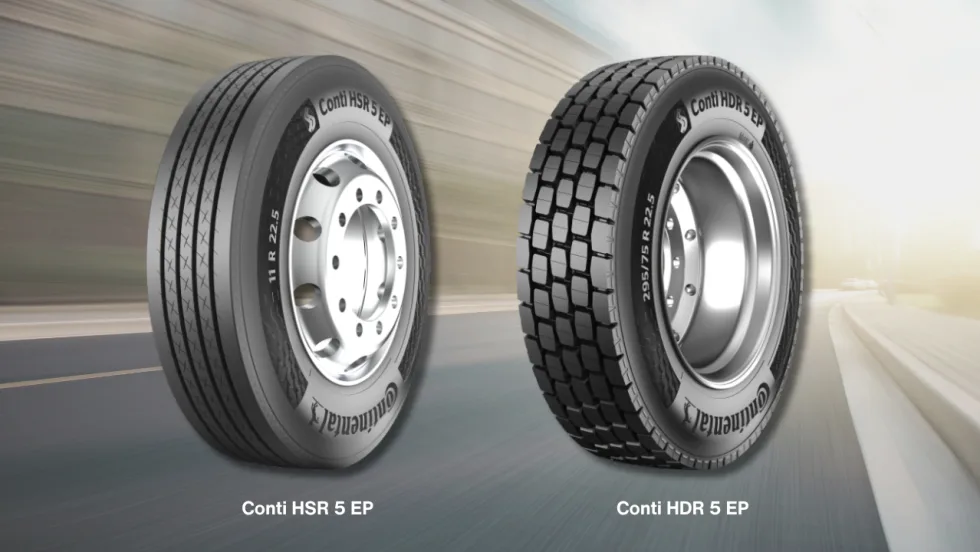
Continental Introduces New Regional Truck Tires
Continental says its new Generation 5 steer and drive tires for regional operations offer longer tread life, with estimated mileage gains of 22% and 19%, respectively.
Read More →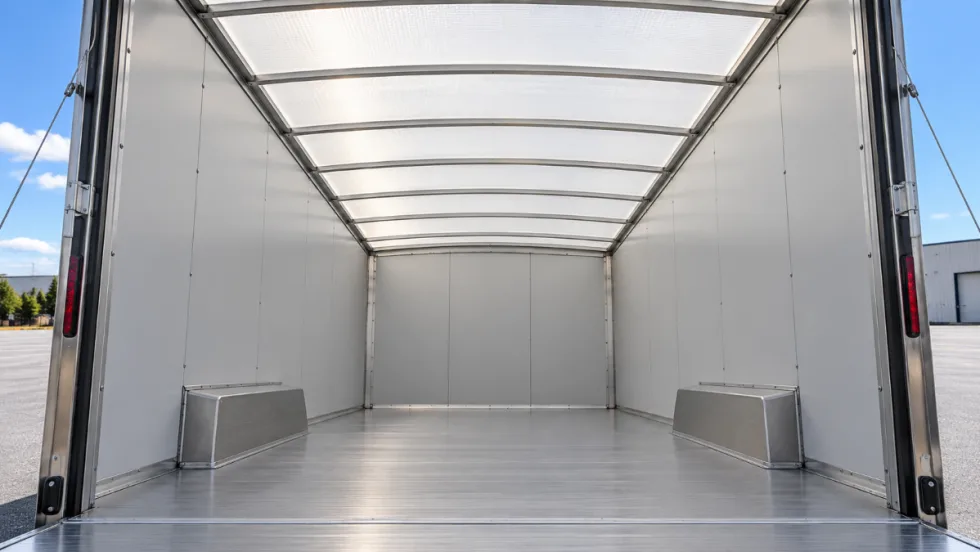
Tekmodo Introduces CargoBright Brand for Translucent Trailer Roofs
CargoBright is designed to diffuse daylight across the cargo area while performing as a working vehicle roof.
Read More →
Fleet Economics Shape Electric Truck Outlook
ACT Research expects costs, charging infrastructure, and technology improvements to drive zero-emission commercial vehicle adoption as federal regulations and incentives retreat.
Read More →