





Related video – On the Spot: Detroit DD5 Midrange Engine
First Look at Detroit DD5 Medium-Duty Engine
HDT Senior Editor Jack Roberts takes to the streets of Chicago for a first hands-on look at Detroit's new DD5 four-cylinder, 5.1L engine.
December 19, 2016
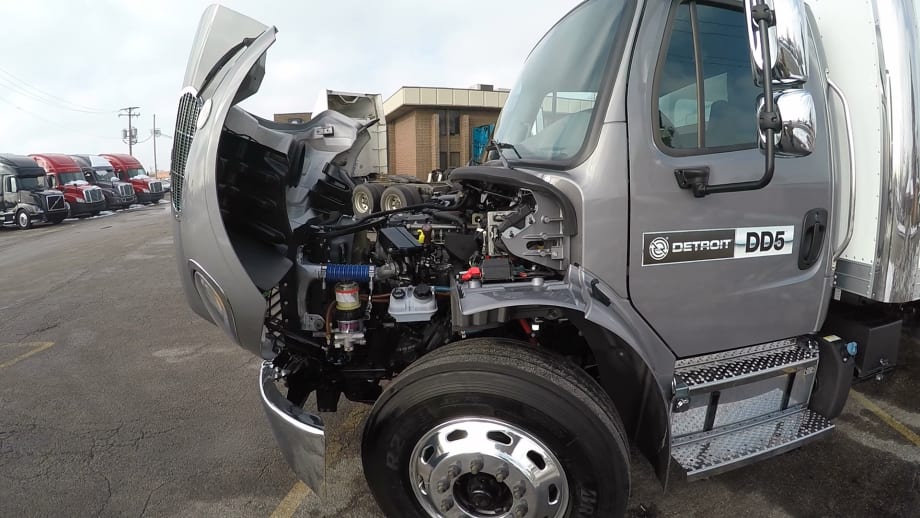
Detroit’s new DD5 diesel is a 5.1L engine designed for urban delivery/service applications in Class 5–6 Freightliner M2 106 trucks. Photo: Jack Roberts
3 min to read
Detroit’s new DD5 diesel is a 5.1L engine designed for urban delivery/service applications in Class 5–6 Freightliner M2 106 trucks. Photo: Jack Roberts
According to Chris Moran, medium duty program manager of sales and marketing for Detroit, the company's new DD5 medium-duty engine is merely the company's first step in filling out its diesel engine portfolio. A larger displacement 8L DD5 is slated to launch next year, which he said will give Detroit a powerful and fuel-efficient diesel to meet any need for fleets ranging from Class 4 up to Class 8.
The DD5 is a four-cylinder engine – a design that has been traditionally suspect in the eyes of North American fleet owners from longevity and power points of view. But Moran said the engine's parent-bore cylinder design has removed complexity from the engine, while a cast iron, deep-rib block has increased overall durability and the engine's overhead cam gives it plenty of low-end power to get a truck rolling and keep it both cruising and passing at highway speeds.
So we headed to Chicago to see how well it lives up to that promise.
Our Freightliner M2 test truck was equipped with an Allison 2500 Series automatic transmission, which gave crisp and instantaneous response when I accelerated out of the dealership into heavy Chicago traffic. In fact, had I not been briefed beforehand that the DD5 is a four-cylinder design, I doubt I would have guessed it, so brisk was the overall acceleration from a dead stop.
The initial stop-and-go traffic also gave Moran the opportunity to show me DD5's extremely effective engine brake, which is activated by a dash-mounted flip-switch to the right of the steering wheel. The brake switch has three settings, Off, Low and High, which gave me an impressive amount of stopping power without putting my foot on the brake pedal.
The engine brake engages immediately after you let off the accelerator pedal and it is aggressive even at highway cruising speeds. Moran said Detroit is so confident in the design it believes fleets running the DD5 will see increased brake life and a decrease in associated maintenance costs if drivers use the engine brake regularly.
Even with a fully loaded box, the DD5-equipped M2 showed consistently crisp throttle response and brisk acceleration as I worked my way through a long series of traffic lights heading toward the entrance ramp to I-290 West toward the Chicago suburbs.
I really put my foot into it as we took off down the freeway entrance ramp and was impressed to see that the M2 was already going 55 mph by the time I needed to merge into traffic.
Once I was at cruising speed, I had to be mindful of the speedometer as the DD5 had no trouble quietly and quickly moving past the posted 55 mph speed limit to much higher speeds. Traffic flow on I-290 was about 65 mph, which the DD5 had no problem maintaining.
A bit later on, in a passing situation, the engine quickly got the M2 up past 75 mph, with the engine brake in "High" setting, quickly decelerating the vehicle once I was past the offending car.
Overall, the engine performed admirably with impressive acceleration and cruising characteristics. Interior noise levels are low throughout the engine's power curve, and the Detroit engineers deserve a special tip of the hat for the engine's integrated engine brake and its extremely effective performance.
Read the full Test Drive in the January issue of HDT.
Subscribe to Our Newsletter
More Fuel Smarts

How Volvo Updated Its D13 for EPA 2027 [Watch]
Volvo’s updated D13 promises lower emissions without sacrificing performance or fuel economy. Take a closer look at what changed inside the engine in this HDT Spotlight video.
Read More →
Diesel Price Spike Shortens Payback for Natural Gas Trucks, Report Says
Energy Vision estimates fleets could recover the higher purchase price of an RNG-fueled Class 8 tractor in 1.3 to 2.8 years under current fuel-price scenarios.
Read More →
Calstart Becomes Catalyst Mobility, Reflecting Broader Focus
Calstart is now Catalyst Mobility, reflecting the nonprofit’s growing national role in clean transportation, including zero-emission trucks, infrastructure and incentive programs.
Read More →

Record Diesel Prices Squeeze Trucking Fleets
Average U.S. diesel prices have climbed to nearly $6 a gallon, surpassing the 2022 record as tight refinery capacity and Middle East disruptions keep fuel costs elevated.
Read More →
Sponsored•September 9, 2026
How Fuel Delivery Shapes Engine Performance
Fuel delivery depends on more than what happens at the injector. For fleet, maintenance and technical professionals, looking at the full path from pump to injector can provide useful context for understanding engine performance.
Read More →
East Coast Port Launches $45M Electric Truck Push
The Port Authority of New York and New Jersey announced millions in incentives for zero-emission drayage trucks, yard tractors, and new charging hubs near the port.
Read More →
California Bill Could Shed Light on Electric Truck Prices
Why do battery-electric Class 8 trucks remain so expensive? A California bill headed to Gov. Gavin Newsom would give fleets and state agencies more visibility into what manufacturers charge.
Read More →
Detroit Opens Orders for EPA 2027 Engines
Detroit isn’t starting from scratch to meet EPA 2027 diesel emissions standards. Its Gen 6 DD13 and DD15 engines keep much of today’s platform while updating the fuel and aftertreatment systems.
Read More →
Zero-Emission Truck Corridor Planned for West Coast
California, Oregon, Washington, British Columbia and Baja California are coordinating plans for truck charging and hydrogen fueling from Canada to Mexico.
Read More →
A Closer Look at Kenworth’s Electric T880E Vocational Truck [Video]
Learn more about Kenworth's T880E battery-electric vocational truck at the Paccar Technical Center, including its range, applications, upfitting considerations, and PTO options, in this HDT Spotlight video.
Read More →