





More from Jeff Kauffman: The Great Modal Migration of 2021 Continues [Commentary]
Fleet Financial Trends Imply Solid Start to 2022
As we neared the end of 2021 and took a look at third-quarter fleet earnings reports, the news looked good — good enough that the stock prices of the group were up 15.6% during the earnings reporting season, compared to the Standard & Poor’s 500 Index that was up 7.6%.
January 4, 2022

Jeff Kauffman, a recongized trucking and transportation authority for almost 30 years, breaks down the trucking's economic indicators in HDT's Behind The Numbers column.
Graphic: HDT
4 min to read
As we neared the end of 2021 and took a look at third-quarter fleet earnings reports, the news looked good — good enough that the stock prices of the group were up 15.6% during the earnings reporting season, compared to the Standard & Poor’s 500 Index that was up 7.6%.
The big story for the third quarter was the overall rate of improvement in yields (pricing + fuel surcharge + mix.) Nearly every freight sector has been experiencing double-digit yield improvement. Because yield improvement carries no associated variable cost, much of this offsets inflation and drops straight to the income line.
We look at margin improvement in terms of basis points (100 basis points = 1 percentage point). The top performances from a margin improvement standpoint this past reporting quarter have been:
Rideshare (Uber/Lyft): 2,725 basis point margin improvement
Delivery (Uber): up 450 basis points
Brokerage/Logistics: up 390 basis points
Intermodal: up 385 basis points.
Both key trucking modes (over-the-road truckload and less-than-truckload) reported solid margin improvement as well, up 230 and 210 basis points, respectively.
On the other side of the coin, sectors disappointing were:
Supply Chain/Warehousing: 550 basis point margin decline
Dedicated Truckload (a larger 320 basis point margin decline)
Final Mile (down 50 basis points).
The common themes here were supply chain inefficiencies and labor cost inflation.
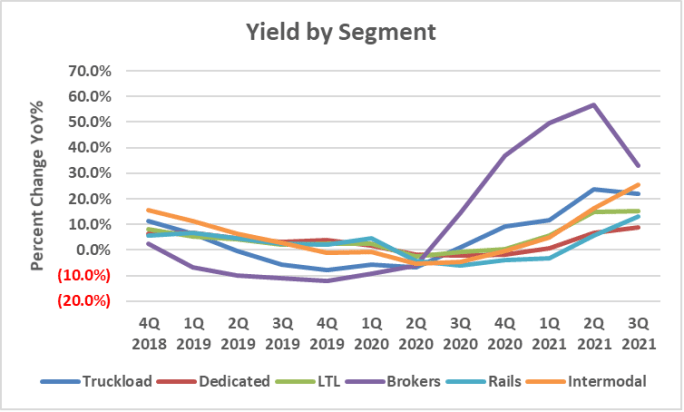
Source: Company Reports, Tahoe Ventures LLC
8 Observations from 3Q Earnings Reports
Truck OEMs are having trouble delivering vehicles related to the chip and supply chain shortage, but we believe that difficulty will peak in the fourth quarter.
Less capacity coming into the industry is a positive in terms of tight truck capacity and therefore pricing favorable to fleets will likely last through 2022.
Tight capacity is also boosting gains on sales for companies in trucking and leasing
Rail system fluidity looked like it might be turning a corner in October.
We are seeing a narrowing of the negative spread between contract pricing and spot rates.
Consumer and retail stock-outs and gift cards may extend holiday shipping into the first quarter of 2022.
LTL continues to be a safe haven within trucking, setting an all-time quarterly rate increase.
Intermodal rates are rising quickly behind trucking rates.
Trucking Sector Performance
Pure Truckload
Truckload fleet earnings are still contracting (down 6%), but yields are rising ahead of expectations, and more than offsetting rising driver wage costs. Those trends resulted in another quarter of double-digit revenue growth (+10.7%) and 230 basis points (2.3 percentage points) of margin improvement — the fifth straight quarter of at least such improvement. Many carriers have been reducing capital spending this year related to truck production challenges of OEMs.
Dedicated Truckload
While dedicated fleets have been a strong growth opportunity over time, they are the Achilles heel of the freight space this year, as long-term contracts have not allowed companies to keep up with rising labor costs, and high purchased transportation expenses have eaten into margins, resulting in a year-over-year margin decline of 320 basis points (3.2 percentage points). Revenue growth remained about 14% higher. In addition, some carriers are being negatively impacted by auto plant shutdowns and in many cases, retail staffing challenges.
Less-than-Truckload
LTL fleets reported some of the most consistent improvement in trucking. LTL yields continue to notch higher, up 15.3% year-over-year in the third quarter, up from a 12.7% rate the quarter before. Tonnage growth was a strong 6.3%, leading to a 2.1 percentage point improvement in operating margins — the fifth straight quarter of margin improvement.
Brokerage/Logistics
The brokerage and logistics group share the elevated revenue growth rates of the transportation sector, though contract rates are not yet keeping pace with spot rates. Companies reported an average of 57% revenue growth with accompanying 62% operating expense growth — yet operating margins grew by 3.9 percentage points because of the 33% improvement in brokerage/logistics yields.
The spread between revenue yields and purchased transportation expense is narrowing, which should be good for brokerage profits in coming quarters.
One trend we are taking note of is growing trailer pools. Some carriers, such as J.B. Hunt, run it through their truckload operation, but many brokerage and logistics companies are developing “power only” options, and those appear to be adding to margins across a greater number of companies.
Subscribe to Our Newsletter
More Fleet Management

Sponsored•September 16, 2026
Color Match Smarter: Tools That Restore & Perform
For fleet managers and collision repair professionals keeping heavy-duty trucks on the road, getting the color right the first time isn't just about appearance — it's about efficiency, turnaround time, and bottom-line results. Discover how today's digital color tools are transforming the repair process from guesswork to precision.
Read More →
FMCSA Pauses Biennial-Update Enforcement Amid Motus Transition
Carriers whose updates were due on or after June 1 have more time, while FMCSA works to stabilize its new registration system and warns of phishing sites impersonating its new carrier registration system, Motus.
Read More →
Sponsored•September 14, 2026
2026 Blueprint for Countering Smarter Supply Chain Theft
Cargo theft is no longer just the cost of doing business. It's a multi-billion-dollar criminal enterprise exploiting vulnerabilities across your fleet, drivers, and supply chain.
Read More →


Sponsored•September 1, 2026
How Telematics Improves Visibility, Control, and Performance in Refrigerated Fleets
Explore how telematics help refrigerated fleets improve visibility, uptime, efficiency, compliance, and cargo protection across connected cold chain operations.
Read More →
What the U.S.-Canada Trade War Means for Trucking
Escalating U.S.-Canada tariffs could disrupt cross-border freight, reduce truck volumes, raise costs, and create new uncertainty for carriers on both sides of the border.
Read More →
What Are Trucking’s Top Concerns for 2026?
The American Transportation Research Institute wants to know what's worrying trucking fleet managers, drivers, and other stakeholders in its annual Industry Issues survey.
Read More →
American Trucking Associations Looks for a New Leader
ATA President and CEO Chris Spear abruptly left his job at the association on August 21, at a pivotal time for the trucking industry.
Read More →
Public Wi-Fi Cybersecurity Risks: How Truck Drivers and Fleets Can Protect Their Data
Public Wi-Fi can expose truck drivers and fleets to credential theft, malware, and other cyber threats. Here’s how to reduce the risk on the road.
Read More →
For Nicky Cupp, Fleet Innovation Starts With Frustration
HDT Truck Fleet Innovator Nicky Cupp turns everyday pain points at Fraley & Schilling into opportunities for better technology and smarter processes.
Read More →
Adam Buttgenbach’s Approach to Electric Trucks: Start With Where They Fit
HDT Truck Fleet Innovator Adam Buttgenbach helped PepsiCo build one of North America’s largest EV fleets by focusing on where electric trucks make operational sense.
Read More →