




Engine Smarts: No Answers Yet
By way of a brief introduction to this first of several Engine Smarts columns to come, let me start by admitting to a lifelong fascination with the hardware of trucking
By way of a brief introduction to this first of several Engine Smarts columns to come, let me start by admitting to a lifelong fascination with the hardware of trucking.
At the age of 3 I was given to kissing truck fenders, bizarre as that may sound. Not moving trucks, I hasten to add, though no doubt greasy and dirty ones. Some might argue the point, but I seem to have suffered no ill effects. The legacy of that early interest is that I've now spent exactly half my life -- and I'm no kid any longer -- writing about the wonderful machinery that's at the very core of our industry.
You'll see by now that I'm not going to shy away from the personal here. I will, on the other hand, steer clear of the nitty-gritty technical detail of the engines that make things tick for us. I'm not an engineer and nor, I suspect, are the vast majority of you. One of my very best friends makes a living designing diesels and their various systems, mechanical and otherwise, and we can spend hours talking about all of that. He can lose me in techno-speak after a while, but he's smart enough to see when he's reached that point and I'm just smart enough to ask the clarifying question.
All of which is to say that I'm a layman like you, perhaps an "informed" layman, and I believe I understand what you know about engines, at least in broad terms, and what you might want to know. We'll see how I fare on that front, and I encourage you to write when you think I'm somehow off the mark.
OK, so what's on my mind these days engine-wise?
The EPA 2010 Debate
Well, it's not the debate about exhaust gas recirculation vs. selective catalytic reduction, I can tell you. I'm a little bored by it, frankly. I certainly have opinions, but I don't think they're worth much yet, because I maintain that we need an awful lot more experience with these 2010-spec motors before reaching any truly useful conclusions. I'd also suggest caution in looking to Europe for firm answers, because the emissions standards are different there and thus the technologies in use aren't exactly the same.
Nor can you look across the big pond for answers concerning diesel exhaust fluid distribution, because European population and commercial densities are wholly different than what we see in North America. It doesn't seem to be an issue here, but I have anecdotal evidence suggesting that things aren't perfect. Not really a biggie, it's only a matter of time.
Anyway, ask me in a year, preferably two, what I think about EGR vs. SCR. Many truths -- though not those concerning durability -- will have been revealed by then, but I wouldn't be in the least surprised if some of the technology in use now had already changed as experience was gained. The diesel engineering game has become a mighty sophisticated enterprise, and activity on that front is still at a fever pitch with all the players, so I look for innovations aplenty in the next few years. There are no givens.
Washington's recent fuel-economy and emissions mandate has guaranteed that, even if present technologies will get us to about mid-decade. Beyond that point? Nobody knows. Nobody. Which is a bit unnerving when you think about it.
Fuels in the Spotlight
A perfect certainty, however, is that fuels are going to be more and more in the spotlight. I believe there's more oil around than the scaremongers would have you believe, and I mean in North America, but it's going to get increasingly expensive -- up 15 percent in the last year -- and environmental concerns will combine with price to make it increasingly unattractive.
Enter natural gas. Enter hybrid power sources. And enter some fuels that are now quite exotic. Do not enter crop-based biofuels.
One fuel interests me in particular, and it's gaining a lot of traction in Europe, where folks pay more than twice what you do for diesel. They're thus motivated to find options like this second-generation biofuel called dimethyl ether, or DME. Volvo Trucks is part of a broad-based DME development project that also includes the European Union itself, the Swedish Energy Agency, and fuel giants like Total. Volvo already has several trucks running on DME, including a hybrid-electric garbage truck in actual service.
DME is a gas that's transformed into a liquid under low pressure, which makes it relatively easy to handle. It's actually used today for a variety of purposes like the propellant in spray-cans, the fuel in cigarette lighters, and a base chemical in the production of plastics.
It can be produced both from natural gas and more likely from a variety of biomass sources, in which case it's known as Bio-DME.
It provides an efficiency rating as high as that of an ordinary diesel engine, but a lower noise level, which is especially important in Europe and will increasingly be an issue in North America. The combustion process produces no soot, so exhaust aftertreatment is far simpler. What's more, a DME-fuelled engine is said to produce higher start-up torque, thus improving driveability.
Injection pressure is much lower than that of diesel but much higher than that found in liquid propane systems used in spark-ignited engines. Issues include poor viscosity, poor lubricity, and incompatibility with most elastomers, so those have to be addressed. But DME has a lower vapor pressure than propane so existing propane tanks can be used. It's actually conceivable that mixtures of DME and propane might be employed.
It's just one of several potentially useable fuels that will make pistons go up and down in the future. Maybe not the near-term future, but we can't afford to limit our gaze to just the next few years. I'll look at other possible fuels in columns to come.
Editor's note: Rolf Lockwood has joined the Newport Business Media staff as Editor at Large. He is vice president of editorial at Newcom Business Media, a publisher of trucking magazines in Canada, and has been writing about trucks and trucking for 31 years. You can e-mail him at rlockwood@truckinginfo.com.
More Equipment

ZF Expands Commercial Vehicle Push in North America
ZF is expanding its North American commercial-vehicle presence with new transmission applications, electrification, trailer technology and autonomous-driving systems.
Read More →
Tesla Wants a Self-Driving Semi. Are Cameras Enough?
Could Tesla’s camera-only autonomous driving technology work on an 80,000-pound Semi? In this commentary, HDT's Deborah Lockridge takes a look at Tesla, Cybercab, and how autonomous trucks see the road.
Read More →
Kodiak: Driverless Long-Haul Truck Launch on Track for 2026
Kodiak AI says its driverless long-haul safety case is 93% complete and it remains on track to begin commercial operations by year-end 2026.
Read More →
What DOT’s Automated Vehicle Strategy Means for Trucking
The U.S. Department of Transportation issued a new automated-vehicle strategy that outlines plans for driverless-truck regulations, cross-state freight corridors, and federal safety standards.
Read More →
East Coast Port Launches $45M Electric Truck Push
The Port Authority of New York and New Jersey announced millions in incentives for zero-emission drayage trucks, yard tractors, and new charging hubs near the port.
Read More →
PlusAI Going Public to Fund Autonomous Truck Launch
A SPAC deal could provide PlusAI with up to $300 million as it works toward a 2027 commercial launch of factory-built autonomous trucks.
Read More →
NHTSA Moves to Rewrite Truck Fuel-Economy Rules
The National Highway Traffic Safety Administration says it lacks authority to regulate medium- and heavy-duty truck engines separately from complete vehicles, but the existing standards have not yet been eliminated.
Read More →
Detroit Opens Orders for EPA 2027 Engines
Detroit isn’t starting from scratch to meet EPA 2027 diesel emissions standards. Its Gen 6 DD13 and DD15 engines keep much of today’s platform while updating the fuel and aftertreatment systems.
Read More →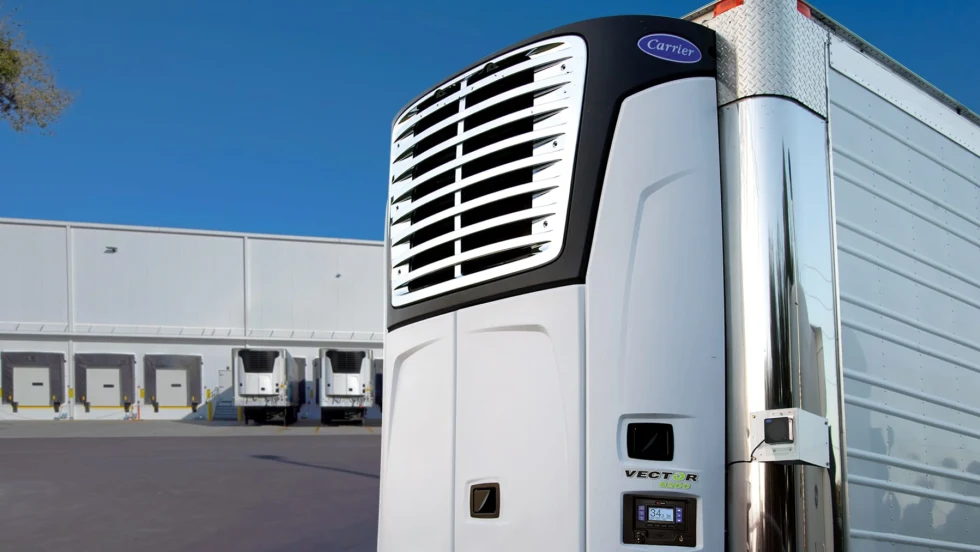
Carrier Transicold Adds All-Electric TRU for Stationary Cold Storage
Carrier Transicold’s new Vector 8200 all-electric transport refrigeration unit gives fleets a diesel-free option for temporary refrigerated and frozen trailer storage.
Read More →
A Closer Look at Kenworth’s Electric T880E Vocational Truck [Video]
Learn more about Kenworth's T880E battery-electric vocational truck at the Paccar Technical Center, including its range, applications, upfitting considerations, and PTO options, in this HDT Spotlight video.
Read More →