




Electronic logbooks in Europe: Endless row of misfortunes, or a paper pusher's dream?
Many in the trucking technology world were relieved that the U.S. government decided to go with a "standards-based" regulation for electronic onboard recorders, rather than a technical specifications approach
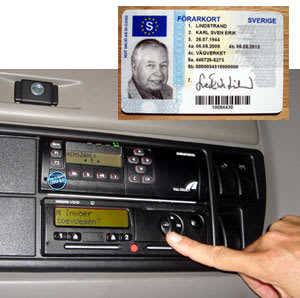
In the EU, the driver's smart card, top, is inserted into the vehicle unit portion of the digital tachograph, above. But there have been reports of the data on the card and the VU not matching up, among other problems.
Many in the trucking technology world were relieved that the U.S. government decided to go with a "standards-based" regulation for electronic onboard recorders, rather than a technical specifications approach.
In other words, the regulations spell out what the EOBRs need to be able to do, but don't go into a lot of detail on exactly how to do it, leaving it up to various electronics providers to develop systems that work best for their customers.
Europe, however, went the other direction, and things have not gone as smoothly as proponents promised.
After working on the legislation for more than a decade, on June 13, 2002, the European Union issued a mandatory rule to require digital tachographs in new medium and heavy trucks as well as new buses.
Before that, analog (chart-based) tachographs had been required in Europe for more than 40 years. A tachograph is a device that combines the functions of a clock and a speedometer. Fitted to a motor vehicle, a tachograph records the vehicle's speed and whether it is moving or stationary. The mechanical tachograph writes on a round piece of paper which constantly turns throughout the work day. But because they are subject to tampering, officials wanted to move to digital systems.
Under EU Regulation 2135/98, new vehicles first put into service after August 5, 2004, were required to be fitted with digital tachographs. But there was a slight problem: no digital tachographs that met the EU technical specifications were available by that date from any manufacturer.
To the intense annoyance of vehicle manufacturers and groups such as the UK Freight Transport Association, the European Commission only grudgingly and belatedly acknowledged this reality, declaring a "moratorium" postponing the deadline until August 2005. That date, too, proved unrealistic. Finally it was decided that new vehicles registered starting in May 2006 would be required by law to be fitted with digital tachographs.
By the 2006 date, three new digital tachograph products were available: Actia, Siemens VDO and Stoneridge.
There was no requirement in the regulations for digital tachographs to be retrofitted in older vehicles. One of the biggest operational challenges associated with digital tachographs was that many fleets had to use them in parallel with the older analog tachographs.
How a digital tachograph works
There are four basic elements to the EU digital tachograph system:
1. the "vehicle unit (VU)" installed in place of the old analog tachograph head;
2. four types of so-called "smart" cards;
3. a data input system;
4. a data output system.
The vehicle unit fitted in the cab sends signals to the speedometer and receives signals from the vehicle by a cable, much the same way as an analog tachograph. But drivers who were used to inserting charts into analog tachographs found nothing familiar in the appearance or use of this unit. It has a small digital display, two smart-card slots (for driver and co-driver), an integral printer and several control buttons.
By law, any driver without a digital smart card will not be allowed to drive one of these vehicles. Should a driver lose the card, he/she may continue to drive for no more than 15 days. A replacement driver card must be applied for within seven days.
The driver card is the same shape and size as the latest EU photo commercial driver's license, but it's not a substitute for it. The driver card is not a valid ID, in spite of having a photo of the holder; the CDL is (and has a higher security level).
Cards, cards, cards
There are also three other smart cards, all color coded : company cards, workshop cards and control cards.
Each one of these smart cards has its own distinct function. The microchip on a driver card has enough memory to store roughly 28 days of information, such as driver activity as recorded by the vehicle units in which the card has been inserted. The card also stores data identifying the driver, such as CDL number, name and date of birth. Each driver card is valid for no more than five years.
The workshop card, valid for one year, is used for testing, calibration and/or data downloading by certified technicians. It should not be confused with driver cards, which technicians will still need to use when driving vehicles equipped with digitachs.
Company cards are issued essentially to allow an owner or operator of a vehicle to lock or unlock data in the vehicle unit so it could not be accessed by a new vehicle owner. This card does not store data, but simply acts as a kind of electronic key, allowing data to be downloaded into a separate plug-in downloading tool.
Control cards are issued only to the police and other law enforcement agencies, giving them access to data stored in vehicle units and in driver cards.
The VU memory is big enough to hold basic data on 365 days of typical truck operation. When the memory is full, it will start overwriting, day by day. Detailed speed data is held in the VU only for the past 24 hours of driving time.
Of course, there are fees for card applications, renewals and replacements. And there are fines for failure to comply.
In the United Kingdom, for instance, not installing the required digital tachographcs can cost you up to $3,800. Someone found guilty of deliberate falsification faces a fine of up to $7,400 or up to two years in prison. The maximum fine for failing to comply with the demands of an enforcement official, including failure to produce the required records, has been raised to $7,600.
Difficulties
Digital tachographs were supposed to make it easier to monitor EU drivers' hours rules, improve the working environment and improve highway safety, plus put trucking companies on more even competitive footing.
Proponents said it was an absolute foolproof and safe system. During the four years since its introduction, however, a huge row of errors in the reporting have been reported.
In Sweden, the Svenska Akariforetagen (National Roadhauliers' Association - the counterpart of our American Trucking Associations) recently requested from the Secretary of Justice that an independent commission be created to investigate all the shortcomings of the digital tachograph, and that digital tachograph manufacturers are forced to report known technical failure for the authorities, among other things.
Svenska Akariforetagen has submitted proven cases of mistakes and "ghost recordings" from digital tachographs to the Secretary of Justice, including:
* differences in accounted time between display and memory of DT
* differences between accounted time on driver's card and the memory of the vehicle unit
* sudden log out of card from the vehicle unit during driving
* driver card accepted in one brand of vehicle unit but rejected by another brand.
* sudden loss of stored information in the vehicle unit.
* drive time recorded while truck was parked inside a secured garage
* the VU reporting "driving without valid card" while the period is correctly registered on the driver card.
* sudden destruction of data on driver card.
* sudden crashes of entire digital tachograph.
* digital tachograph switches from "rest period" to "other work" when strong winds appear.
Last year the German insurance company Kravag reported an investigation that found trucks with digital tachograph were involved in more accidents than those with manual analog recorders. The reason is assumed to be that drivers get more stressed by the new black boxes, which force them to find a parking place for a 30 minute break after 4.5 hours of driving. Even five minutes over this driving time can result in heavy fines.
Editor's Note: For more on electronic logs in the U.S., see the May issue of Heavy Duty Trucking magazine.
More Fleet Management
Why Private Fleets Are Taking More Freight
Private fleets are putting their own trucks on demanding customers and high-cost lanes as companies seek greater control over service, costs, and capacity.
Read More →
Color Match Smarter: Tools That Restore & Perform
For fleet managers and collision repair professionals keeping heavy-duty trucks on the road, getting the color right the first time isn't just about appearance — it's about efficiency, turnaround time, and bottom-line results. Discover how today's digital color tools are transforming the repair process from guesswork to precision.
Read More →
FMCSA Pauses Biennial-Update Enforcement Amid Motus Transition
Carriers whose updates were due on or after June 1 have more time, while FMCSA works to stabilize its new registration system and warns of phishing sites impersonating its new carrier registration system, Motus.
Read More →


2026 Blueprint for Countering Smarter Supply Chain Theft
Cargo theft is no longer just the cost of doing business. It's a multi-billion-dollar criminal enterprise exploiting vulnerabilities across your fleet, drivers, and supply chain.
Read More →
How Telematics Improves Visibility, Control, and Performance in Refrigerated Fleets
Explore how telematics help refrigerated fleets improve visibility, uptime, efficiency, compliance, and cargo protection across connected cold chain operations.
Read More →
What the U.S.-Canada Trade War Means for Trucking
Escalating U.S.-Canada tariffs could disrupt cross-border freight, reduce truck volumes, raise costs, and create new uncertainty for carriers on both sides of the border.
Read More →
What Are Trucking’s Top Concerns for 2026?
The American Transportation Research Institute wants to know what's worrying trucking fleet managers, drivers, and other stakeholders in its annual Industry Issues survey.
Read More →
American Trucking Associations Looks for a New Leader
ATA President and CEO Chris Spear abruptly left his job at the association on August 21, at a pivotal time for the trucking industry.
Read More →
Public Wi-Fi Cybersecurity Risks: How Truck Drivers and Fleets Can Protect Their Data
Public Wi-Fi can expose truck drivers and fleets to credential theft, malware, and other cyber threats. Here’s how to reduce the risk on the road.
Read More →
For Nicky Cupp, Fleet Innovation Starts With Frustration
HDT Truck Fleet Innovator Nicky Cupp turns everyday pain points at Fraley & Schilling into opportunities for better technology and smarter processes.
Read More →