




Driving impressions: Electronic Assist Systems Help New Sprinter’s Handling
The day after its introduction in Dusseldorf, in northern Germany, we reporters had a chance to drive Mercedes-Benz’s new Sprinter van for a few hours on various surfaces, from a test track to a dirt road and on a nearby Autobahn.

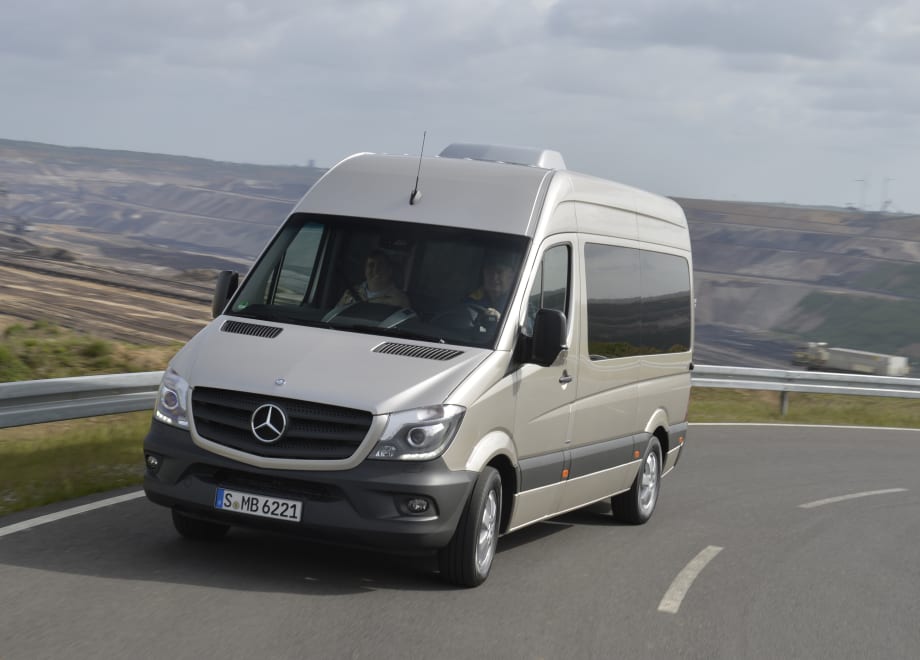
The Sprinter chassis features independent wheel suspension at the front with transverse leaf springs, something that contributed to a comfortable ride and an absence of feeling tracks and bumps in the more worn parts in the pavement.
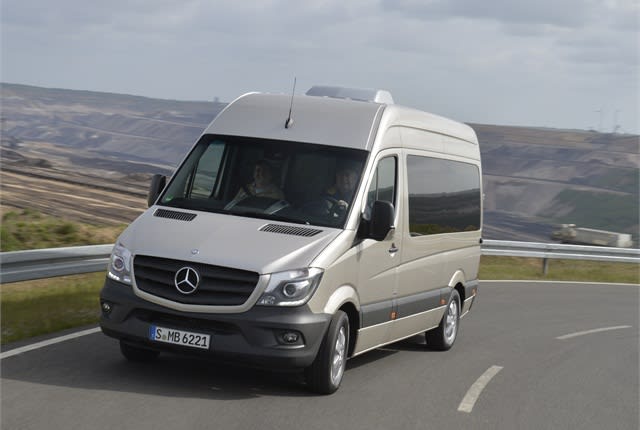
The Sprinter chassis features independent wheel suspension at the front with transverse leaf springs, something that contributed to a comfortable ride and an absence of feeling tracks and bumps in the more worn parts in the pavement.
The day after its introduction in Dusseldorf, in northern Germany, we reporters had a chance to drive Mercedes-Benz’s new Sprinter van for a few hours on various surfaces, from a test track to a dirt road and on a nearby Autobahn.
Our vehicle was a truck-based crew bus with a wheelbase of 3.665 meters (144.3 inches) and a GVW of 3.5 tons (7,112 pounds). This bus was powered by the standard 2.1-liter 4-cylinder twin turbo diesel rated at 161 horsepower and 265 pounds-feet, and had a 7-speed fully automatic transmission with torque converter. Acceleration was very good, and gears changed very smoothly and seamlessly without any loss of torque or forward momentum.
The Sprinter has an electronic governor that limits top road speed to 160 km/h (100 mph), although we did not pass 150 km/h on the few occasions when traffic so allowed. This speed is legal because the German Autobahn allows unlimited speed unless other is posted. Still, this is an impressive velocity for a big van like the model that we tried. Noticeable was the silence inside the cab with a minimum of wind noise.
The Sprinter chassis features independent wheel suspension at the front with transverse leaf springs, something that contributed to a comfortable ride and an absence of feeling tracks and bumps in the more worn parts in the pavement.
We also noticed that the Crosswind Assist worked well when exposed to heavy artificially created side winds on a special private test circuit. The wind felt like a punch from the side, but the vehicle stayed in its place in the lane, unlike the previous Sprinter model that we also tested for comparison. That one wobbled and went out of course almost a meter to the side.
Crosswind Assist is a feature of the Electronic Stability Program, and braking sounds from individual wheels could be heard as the van kept its direction.
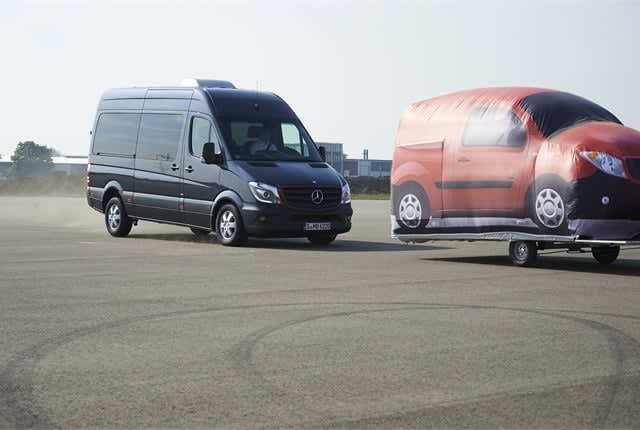
Towed inflatable “car” was spared being rear-ended when the Sprinter’s active braking system brought the van to a stop.
Part of the demonstration was a ride with one of the engineers behind the adaptive technology, Dietmar Munz, who heads development of these assist systems at Mercedes Vans in Stuttgart.
A mock-up inflated car was towed at a speed of 20 km/h while we approached at twice the speed. When getting closer, warning signals were given both with sound and visually. Munz touched the brake pedal, thus giving a “go” for the system to take over. It then performed perfect emergency braking to a standstill without running into the “car” in front.
The new Sprinter also included the standard Blind Spot Assist as well as the optional Lane Keeping Assist and Highbeam Assist. Apart from the headlamp feature, which we didn’t try because we were running in daylight, the new safety systems performed as intended.
Traditionally the Sprinter has been a pioneer for driver assistance systems. In the new Sprinter, the added assistance systems – including some world premieres in the van segment, according to executives – will most likely help to reduce the number of accidents even further.
Chris Wolski of HDT’s sister magazine, Work Truck, contributed to this article.
More Equipment

How Volvo Updated Its D13 for EPA 2027 [Watch]
Volvo’s updated D13 promises lower emissions without sacrificing performance or fuel economy. Take a closer look at what changed inside the engine in this HDT Spotlight video.
Read More →
Michelin Tire Improves Efficiency and Durability for Regional Fleets
The Michelin X Multi Energy D2 is a regional haul drive tire engineered to help fleets improve fuel efficiency, durability and traction in demanding stop-and-go operations.
Read More →
ZF Expands Commercial Vehicle Push in North America
ZF is expanding its North American commercial-vehicle presence with new transmission applications, electrification, trailer technology and autonomous-driving systems.
Read More →
Tesla Wants a Self-Driving Semi. Are Cameras Enough?
Could Tesla’s camera-only autonomous driving technology work on an 80,000-pound Semi? In this commentary, HDT's Deborah Lockridge takes a look at Tesla, Cybercab, and how autonomous trucks see the road.
Read More →
Kodiak: Driverless Long-Haul Truck Launch on Track for 2026
Kodiak AI says its driverless long-haul safety case is 93% complete and it remains on track to begin commercial operations by year-end 2026.
Read More →
What DOT’s Automated Vehicle Strategy Means for Trucking
The U.S. Department of Transportation issued a new automated-vehicle strategy that outlines plans for driverless-truck regulations, cross-state freight corridors, and federal safety standards.
Read More →
East Coast Port Launches $45M Electric Truck Push
The Port Authority of New York and New Jersey announced millions in incentives for zero-emission drayage trucks, yard tractors, and new charging hubs near the port.
Read More →
PlusAI Going Public to Fund Autonomous Truck Launch
A SPAC deal could provide PlusAI with up to $300 million as it works toward a 2027 commercial launch of factory-built autonomous trucks.
Read More →
NHTSA Moves to Rewrite Truck Fuel-Economy Rules
The National Highway Traffic Safety Administration says it lacks authority to regulate medium- and heavy-duty truck engines separately from complete vehicles, but the existing standards have not yet been eliminated.
Read More →
Detroit Opens Orders for EPA 2027 Engines
Detroit isn’t starting from scratch to meet EPA 2027 diesel emissions standards. Its Gen 6 DD13 and DD15 engines keep much of today’s platform while updating the fuel and aftertreatment systems.
Read More →