





Related: Ploger Pushes 10 Mpg With a Far-From-Typical Powertrain Spec
Downspeeding Comes of Age
The question of how downspeeding is helping fleets save on fuel – and what's in store for the future – was the topic at a recent session at the American Trucking Associations’ Technology & Maintenance Council annual meeting.
April 24, 2017
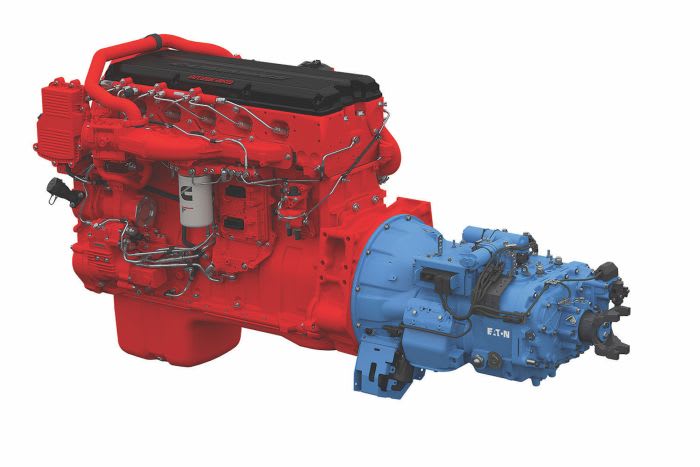
The game-changer in the development of downsped drivetrains was the automated manual transmission, which offered new opportunities for fine-tuning and controlling powertrains at cruise speeds. Photo: Cummins
4 min to read
The game-changer in the development of downsped drivetrains was the automated manual transmission, which offered new opportunities for fine-tuning and controlling powertrains at cruise speeds.Photo: Cummins
Low and slow” may be a bad thing in aviation, but in linehaul trucking, it appears to be the operating mode of the future.
First, a quick review: Downspeeding is not a new concept. The basic idea has been around as long as the internal combustion engine: Reduce overall engine revolutions at highway cruise speeds to increase fuel economy. It’s just common sense, after all. A slower-turning engine burns less fuel. The basic problem working against downspeeding was equally simple: A slower-turning engine also meant a slower-running truck.
A drivetrain optimized for lower rpm at highway speeds didn’t develop the large amounts of low-end torque required to get fully loaded tractor-trailers up and moving in an efficient – and timely – manner. What was needed was some way of limiting engine torque at low speeds. Ideally, such a system would be combined with robust, yet lightweight driveshafts, U-joints and axles.
The game-changer was the automated manual transmission, which offered new opportunities for fine-tuning and controlling powertrains at cruise speeds. With this foundational piece of technology in place, work began on developing lighter-weight driveshafts and lower-ratio rear axles to better handle the increased strain inflicted on them at vehicle launch.
The first production downsped drivetrains cruised with 1,150 rpm showing on the tachometer with 900 rpm and even 700 rpm suggested as targets for the near future. That’s a clear sign there’s a real drive to go slower, said Mike Roeth, principle of the North American Council for Freight Efficiency, a nonprofit group that works to validate current and emerging fuel-economy technology for fleets, in a session at the American Trucking Associations’ Technology & Maintenance Council annual meeting recently.
Roeth said as a general rule of thumb, tractor-trailers can expect to see a 1% fuel economy boost for every 100 rpm slower a diesel engine is turning at cruise speeds. At the same time, he noted, recent sales figures for 40,000-pound rear axles (the preferred axle spec for downsped drivetrains) show clear market movement toward these specialized powertrains as an increasingly standard long-haul spec.
The current “typical” downspeed spec today centers on either a direct-drive manual transmission or AMT mated with a 2.15 fast-axle ratio, said Florin Patrascu, engineering manager, North American application and customer support for Meritor. This drivetrain configuration is rated for 21,500 pounds of torque and indicates 1,130 rpm at 62 mph.
“Overall, we see this drivetrain yielding nearly a 2.6% gain in fuel economy compared to conventional powertrains,” Patrascu said. “And these advantages can be ideal for fleets in linehaul or long-haul applications with annual high mileage of over 60,000 miles per year on their trucks. Moreover, these fleets need to be mostly driving in the top two gears at highway speeds at least 80% of the time, with at least 30 miles between scheduled stops.”
Fleets that run city delivery routes or linehaul split delivery routes are a bad fit for downsped drivelines, he added. “If your trucks are running under 60,000 miles per year and fewer than 30 miles between stops with less than 80% of their time at highway speeds or in lower gears, then downspeeding is not for you,” he said. “In fact, if even one of these criteria apply to your application, then downspeeding with fast axle ratios is not appropriate for your trucks.”
Jason Owens, customer technical support manager, Cummins Engine, said downspeeding has a firm beachhead in trucking today and that fleets can expect even better-performing powertrains in the near future.
“The next generation of electronics will augment downspeeding in several important ways,” he explained. “We will see increased use of features such as neutral coast, predictive cruise control and variable torque control systems to better manage engine power at launch.”
Patrascu agreed, and added that OEMs and suppliers such as Meritor are already coming to market with more robust drivetrain components to better handle the higher torque loads at launch while keeping maintenance costs under control.
Roeth believes that spec’ing trucks for downspeeding will put fleets ahead of the curve in another important way. “I believe that in time, as these drivetrains are perfected, the government will mandate their use in certain applications as a fuel economy/emissions-compliance measure.”
Taken as a whole, it seems downspeeding has carved out a niche in modern fleet operations and will be an increasingly important vehicle spec in the coming years. Fleets that evaluate and adopt today can yield immediate fuel economy benefits while getting a jump on the competition and ahead of potential future government regulations.
Subscribe to Our Newsletter
More Fuel Smarts

How Volvo Updated Its D13 for EPA 2027 [Watch]
Volvo’s updated D13 promises lower emissions without sacrificing performance or fuel economy. Take a closer look at what changed inside the engine in this HDT Spotlight video.
Read More →
Diesel Price Spike Shortens Payback for Natural Gas Trucks, Report Says
Energy Vision estimates fleets could recover the higher purchase price of an RNG-fueled Class 8 tractor in 1.3 to 2.8 years under current fuel-price scenarios.
Read More →
Calstart Becomes Catalyst Mobility, Reflecting Broader Focus
Calstart is now Catalyst Mobility, reflecting the nonprofit’s growing national role in clean transportation, including zero-emission trucks, infrastructure and incentive programs.
Read More →

Record Diesel Prices Squeeze Trucking Fleets
Average U.S. diesel prices have climbed to nearly $6 a gallon, surpassing the 2022 record as tight refinery capacity and Middle East disruptions keep fuel costs elevated.
Read More →
Sponsored•September 9, 2026
How Fuel Delivery Shapes Engine Performance
Fuel delivery depends on more than what happens at the injector. For fleet, maintenance and technical professionals, looking at the full path from pump to injector can provide useful context for understanding engine performance.
Read More →
East Coast Port Launches $45M Electric Truck Push
The Port Authority of New York and New Jersey announced millions in incentives for zero-emission drayage trucks, yard tractors, and new charging hubs near the port.
Read More →
California Bill Could Shed Light on Electric Truck Prices
Why do battery-electric Class 8 trucks remain so expensive? A California bill headed to Gov. Gavin Newsom would give fleets and state agencies more visibility into what manufacturers charge.
Read More →
Detroit Opens Orders for EPA 2027 Engines
Detroit isn’t starting from scratch to meet EPA 2027 diesel emissions standards. Its Gen 6 DD13 and DD15 engines keep much of today’s platform while updating the fuel and aftertreatment systems.
Read More →
Zero-Emission Truck Corridor Planned for West Coast
California, Oregon, Washington, British Columbia and Baja California are coordinating plans for truck charging and hydrogen fueling from Canada to Mexico.
Read More →
A Closer Look at Kenworth’s Electric T880E Vocational Truck [Video]
Learn more about Kenworth's T880E battery-electric vocational truck at the Paccar Technical Center, including its range, applications, upfitting considerations, and PTO options, in this HDT Spotlight video.
Read More →