





Related: Private Fleet Tackles Turbulence To Improve Fuel Economy
Ploger Transportation Pushes 10 Mpg With a Far-From-Typical Powertrain Spec
Ploger is a diverse carrier hauling mostly high-cube multi-drop loads to customer retail locations in urban areas predominantly east of the Mississippi.
September 26, 2016
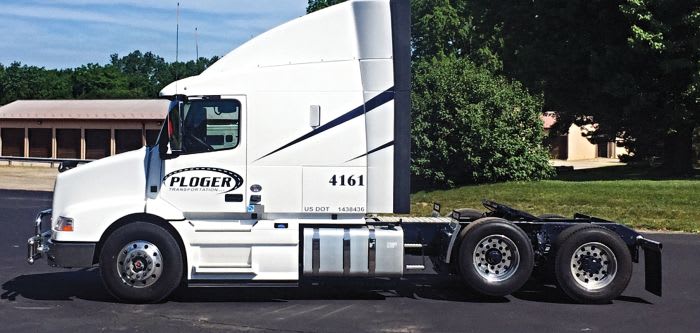
Ploger Transportation’s diverse customer base provides a mix of light and heavy loads, many multi-stop routes and high exposure to urban environments. Photos: Ploger Transportation
7 min to read
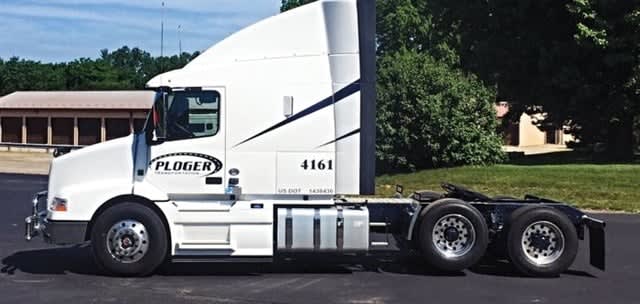
Ploger Transportation’s diverse customer base provides a mix of light and heavy loads, many multi-stop routes and high exposure to urban environments.Photos: Ploger Transportation
Right-sizing is proving to be an effective way of maximizing fuel economy with literally no performance penalty, says Joel Morrow of Bellevue, Ohio-based Ploger Transportation. The company’s director of research and development, he’s also a driver and test pilot running the same truck every day on revenue runs.
“In general freight especially, drivers and owners over-estimate their duty cycles – and not by a little bit,” he says. “They get caught believing they need 550 hp and 1,850 lb-ft or they just won’t get anywhere. We’re living proof that’s just not so.”
At Morrow’s direction, Ploger recently put a new truck into service with a very interesting spec. He drives it and sends performance reports to the company and to Volvo Trucks. As of this writing, the truck has clocked about 30,000 miles with lifetime mpg standing at 8.5. A LinkeDrive report for a weeklong period from August 11-18 (see next page) shows 10.47 mpg with 2.43% idle time over 2,398 miles.
The route to an unusual spec
Ploger is a diverse carrier hauling mostly high-cube multi-drop loads to customer retail locations in urban areas predominantly east of the Mississippi. Backhauls range from steel coils and roofing shingles to scrap paper. The trucks are usually loaded close to gross on the way home, with lighter outbound loads. A typical outbound leg would be 800-1,000 miles with seven or eight drops, with a single-stop backhaul. There’s lots of stop-and-go driving, docking, and congestion to deal with, and when he’s out on the highway Morrow unashamedly runs as close to 70 mph as he can where speed limits permit.
“We had a couple of high-speed customers with multiple pickups and drops, so we were forced up to 70 mph to make up some time,” Morrow says. “As we increased the speed we saw the need to make a few adjustments to the spec. After those changes, even at 70 mph, I’m just kissing 10 mpg a lot of the time.”
In a nod to aerodynamic efficiency, Morrow has fixed the tractor-trailer gap at 42 inches with fixed fifth wheels, but other than that, there are no aero devices on his trailers and only the standard aerodynamics on the VNM model.
“With a 3-to-1 trailer-to-tractor ratio the payback just isn’t there” for trailer aero devices, Morrow says. “And because we run mostly East Coast with lots of really awkward places to get into, the potential for damage is uncomfortably high. If I ran strictly highway, I’d have every aero device known to man on the truck, but in this application it just doesn’t pay.”
From the description of Morrow’s operation you’d think there would be few opportunities for fuel savings, yet his numbers tell a different story. He has worked closely with Volvo Truck’s driveline expert and “godfather” of the Adaptive Loading concept, Peter Blonde, in spec’ing this truck. The beauty of the spec lies in the small stuff – literally.
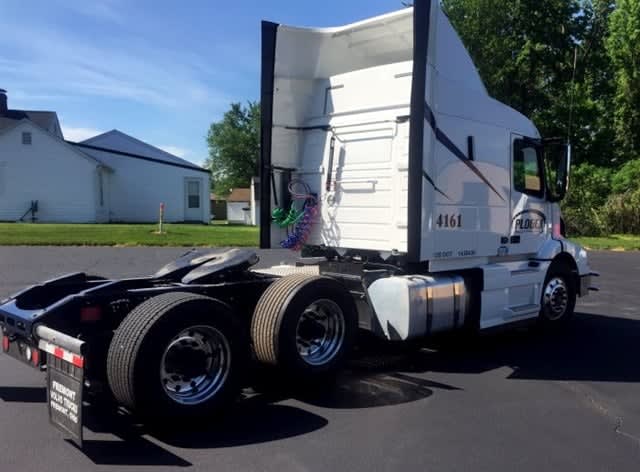
Volvo’s Adaptive Loading 6x2 setup works well when there is a high concentration of lightweight freight.
The engine is an 11-liter Volvo D11 producing 385 hp with the Eco-Torque option, with 1,250-1,450 lb-ft of torque mated to a direct-drive I-Shift transmission. Some would dismiss that engine as too small for an over-the-road operation, fearing driver contempt and poor performance resulting in longer trip times.
“People cringe when I tell them I’m running 385 hp,” Morrow admits. “They say ‘Oh, my drivers would never drive that.’ Let me tell you, I won’t win a race going up a big hill like Fancy Gap on I-77, but I won’t be the last guy up the hill. I can guarantee you I’ll be the most efficient guy going up the hill.”
Morrow recently proved that point to one of his nay-saying drivers on a pair of 46,000-lb loads from Upstate New York to Baltimore. The driver with the larger engine had some difficulty scaling the load, for starters. Morrow, with his 11-liter 385, also beat the other driver with his 13-liter 485 to Baltimore by a significant margin. That driver is now one of the biggest proponents of the small engine.
Interestingly, in the days when drivers did the gear shifting, the “shortcomings” of a 385/1,450 compared to a 485/1,640 would have been glaringly obvious. Automated transmissions seem to have rendered the difference invisible.
“I haven’t had a single low-power complaint from any of the drivers using the new spec,” Morrow claims.
Blonde says there would be a small reduction in parasitic loss on a smaller block engine of maybe 40-50 lb-ft.
“In essence, you’re getting the same amount of torque to the wheels with an 11-liter at 1,450 lb-ft as you would with a 13-liter at 1,550,” Blonde says.
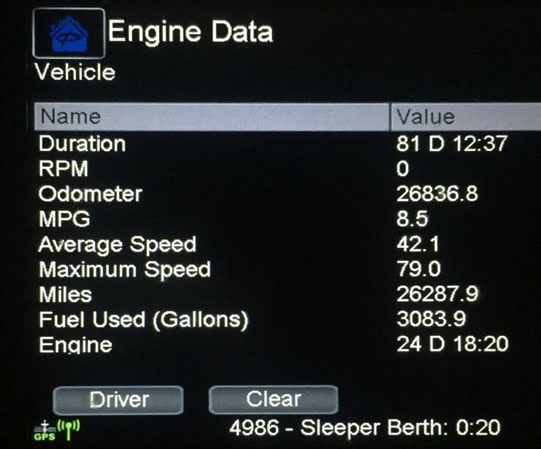
Ploger unit 4161’s lifetime trip and fuel consumption data speaks for itself – and it’s not even broken in yet.
Volvo’s Adaptive Loading option has done its share to improve fuel economy too, Morrow says. This 6x2 drive axle configuration features a liftable forward axle that automatically adjusts to load weight changes and offers 4x2 operation in certain conditions.
He reports running with the lift axle up “way more than half the time,” thanks to the lighter loads of furniture he hauls. There’s no parasitic loss from a rear drive axle, while not having the extra set of tires on the ground reduces the overall amount of rolling resistance.
One other thing worth noting is the addition of a sway bar to the front suspension. Both Morrow and Blonde concede they have not done any fuel economy testing to prove its effectiveness, but their reasoning is sound.
“It helps keep the truck going in a straight line while eliminating the cab sway some Volvos are famous for,” Morrow says. “If you think about it, every deviation from straight is literally ‘off-route’ miles, and all the corrections the driver has to make, as minute as they are, contribute to tire scrub and uneven wear. That’s just another way of saying we’re wasting energy scrubbing rubber off the tires.”

A sample of the results from a typical week’s work for unit 4161.
And Blonde notes, while it’s probably too small to measure, there’s also a little less work for the power steering pump, which translates into a little less fuel burned to turn the wheels. That’s particularly significant on 6x2 configurations, which are known to wander a bit.
The sway bar has been an unpublished option on Volvo trucks for some time, but Blonde says Volvo will make it standard on their 6x2s for 2018.
We have written about Ploger’s unique tire spec in the past, and you can read about it in this issue’s tire column, “Making Wide Single Tires Work,” on page 84, but there’s another interesting issue that Ploger says they have and eliminated: tire slip.
“I don’t think the tire people realize how much slip is actually going on with drive tires, especially on 6x2s with wide-single tires,” Morrow says. “We have done some comparisons with dual hubodometers [one on the drive axle, the other on the trailing axle] and we found it wasn’t uncommon to see 5, 6, 7% difference between the two.”
He says the lower torque of the D11 engine significantly reduces slippage, as does his 80-psi tire inflation spec.
“We run Yokohama 902L tires on the drive axles, which are open-shoulder traction tires,” Morrow points out. “You’d expect them to wear pretty fast in a 6x2 application, but we run 80 psi in those tires, which optimizes the footprint and gives it great grip on the road, thereby eliminating rubber-munching tire slip. The worst tires we’ve found for a drive axle are the low-rolling-resistance tires, especially when inflated to 100 psi. I’m not a tire engineer so I can only speculate on what’s happening back there, but with those Yokohamas tracking to run 400,000 miles or more at nearly 10 mpg, obviously something is working in my favor.”
Ploger’s new truck spec won’t work for everyone, but for fleets that run a wide variety of loads, typically on the lighter side, it seems like something worth considering. Volvo’s Blonde pulled some fleet data from their system and found that many trucks are running in terrain with average grades of 2% or less, and are in top gear more than 86% of the time. Morrow says in a sampling of fleets that stick close to the Midwest, that number jumps to the low nineties.
“That’s the type of operation this spec was designed for, and it is doing exactly what we expected it to do,” he says.
With the average truckload carrier running loads well below 80,000 lbs gross much of the time, there’s probably opportunity for many of them to scale back on the horsepower, the torque, the number of driving axles and of course the amount of fuel used to get the load down the road.
Subscribe to Our Newsletter
More Fuel Smarts

FlowBelow Redesigns Trailer AeroSlider to Cut Fuel Use
The lighter trailer aerodynamic system installs in less than 45 minutes, according to the company, with potential payback in under a year depending on fuel prices and trailer mileage.
Read More →
Why Diesel Price Relief Efforts May Fall Short
Diesel prices have eased from September’s record high, but doubts about additional Russian supply and limits on dyed-diesel tax relief mean trucking fleets still face expensive fuel. And prices could go higher.
Read More →
Why Small Fuel Savings Matter in Trucking
Can better fuel economy help pay for driver raises? In this podcast, GP Transco explains how small efficiency gains create room to reinvest in its people.
Read More →
How GP Transco Cuts Trucking Fuel Costs, a Tenth of a Gallon at a Time
What’s another tenth of a mile per gallon worth? GP Transco shares how equipment upgrades and driver coaching turn small gains into meaningful fuel savings.
Read More →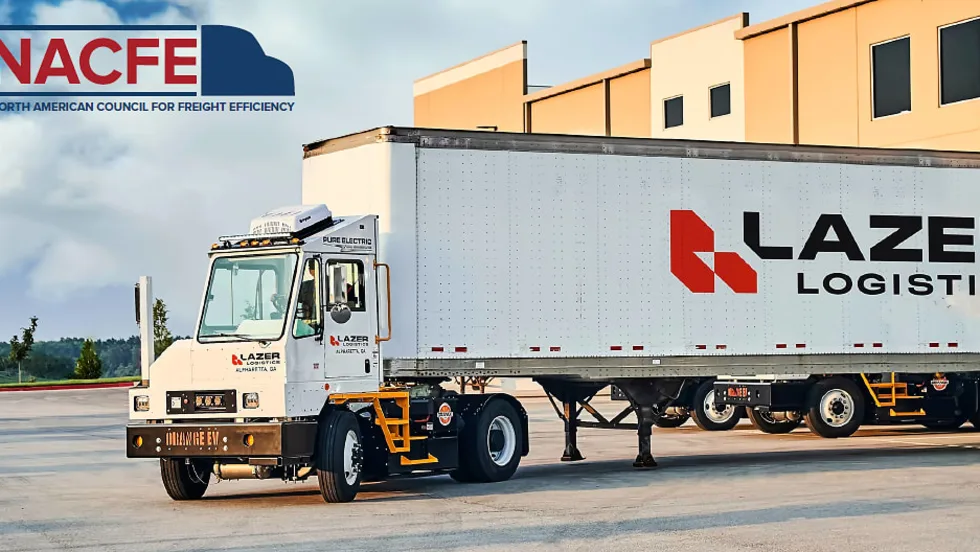
Electric Yard Tractors Move Beyond Pilots
Operating-cost savings have overtaken sustainability goals as the leading reason surveyed fleets are adopting battery-electric terminal tractors, according to new NACFE research.
Read More →
Geotab Links Fleet Card to Vehicle Data
The new card combines fuel discounts with telematics-based purchase controls. Geotab’s analysis also points to potential savings from choosing lower-priced fuel stops.
Read More →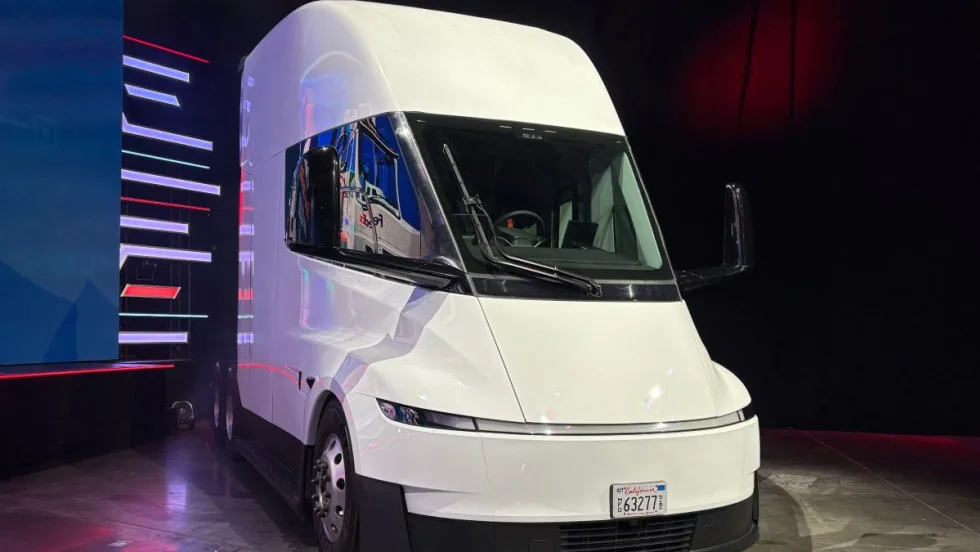
Fleet Economics Shape Electric Truck Outlook
ACT Research expects costs, charging infrastructure, and technology improvements to drive zero-emission commercial vehicle adoption as federal regulations and incentives retreat.
Read More →
Wex Adds Cardless Fuel Payments for Over-the-Road Customers
A new fuel card feature for Wex customers offers convenience and security.
Read More →
New California Law Could Shed Light on Electric Truck Prices
Why do battery-electric Class 8 trucks remain so expensive? A California bill signed by Gov. Gavin Newsom would give fleets and state agencies more visibility into what manufacturers charge.
Read More →
How Volvo Updated Its D13 for EPA 2027 [Watch]
Volvo’s updated D13 promises lower emissions without sacrificing performance or fuel economy. Take a closer look at what changed inside the engine in this HDT Spotlight video.
Read More →