




Does Clean Equal Green?
Colorful, clean trucks can offer a gleaming, positive image of a fleet and the services it provides but can a regular wash program pay for itself, or is it just money down the drain?
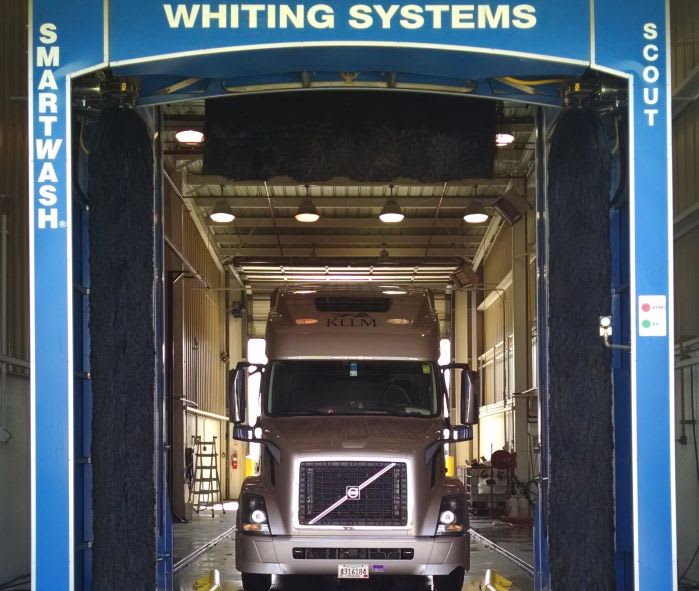
Thanks to automation advances, modern drive-through truck washes can clean and wax a vehicle in 10 minutes or even less. Photo: Whiting Systems
Thanks to automation advances, modern drive-through truck washes can clean and wax a vehicle in 10 minutes or even less. Photo: Whiting Systems
A truck is a rolling billboard, and companies have taken advantage of that to advertise their wares since Theodore Roosevelt was president and goods were as likely to be delivered by horse-drawn wagons as by a clattering, coughing, new-fangled motor vehicle.
Colorful, clean trucks can offer a gleaming, positive image of a fleet and the services it provides or the products it carries — but the opposite can also be true, with dirty, muddy, scarred-up trucks sending a far less positive message.
And it’s not always just the public (or prospective drivers) taking note.
“A dirty truck is a rolling bullseye,” says Darry Stuart, CEO of DWS Fleet Services. “There is no question that DOT officers take note of dirty trucks. Because they know that a truck that hasn’t been washed probably hasn’t been well maintained, either.”
Russ Whiting, owner of the Whiting Systems nation truck-washing chain, agrees. “You’ll never get that on record” from the DOT he says. “But it’s true. If a truck looks sloppy, then odds are its maintenance program is sloppy.”
According to Todd Mathes, technical expert at 3M Automotive Aftermarket Division, there are three considerations when investing in fleet maintenance — brand appeal, safety and resale value. And vehicle appearance directly affects all of those goals. “Showing a trucking company’s brand in the best light is a main reason to keep the fleet exteriors looking good,” Mathes says. “But there are other positive payoffs, too.”
Mathes says if a truck’s finish is not properly maintained, the clarity of paint image will fade over time, decreasing the resale value. Additionally, if the truck has damage and is not maintained, it could cause additional issues such as rust or structural integrity. “Keeping truck surfaces clean and waxed simply will keep the truck looking better, longer,” Mathes adds. “Polishing the paint, chrome, and other surfaces regularly will keep the truck from developing a dull, faded appearance over time.”
Corrosion, brought about by chemicals on the road, is another serious maintenance consideration that has gained considerable attention in recent years. Stuart says a fleet’s first line of defense against chemicals eating away at various vehicle components and systems is, again, a clean, well-maintained exterior.
“Trucks have come a long way over the last 20 years or so in terms of paint jobs,” Stuart says. “And the trailer manufacturers are getting better, too. You used to get a lot of ‘chalking,’ paint that would fade out and lose luster over time. But that’s rare today — provided a fleet washes and waxes the vehicle regularly to establish and maintain protection from chemicals and UV radiation.”
The consequences for failing to do so can be dire, Stuart adds. Over the course of his career he says he’s seen oil pans drop off engines and radiators rot away from the outside in — not to mention the constant headaches corrosion causes in truck electrical wiring and components.
“Obviously, this is more of an issue in the Northeast and colder states where a lot of road salt is used in the winter,” he notes. “If you’re running in those climates, you simply have to wash your trucks whether you want to or not. Otherwise, those salts and chemicals will literally eat a truck up.”
Whiting stresses the safety factor, as well. He says it’s simply common sense to keep grease off of cab entry step surfaces and grime off of windshields and headlamps. “It also makes it a lot easier for your maintenance guys to spot or troubleshoot problems if there’s not a lot of gunk and grime on your vehicles,” he adds.

If you choose to wash your trucks at your own shops, a host of professional-grade cleaning products can help speed the process and give vehicle surfaces and paint finishes extra protection out on the road.Photo: 3M Automotive Aftermarket
Preventive maintenance
Stuart thinks too many fleets today skimp on adding regular washes and wax jobs to their maintenance programs. “And that’s more a question of effort than money,” he says. “It’s not that hard. If you have a wash bay at your facility, then it’s a no-brainer to keep your trucks clean. Most fleets today have to use outside companies to get the job done. But luckily, washing trucks is a lot cheaper and quicker than it used to be.”
Both Whiting and 3M’s Mathes agree. Mathes says that’s the reasoning behind Meguiars, a 3M brand of products that offer different levels of cleaning and maintaining appearance. There are products for everything from washing the vehicle to complete detailing. “There are also step-by-step processes and procedures along with metering systems for dilution to keep product costs low and labor costs to a minimum.”
Proactive exterior maintenance is the recommended best practice, Mathes adds. “3M Automotive Aftermarket has been working with several maintenance facilities to offer different levels of interior and exterior programs while fleet vehicles are in for scheduled maintenance,” he says. “Washing, polishing, waxing, cleaning interior and exterior surfaces should all have some timeline assigned to them. This can prevent additional repairs and costs. If trucks are maintained on a monthly or bi-monthly basis, it will help keep the image comparable to factory condition.”
Whiting stresses that automation technology has also transformed the truck wash business today, cutting wait times dramatically while increasing the effectiveness of the cleaning process and the application of protective compounds. “The bottom line today is that we can wash a truck in less than 10 minutes with a high degree of effectiveness and protection. And in some cases we can do so in less than 5 minutes.”
Whiting says recommended wash frequency varies depending on application and geography. He recommends weekly washes in harsh conditions such as Alaska, but says fleets in milder climates may opt to only wash once a month. “If you’re not washing regularly, we can sit down with you and help put a program together that makes sense for your fleet, your climate and your application,” he says. “But somebody needs to be washing your truck — even if it’s not me.”
More Fleet Management

Why Private Fleets Are Taking More Freight
Private fleets are putting their own trucks on demanding customers and high-cost lanes as companies seek greater control over service, costs, and capacity.
Read More →
Color Match Smarter: Tools That Restore & Perform
For fleet managers and collision repair professionals keeping heavy-duty trucks on the road, getting the color right the first time isn't just about appearance — it's about efficiency, turnaround time, and bottom-line results. Discover how today's digital color tools are transforming the repair process from guesswork to precision.
Read More →
FMCSA Pauses Biennial-Update Enforcement Amid Motus Transition
Carriers whose updates were due on or after June 1 have more time, while FMCSA works to stabilize its new registration system and warns of phishing sites impersonating its new carrier registration system, Motus.
Read More →


2026 Blueprint for Countering Smarter Supply Chain Theft
Cargo theft is no longer just the cost of doing business. It's a multi-billion-dollar criminal enterprise exploiting vulnerabilities across your fleet, drivers, and supply chain.
Read More →
How Telematics Improves Visibility, Control, and Performance in Refrigerated Fleets
Explore how telematics help refrigerated fleets improve visibility, uptime, efficiency, compliance, and cargo protection across connected cold chain operations.
Read More →
What the U.S.-Canada Trade War Means for Trucking
Escalating U.S.-Canada tariffs could disrupt cross-border freight, reduce truck volumes, raise costs, and create new uncertainty for carriers on both sides of the border.
Read More →
What Are Trucking’s Top Concerns for 2026?
The American Transportation Research Institute wants to know what's worrying trucking fleet managers, drivers, and other stakeholders in its annual Industry Issues survey.
Read More →
American Trucking Associations Looks for a New Leader
ATA President and CEO Chris Spear abruptly left his job at the association on August 21, at a pivotal time for the trucking industry.
Read More →
Public Wi-Fi Cybersecurity Risks: How Truck Drivers and Fleets Can Protect Their Data
Public Wi-Fi can expose truck drivers and fleets to credential theft, malware, and other cyber threats. Here’s how to reduce the risk on the road.
Read More →
For Nicky Cupp, Fleet Innovation Starts With Frustration
HDT Truck Fleet Innovator Nicky Cupp turns everyday pain points at Fraley & Schilling into opportunities for better technology and smarter processes.
Read More →