




Diagnostics: Beyond the Fault Code
New EPA 2010 engine technology has made truck diagnostics even more complex
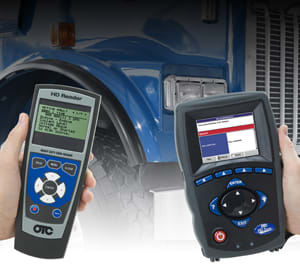
Various hand-held diagnostic tools, like these from OTC, offer different levels of diagnostic info.
New EPA 2010 engine technology has made truck diagnostics even more complex.
A typical engine has about 150 diagnostic trouble codes, according to Dave Costantino, director of the commercial vehicle group at Mitchell 1, a provider of diagnostics software. DTCs are codes used to identify a problem in any of the systems monitored by the vehicle's on-board computer. New aftertreatment systems mean even more sensors that can throw off DTCs, including sensors to monitor the diesel exhaust fluid tanks required for selective catalytic reduction systems.
But Doug Reeves, shop manager for truck repair chain Boss Shops, believes he's ready for the onslaught of new truck technology and the increasing complexity, thanks to the diagnostics technology his shop uses from Noregon Systems. Before adopting the technology about three years ago, Reeves felt his technicians were "shooting in the dark" when diagnosing problems. They would have to just start replacing parts until the problem was solved.
Noregon's diagnostic system works by plugging a laptop or PC into the vehicle's electronic control unit, or ECU. The diagnostics software reads the DTCs on the vehicle, providing a description of the problem on the computer screen. Noregon offers a suite of products, called JPro, specifically designed for fleet diagnostics.
Other third-party systems are available from companies such as Diagnostic Innovations, Nexiq and OTC, and vendor-specific diagnostics are offered as well.
"With truck component/system technologies advancing so rapidly and becoming increasingly electronic, fleet owners are at a disadvantage if they are not keeping pace with current diagnostic systems," says Ed Lipscomb, SPX senior product manager of diagnostic systems, and Chuck Kinkade, SPX industrial account manager and heavy-duty electronic product development lead.
A long way
Diagnostics used to involve a technician simply looking at the truck's engine and symptoms and trying to tell what's wrong, Mitchell 1's Costantino says. If that didn't work, the technician could pull out a manual. "You could have a wall of books," he says. But books can be unruly, pages fall out, they get greasy and unreadable, or can't be found at all.
"Those days are over," Costantino says, noting that Mitchell 1's Tractor-Trailer.net and Medium-Truck.net programs are Web-based, offering 24/7 access to service information to help diagnose and repair trucks.
According to Drew Gibson, president of Diagnostic Innovations, diagnostics technology began with handheld devices that weren't too complicated. By switching to a PC-based system, which many diagnostics are today, fleets and technicians can get the same information as dealers and OEMs.
The company's Vehicle Diagnostic Assistant software, which runs on the Panasonic Toughbook, integrates the major OEM software with its own proprietary software. A graphical user interface helps guide the technician through diagnostic procedures.
Today's technology is also faster, says Noregon's Lee Lackey, director of technical sales. The SAE J1939 protocol, the successor to the J1587 protocol, is the newest standard for networking and communication in heavy-duty, and it's catching on. Lackey compares the J1587 to a dump truck - it's slower and carries lots of data. The J1939 is like a Formula 1 race car in comparison, he says.
Translating the data
How does fleet diagnostics work? Noregon Systems provides a complete kit with all the tools needed to diagnose a problem. Like Diagnostic Innovations, Noregon integrates its own software with the software provided by the OEMs on specific components. It then sells the software in a laptop or PC. The kit also comes with an interface adapter, which connects from the vehicle to the computer. A USB cable connects the adapter to the computer.
This type of system can help troubleshoot any electrical system on the truck that's powered, Lackey says - engines, brakes, transmissions and more. These ECUs can communicate with each other through the J1587 and J1939 protocols. The adapters translate the computer language into raw data the user can understand.
This data often comes in the form of diagnostics trouble codes, DTCs, which can point the technician to the vehicle subsystem affected and give an indication of what the problem is and how often it has occurred. These fault codes provide a basic description of the problem, while good diagnostics software will go into a more detailed analysis of the problem.
Handheld tools are becoming more sophisticated and powerful, as well. For instance, the Pro-Link iQ from Nexiq is a handheld scan tool designed to diagnose engine faults, create data lists, provide trip information, and perform special functions tests and reports. It features a graphic user interface via a touch screen.
A touch screen is also a feature of the OTC Pegisys tool from SPX, which provides untethered, wireless diagnostics. Pegisys PC Scan can take it a step further, communicating with a remote laptop running Windows Vista or XP.
SPX will be partnering with XscapeEz LTD this month to release a new line of Heavy Duty VCI products that will run diagnostics wirelessly. The new line includes the OTC Ez-Tap and Ez-Tap USB as well as two new base stations that work with the wireless VCIs, the company says. The Ez-TAP will feature AirBridge2 wireless technology and allows fast ad-hoc switching from one vehicle to another for diagnostics.
"As the vehicles enter the yard they can literally be directed to go in for service or immediately be put back in service without having to run a full diagnostic," says SPX's Kinkade.
Helping with repairs
Once the technician has discovered what the problem is, now what?
When Mitchell 1 asked technicians what they needed when diagnosing trucks, the top response was a better description of the problem. Mitchell 1's online repair programs provide a more complete description, as much as 256 characters.
Technicians also wanted to see a wiring diagram if electrical systems were involved. Most diagrams show the entire truck, bumper to bumper, or the engine. Mitchell 1's Repair-Connect includes a "to-the-point" wiring diagram, displaying just the wires making up a particular circuit. There are also thousands of engine component and connector photos, information on how to remove and install new components and more.
Mitchell 1 isn't the only system offering technicians help in actually repairing the problem once it's been diagnosed. Some other examples:
* Meritor Wabco's Toolbox software, a comprehensive PC-based diagnostics program, has incorporated a maintenance manual in PDF format, says Mark Melletat, director of trailer systems and field operations. It "gives you an intuitive method of understanding the system and quickly repairing it," if needed.
* Bendix Commercial Vehicle Systems' ACom Diagnostics software for brakes includes a detailed service data manual, which explains how to fix the problem and provides background information on the system.
Why do it yourself?
Some fleets may be tempted to throw up their hands and just let the dealership or a more sophisticated local aftermarket shop handle the high-tech diagnostics. But Lackey says for most fleets this is an expensive proposition. Fleets can save money doing their own diagnostics, he says, because every time you send a truck out, you lose uptime, as work stacks up at the dealer or service facility.
Diagnostic Innovations' Gibson recalls a fleet customer in Texas whose dealer was 150 miles away. With the company's tool, they were able to diagnose problems, order the parts and repair it themselves.
Meritor Wabco's Melletat points out that fleets cannot always rely on the driver to report problems. Doing diagnostics in-house produces quicker turnaround, while allowing fleet
More Fleet Management

2026 Blueprint for Countering Smarter Supply Chain Theft
Cargo theft is no longer just the cost of doing business. It's a multi-billion-dollar criminal enterprise exploiting vulnerabilities across your fleet, drivers, and supply chain.
Read More →
How Telematics Improves Visibility, Control, and Performance in Refrigerated Fleets
Explore how telematics help refrigerated fleets improve visibility, uptime, efficiency, compliance, and cargo protection across connected cold chain operations.
Read More →
What the U.S.-Canada Trade War Means for Trucking
Escalating U.S.-Canada tariffs could disrupt cross-border freight, reduce truck volumes, raise costs, and create new uncertainty for carriers on both sides of the border.
Read More →

What Are Trucking’s Top Concerns for 2026?
The American Transportation Research Institute wants to know what's worrying trucking fleet managers, drivers, and other stakeholders in its annual Industry Issues survey.
Read More →
American Trucking Associations Looks for a New Leader
ATA President and CEO Chris Spear abruptly left his job at the association on August 21, at a pivotal time for the trucking industry.
Read More →
Public Wi-Fi Cybersecurity Risks: How Truck Drivers and Fleets Can Protect Their Data
Public Wi-Fi can expose truck drivers and fleets to credential theft, malware, and other cyber threats. Here’s how to reduce the risk on the road.
Read More →
For Nicky Cupp, Fleet Innovation Starts With Frustration
HDT Truck Fleet Innovator Nicky Cupp turns everyday pain points at Fraley & Schilling into opportunities for better technology and smarter processes.
Read More →
Adam Buttgenbach’s Approach to Electric Trucks: Start With Where They Fit
HDT Truck Fleet Innovator Adam Buttgenbach helped PepsiCo build one of North America’s largest EV fleets by focusing on where electric trucks make operational sense.
Read More →
Deen Albert: Let Automation Do the Math, People Make the Decisions
HDT Truck Fleet Innovator Deen Albert makes sure people are still at the heart of operations at Grand Island Express, even while adopting artificial intelligence tools. AI-assisted dispatch helped boost revenue 25% with the same number of trucks.
Read More →
Trimble’s New AI Agent Takes Aim at Fleet Back-Office Busywork
Arc Agent works across Trimble TMS products to automate repetitive tasks such as freight orders, maintenance, invoices, fuel costs and more.
Read More →