




Daimler Pumping R&D into Electric Trucks, Connectivity, Autonomous Trucks
Daimler Trucks North America chief Roger Nielsen talked to reporters recently about the company's investments and initiatives in technology such as connectivity, electric trucks, autonomous trucks, advanced driver assistance systems, platooning, and predictive maintenance.
March 1, 2018


Daimler Trucks has a 'Baby 8' eActros electric truck in fleet testing in Europe; is an e-Cascadia next? Photo: Mercedes-Benz
6 min to read
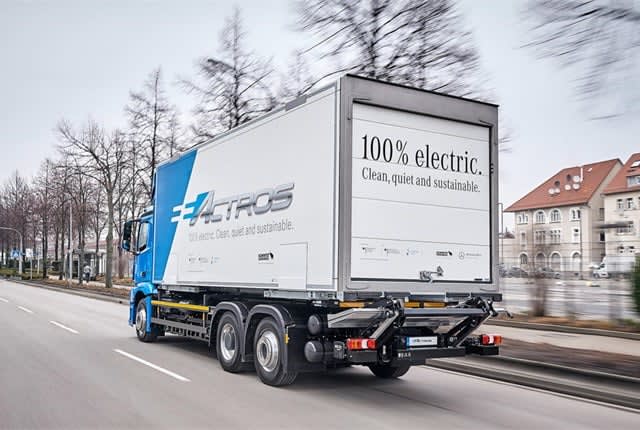
Daimler Trucks has a 'Baby 8' eActros electric truck in fleet testing in Europe; is an e-Cascadia next?Photo: Mercedes-Benz
Daimler Trucks is not taking disruption sitting down. Last week the Germany-based company announced that it’s investing 2.6 billion euros ($3.2 billion) in research and development at its trucks division by 2019, as it gets ready to produce electric heavy-duty commercial vehicles starting in 2021, along with continuing work on connectivity and autonomous driving technologies.
Daimler is placing Mercedes-Benz eActros emissions-free electric trucks with some customers so they can test them in real-world conditions, with real drivers and real freight. If all goes well, the electric truck could go into full production starting in 2021.
And last year Daimler subsidiary Mitsubishi Fuso brought its electric eCanter medium-duty cabover to the U.S., where UPS is among the fleets evaluating it in real-world operations.
The eActros may technically be heavy-duty, it’s more of what we call a Baby 8 in this country, noted Roger Nielsen, Daimler Trucks North America President and CEO, in a conference call with trucking reporters this week. At the same time, however, he hinted that we will see an announcement in the coming months regarding electric heavy-duty trucks in North America. It’s not the first time he’s hinted at this, telling reporters last fall during the ATA Management Conference & Exhibition that he’s love to see an e-Cascadia.
During the recent conference call, Nielsen noted “Driving future technology” as one of his six goals for 2018, along with leveraging the global resources and “cutting-edge technology” of DTNA’s global parent.
“Our customers are all interested in future technology,” he said. “ We want to put future technology out there that makes sense for our customers. They don’t want new technology for the sake of technology – they want new technology because they believe it can give them a competitive edge in the marketplace, or can reduce their real cost of ownership.”
He outlined three areas where the company is investing heavily in technology research: Connectivity, electric mobility, and automated driving.
Connectivity
The nearest term of these three is connectivity, an extension of what DTNA has already been working on for a number of years, starting with its launch of Detroit Virtual Technician seven years ago, billed as the industry’s first remote diagnostics using factory-installed software.
More recently, we’ve seen other systems added as part of the Detroit Connect suite, the latest of which is remote updates. Nielsen cited this as a great example of how technology can help reduce fleets’ total cost of ownership. “We had one customer who wanted to increase the cruise control speed limited to 65 mph. With the size of his fleet, that would normally take four months, for each truck to be brought in for 30 minutes to be reprogrammed. Using remote updates, it only took a few minutes to change the cruise control speed of all his trucks. This is an amazing way to bring additional uptime to our customers.”
Up next, DTNA is working on agreements with third-party telematics service providers to offer them via the Detroit Connect platform. “Our goal is to reduce the number of individual devices with a sim card on the truck, so customers only have to manage one account,” Nielsen explained. “Our customers want flexibility in interacting with the data captured and transmitted.” And in some cases, large fleets have proprietary systems, which DTNA is working on developing ways to pipe the data directly into the back office of those fleets.
In addition, it’s working on predictive analytics. “I think what’s going to come first is we will have the find the patterns in all this data that can predict an imminent failure 500 to 100 miles out,” he said. The first part of the truck will be the powertrain, where extended warranties go out to five years/500,000 miles or more. “So when we call up a customer and say, ‘Hey, injector 3 is going to fail, bring your truck in and we’ll repair it under warranty while the driver takes his break time.’ That’s how trust will be built.”
Electric trucks
While connectivity is “completely under way,” Nielsen said, electrification is a near-term project. He noted that in November, DTNA subsidiary Thomas Built Bus introduced “Jouley,” an electric school bus, with plans for low-volume series production in 2019.
“We’re exploring use cases to bring electrification to market on other models as well,” Nielsen said. “And most importantly, what you’ll see us put out first is the charging infrastructure solution.”
He stressed the importance of thoroughly testing these new technologies. “You guys remember when we introduced original Cascadia 10 years ago, we put 24 million miles on the road, because we did not what to put our customers’ business at risk –and we will not do anything diff with electric vehicles,” he said. Some of that testing will involve Daimler work on electric vehicles around the world.
“It’s critical that from the very beginning that the new technology positively contributes to the customer’s real cost of ownership,” he said. “Maybe one or two is sexy or cool to have, but they want to make money.”
Like connectivity, electric vehicle development has also gotten a new DTNA exec to head it up, with Andreas Juretzka leading a newly created electric mobility group.
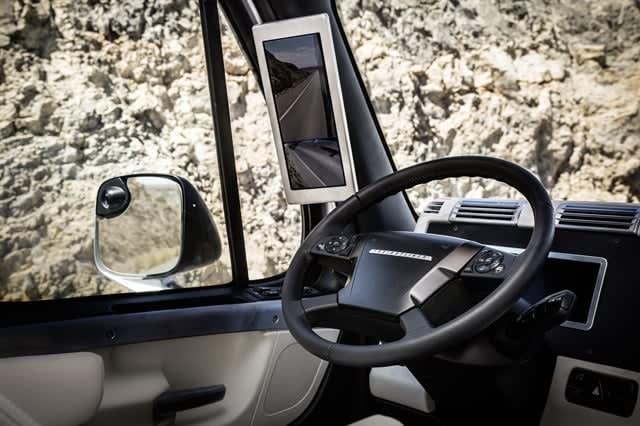
In 2015, Freightliner's Inspiration Truck showed off autonomous driving technology in a concept/test vehicle.Photo: Daimler Trucks North America
Autonomous trucks
Looking further into the future, Nielsen said that DTNA is continuing to work on the technologies it pioneered in 2015 when it drove the Freightliner Inspiration Truck across the Hoover Dam – without a driver.
“We really inspired a discussion within the industry, and since then we have been rigorously developing and testing the components necessary for automated driving,” he said, including sensors and artificial intelligence, noting that there’s a lot more to automated driving than what was demonstrated in Nevada. “Don’t forget, the main reason we’re working on automated driving is not to take the driver out of the cab, but to make driving safer for the drivers and the motorists around them.”
Automated driving goes hand in hand with advanced driver assistance systems, or ADAS, he said, such as Freightliner’s Detroit Assurance system, the 4.0 version of which is now being delivered to customers.
There’s more to come with Detroit Assurance, Nielsen noted, adding “there are many more numbers after 4. We’re going to have some exciting news later this year that will further expand the features of adaptive cruise control, actively keep drivers in their lane and so forth.”
“ADAS today and in the foreseeable future will still require a driver in the driver’s seat with his hands on the wheel, monitoring the vehicle performance and everything going on around him.”
Truck platooning to get real-world test
While truck platooning, or pairing, as Nielsen called it, isn’t exactly the same as autonomous trucks, it does use some of the same technologies, as well as connectivity, and it’s another areas DTNA is working on.
“In pairing, we’ve been evaluating safety and fuel efficiency at a variety of following distances closer than 100 feet. I’ve been in that cab and definitely can tell you that there is a distance which is optimal for fuel efficiency – and for your heart rate.”
DTNA is finalizing details with a top fleet customer to begin real-world platoon fleet testing in the next few weeks, using Freightliner test vehicles in real-world operations with real drivers, hauling real freight for real shippers. “This test will be conducted with a fleet of vehicle in actual business operations on a public highway where it’s legal.”
He added, “We have been talking to numerous customers over the past month, and in a nutshell, they’re interested in this new technology – but only if it will pay off. It has to be safe, it has to be reliable, and it has to be durable.”
Subscribe to Our Newsletter
More Fleet Management

What Will ATA’s New Leader Bring to Trucking's Table?
Incoming President and CEO Mark Colson’s record in Alabama offers clues about his priorities and approach following Chris Spear’s abrupt departure as the head of the American Trucking Associations.
Read More →
Volvo, Waabi Start Commercial Autonomous Operations in Texas
Volvo VNL Autonomous trucks, powered by the Waabi Driver, are hauling freight directly to third-party facilities for a customer in Texas.
Read More →
Samsara Launches Custom AI Agent Builder
Agent Studio lets fleets create AI tools for hours-of-service monitoring, reporting and driver support, including agents that communicate by phone.
Read More →
Einride Driverless Electric Trucks Begin Daily Freight Operations in Ohio
Two cabless electric trucks are hauling freight between EASE Logistics facilities in Marysville, Ohio, as part of a multi-state truck automation project.
Read More →
Geotab Links Fleet Card to Vehicle Data
The new card combines fuel discounts with telematics-based purchase controls. Geotab’s analysis also points to potential savings from choosing lower-priced fuel stops.
Read More →
How MFA Helps Protect Trucking Fleets
Multi-factor authentication adds protection when passwords are stolen. Here’s how it works and where fleets should start.
Read More →
How Better Freight Data Helps Trucking Teams Get Ahead of Disruption
Trucking and logistics teams have plenty of data. The problem is getting the right information in front of the right people soon enough to act. Better-connected data can help teams spot trouble earlier and make smarter decisions before small problems become big ones.
Read More →
Trimble: Taking Artificial Intelligence in Trucking Beyond Faster Tasks
At Insight 2026, Trimble executives argued that fleets may need to redesign workflows to get more from AI as it introduced new products and enhancements. AI’s value will depend on how fleets combine automation with their people's knowledge.
Read More →
Sponsored•September 28, 2026
Build a bulletproof fleet: Uniting ELDs and dash cams for total compliance
An ELD can prove compliance, but it cannot always prove what happened on the road. Discover how uniting accurate ELD data with AI-powered dash cam video can help your fleet strengthen compliance, defend against liability, protect drivers and reduce operational costs.
Read More →
Nominations Open for HDT Emerging Leaders
Heavy Duty Trucking is looking for accomplished trucking fleet professionals under 40 who are making an impact and helping lead the industry forward.
Read More →