





Fuel Pros & Cons: Diesel vs. Gas in Class 3-4 Trucks
Cummins’ X15N: The Right Engine at the Right Time?
Despite critics who say natural gas is a bridge fuel at best, Cummins is very bullish on the long-term future of its X15N natural gas engine — and for good reason.
July 25, 2022
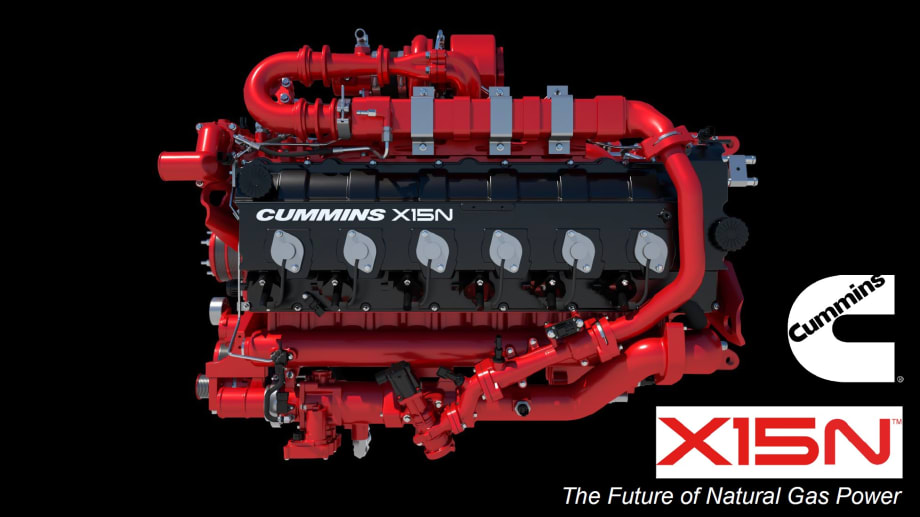
Cummins says the X15N, already in service in China, should hit North American streets in 2024.
Photo: Cummins
9 min to read
Natural gas engines have the potential to be the least commercially disruptive technology available in the quest to reduce trucking’s carbon footprint, even though they haven’t caught fire in trucking so far. The engines traditionally available get the job done, like diesels, but drivers haven’t been fond of them. Residual values haven’t historically worked out in owners’ favor, and they are pretty demanding from a maintenance perspective.
But Cummins is currently developing a new natural gas engine, the X15N, which the company believes will resolve the industry’s current unease about natural gas. It’s currently in production and fleet service in China, and plans are to start building the engine in Jamestown, New York, starting in 2024.
Cummins says the engine will be available to American, Mexican, and Canadian fleets, with probable expansion to certain South American and Latin American markets. Those are pretty aggressive marketing plans for an engine that nobody wants…. or do they? Cummins says it received more than 400 demonstration requests from fleets immediately after it announced plans for a 15L natural gas engine.
“Our phones started ringing the day we announced the X15N,” says Puneet Jhawar, the general manager of Cummins’ global natural gas business. “Our existing customer base was very enthusiastic about it. We also saw a phenomenal response from people who had probably looked at natural gas at some point in time but then moved away from it.”
There was also significant interest in the 15L engine from fleets that had never looked at natural gas.
“I think for some fleets, the 12-liter engine just didn’t have the power they needed,” he says. “They probably had routes in the hills and valleys that the 12 didn't have the power to get through. Some of those fleets tried the 12-liter and then handed it back to us, saying, ‘Come talk to us when the 15 comes.’”
Not Just a Bigger Version of the 12L Engine
The X15N started as a clean sheet. The goal from the beginning was to create an engine that could be manufactured at a global scale to keep engineering and production costs down, while retaining the flexibility operate on three different fuels: natural gas, hydrogen, and diesel. As Jhawar puts it, almost everything below the head gasket will be a common architecture. That provides the manufacturing scale as well as easing the installation challenges for OEMs.
“The OEMs are putting a lot of effort into trying to integrate new technology into their products,” he says. “Hopefully this helps them get a clearer path so that they can start with natural gas and then transition to hydrogen with less engineering effort.”
The top side of the engine will be fuel-specific, and for a number of reasons, not interchangeable by the customer. Natural gas, hydrogen, and diesel require different combustion strategies and therefore different cylinder head and air management designs.
There’s also the issue of certification. Some of that comes at the chassis level, so customers will have to spec the fuel of their choice and stick with that for the life of the vehicle.

Lessons learned from previous generations of natural gas engines has led to several significant design changes aimed at improving reliability and extending maintenance intervals.
Source: Cummins
Looking Beyond Engine Displacement Numbers
Dave King, Cummins’ on-highway product manager for natural and renewable gas engines, points out that displacement probably isn’t the key feature to focus on with this new engine. He says displacement is often used as a proxy for power, but he prefers to talk about being able to provide the power and the torque the mission needs in a package that fits the vehicle without adding weight.
“The X15N provides the same 400 horsepower and 1,450 foot-pounds at the bottom-end of the rating scale, but it can deliver 500 horsepower and 1,850 foot-pounds at the high end,” he says. “The X15N offers that kind of flexibility within the same space claim as the X12, and it’s 200 pounds lighter than the X12.”
It’s also 500 pounds lighter than the current X15 diesel.
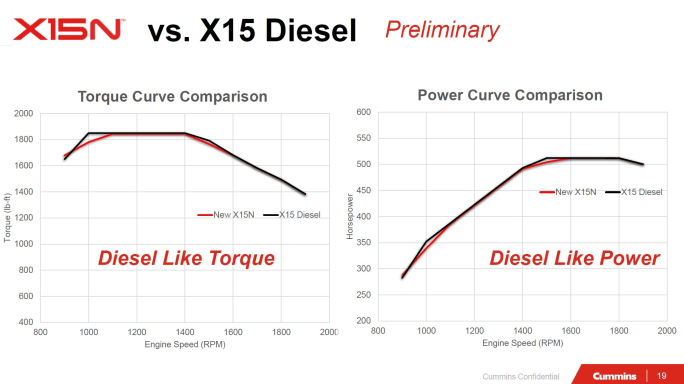
From a performance perspective, the X15N will perform very much like a big diesel.
Source: Cummins
King says the lowest ratings on the X15N are the same as the highest rating of the current ISX12N (400/1,450).
“Anyone who is comfortable with that amount of power will still be able to get that,” he says. “Very few of our current natural gas customers spec anything less than that, but they would probably choose probably higher horsepower and torque for some applications if we had it. That’s where the 15-liter is going to satisfy or even delight them.”
Addressing Maintenance and Reliability Concerns with Natural Gas Engines
The ISX12N is not without its share of baggage, but Cummins sounds quite confident that what bugged users in the past will not carry through on the X15N.
“Every time that we launch a new engine, we learn from our mistakes,” Jhawar told HDT. “Our customers have told us a lot of things. We’ve heard them, and our engineers have spent the time and made sure that, all through our analysis, we’ve not seen those problems in the testing we've done so far.”
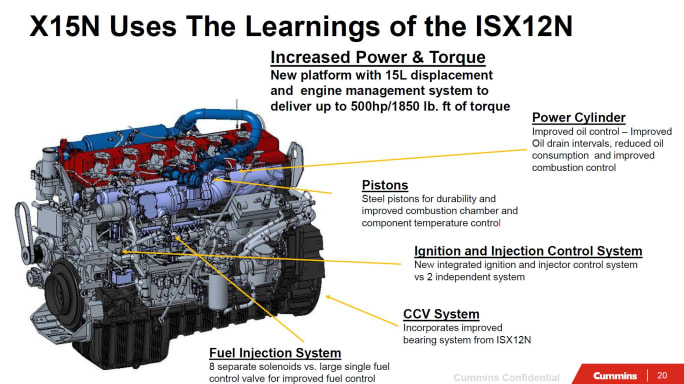
Heat has been a challenge with natural gas engines because they generally run hotter than diesels. Steel pistons and improved oil control will help improve longevity.
Source: Cummins
There are two aspects that differentiate natural gas engines from diesels: They run hot all the time, and the prescribed maintenance intervals are not guidelines. Some fleets have taken liberties with oil and spark plug changes — and that has come back to bite them. That can leave prospective customers with the impression that natural gas engines are more difficult to maintain, or perhaps more costly. That may or may not be universally true, but King says Cummins is taking steps with the X15N to align certain maintenance procedures to reduce vehicle downtime while designing in some additional durability.
“We are working to have alignment on spark plug and oil drain intervals, and we’re working to extend those intervals further than we have with the 12-liter,” he says.
The new cylinder head design offers lower head temperature with better cooling around the combustion face of the cylinder head as well as around the spark plug. Keeping the spark plug bore-area cooler helps protect the spark plug and drives longer spark plug life. The spark plug has been re-engineered, too, and the X15N uses steel pistons to reduce thermal loading.
On top of that, the oil pan has a larger capacity than the previous design, which lends itself to better thermal control of the oil, as well as longer drain intervals. And while it may seem like a small detail, Cummins will be referring to those service intervals in miles rather than hours.
“We talk a lot about hours of operation because many of our applications have historically been vocational types with a lot of stationary time,” King says. “When we had applications that ran highway miles, the hour measure for service intervals became challenging for those customers. We’re being very cognizant of that with this product, to talk about service intervals in terms that our diesel customers are comfortable with.”
Cummins and Valvoline have also developed an engine oil, Premium Blue One Gen2, that can be used in diesel, natural gas, and gasoline engines to avoid mix-ups in the shop.
Natural-Gas Fueling Infrastructure
One of the traditional barriers to wider-scale adoption of natural-gas powered trucks, the paucity of on-route fueling infrastructure, seems close to being resolved. Love's travel centers, in partnership with Trillium CNG, now operate 65 public-access compressed-natural-gas fueling facilities across the United States. Chevron announced recently that it plans to open a network of more than 30 CNG stations in California alone by 2025.
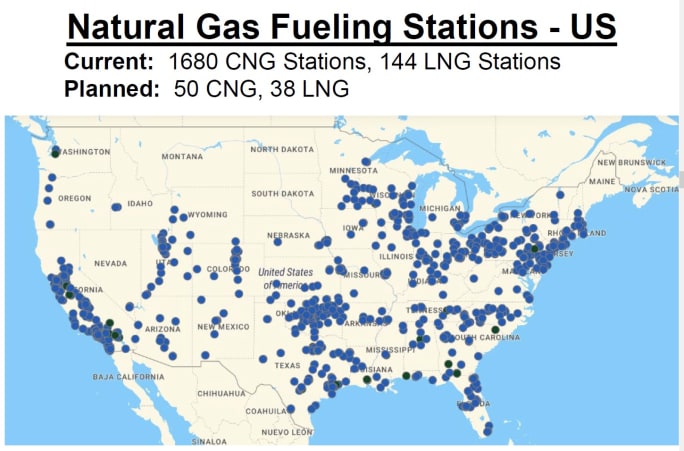
The natural gas fueling network is expanding rapidly, with several major fuel providers saying they are prepared to build more stations along viable corridors.
Source: Cummins
Other major oil companies also have substantial networks in place to serve fleets with more on the way. Most have said they are consulting with fleet customers to build out networks along corridors where natural gas or renewable natural gas will be consumed.
Jhawar says the total number of CNG fueling sites, both public and behind-the-fence, is about 1,600 as of June 2022.
“I think the more stations that open, the easier it is for the adoption of the natural gas vehicles,” he says. “I think we still need to educate the potential customers to show them there already is fueling infrastructure in place. We think a better understanding of the availability of natural gas will help to relieve the range anxiety over whether they’ll be able to complete the trip or not.”
We haven’t said much about renewable natural gas. RNG is formed when biomethane from decomposing organic matter such as cow manure or landfill waste is captured, treated and placed into the natural gas network. That’s a story for another day, but in short, the reduced and even negative carbon intensity of such a fuel is impossible to ignore, and the growth rates of RNG production are staggering.
Data collected and analyzed by GNA Consulting (Gladstein Neandross & Associates) show that the increase in the proportion of dairy biogas in California went from less than 1% in 2017 to nearly 24% in 2021. Over the same time, fossil gas consumption decreased from 22.3% of the market in 2019 to 2.3% in 2021. Last year, nearly 98% of all the natural gas consumed in California was RNG. Nationwide, RNG represents about 64% of all gaseous fuels consumed.
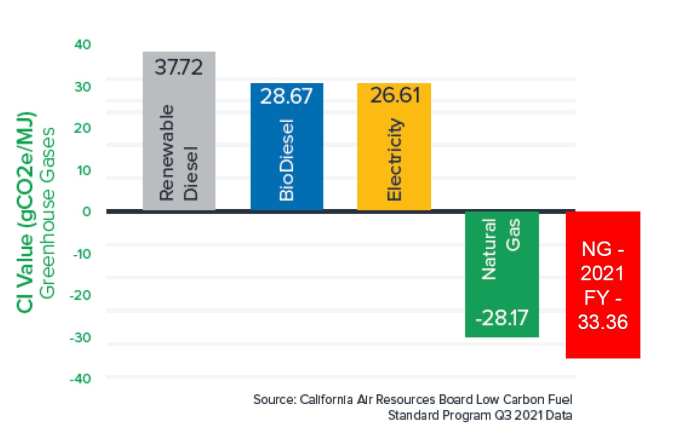
Data from the California Air Resources Board released in January 2021 confirms that 100% of the natural gas used as a transportation fuel and reported in the Low Carbon Fuel Standard (LCFS) program is carbon negative (-28.17 gCO2e/MJ).
Source: Cummins
A Bridge Engine?
Jhawar told HDT that customers have been asking for a 15L natural gas engine for more than 10 years, but Cummins held out until it believed the market was ready for such an engine. The business case for the X15N is much clearer today that it would have been in the past. Previously, high diesel prices helped drive demand for natural gas, but with today’s push for lower if not zero carbon emissions, it’s a design whose time has come.
Higher acquisition costs have helped limit uptake of natural gas engines, but the increasing complexity of diesel engines will drive their cost up, narrowing the gap with diesel. Jhawar says the cost of the X15N will be competitive with a similar diesel.
And Cummins is confident that drivers will be much happier with this one. The company is planning to fully integrate the engine and the Eaton-Cummins Endurant transmission, which, if the author’s experience is anything to go on, will markedly improve drivability. And who can argue with 500 hp and 1,850 lb-ft, no matter what fuel is making it?
Still, there are those who insist on calling natural gas, apparently ignoring the benefits of RNG, a bridge fuel. To that, Jhawar says, “I don’t like that term.
“That bridge could be anywhere as long as 10 to 15 years,” he says. “I think by the time the hydrogen infrastructure and electrification infrastructure happens, it’s a long, long way to go.”
Natural-Gas Engine Tailwinds
ESG and sustainability goals
Least commercially disruptive for long-haul heavy-duty
Next best infrastructure after diesel
Suitable for multi-shift operation
Stable natural gas fuel pricing
Improved total cost of operations to achieve reduced GHGs
Barriers to Adoption
Insufficient fueling infrastructure
Higher vehicle cost and lower residual value
Incomplete product lineup
Subscribe to Our Newsletter
More Equipment

Used-Truck Remarketing Math Is Changing
Used-truck value is no longer just a concern at trade-in. Decisions made throughout a truck’s first life can influence what it’s worth years later.
Read More →
How Volvo Updated Its D13 for EPA 2027 [Watch]
Volvo’s updated D13 promises lower emissions without sacrificing performance or fuel economy. Take a closer look at what changed inside the engine in this HDT Spotlight video.
Read More →
Michelin Tire Improves Efficiency and Durability for Regional Fleets
The Michelin X Multi Energy D2 is a regional haul drive tire engineered to help fleets improve fuel efficiency, durability and traction in demanding stop-and-go operations.
Read More →
ZF Expands Commercial Vehicle Push in North America
ZF is expanding its North American commercial-vehicle presence with new transmission applications, electrification, trailer technology and autonomous-driving systems.
Read More →
Tesla Wants a Self-Driving Semi. Are Cameras Enough?
Could Tesla’s camera-only autonomous driving technology work on an 80,000-pound Semi? In this commentary, HDT's Deborah Lockridge takes a look at Tesla, Cybercab, and how autonomous trucks see the road.
Read More →
Kodiak: Driverless Long-Haul Truck Launch on Track for 2026
Kodiak AI says its driverless long-haul safety case is 93% complete and it remains on track to begin commercial operations by year-end 2026.
Read More →
What DOT’s Automated Vehicle Strategy Means for Trucking
The U.S. Department of Transportation issued a new automated-vehicle strategy that outlines plans for driverless-truck regulations, cross-state freight corridors, and federal safety standards.
Read More →
East Coast Port Launches $45M Electric Truck Push
The Port Authority of New York and New Jersey announced millions in incentives for zero-emission drayage trucks, yard tractors, and new charging hubs near the port.
Read More →
PlusAI Going Public to Fund Autonomous Truck Launch
A SPAC deal could provide PlusAI with up to $300 million as it works toward a 2027 commercial launch of factory-built autonomous trucks.
Read More →
NHTSA Moves to Rewrite Truck Fuel-Economy Rules
The National Highway Traffic Safety Administration says it lacks authority to regulate medium- and heavy-duty truck engines separately from complete vehicles, but the existing standards have not yet been eliminated.
Read More →