




Creating a Safety Environment
Winners of the 2014 Volvo Truck Safety Awards believe safety starts at the top, but the driver is the most important part of the equation.

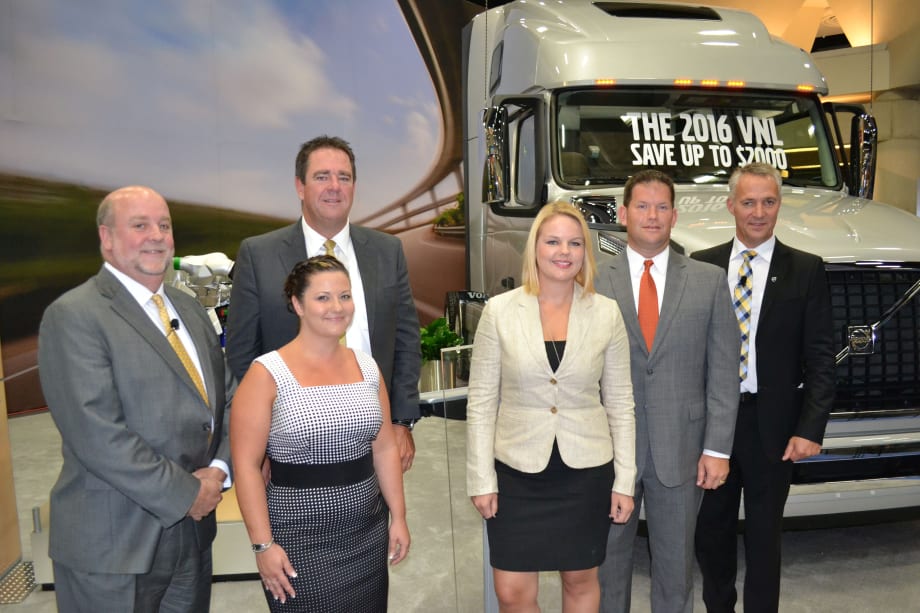
(L-R): Mike Cain, Michelin vice president of original equipment, co-sponsor of the award; Mark Seymour, president of Kriska Holdings; Denise Elliot, safety manager, Kriska Holdings; Senta Brookshire, director of safety and driver development, Britton Transport; Jim Stockeland, president of Britton Transport; and Göran Nyberg, president of Volvo Trucks North American sales and marketing.
(L-R): Mike Cain, Michelin vice president of original equipment, co-sponsor of the award; Mark Seymour, president of Kriska Holdings; Denise Elliot, safety manager, Kriska Holdings; Senta Brookshire, director of safety and driver development, Britton Transport; Jim Stockeland, president of Britton Transport; and Göran Nyberg, president of Volvo Trucks North American sales and marketing.
When it comes to safety, there are no prizes for second best. Without a solid safety program, a fleet opens itself up to a number of dangers, including those to their own drivers as well as the ones sharing the road. During the 2014 ATA Management Conference and Exhibition this past October, Volvo Trucks honored a pair of fleets that have excelled in safety — Ontario, Canada’s Kriska Transportation and Britton Transport of Grand Forks, N.D. — with its 2014 Volvo Truck Safety Awards.
“A fleet safety program needs to be at the core of a company’s operating plan,” says Jonathan Wahba, chief operating officer at Kriska, adding that buy-in from operations, sales, human resources and the executive team is critical in order to ensure a successful program and to help drive home the safety message.
When planning a safety program, Jim Stockeland, president of Britton Transport, advises fleet managers to not be overwhelmed with the whole program.
“Instead, assess your most significant gap areas and build a plan on addressing those. Utilize the many tools that are available to support safety programs in fleets today,” he says.
It is not as easy as just mandating some rules and regs, then sitting back down behind the desk. Managers need to ensure that there is a consistent application of the policy from driver to driver and customer to customer, which Wahba considers a mistake that can be common among first-time fleet managers. But, the most important part of the safety equation is the driver.
“Technology can only provide a limited amount of influence over the behavior of the driver,” says Wahba. “Screening, qualifying, and selecting safety-minded drivers have to be the enterprise’s top priority.”
Wahba also point to Kriska’s experience of seeing a vast majority of drivers who walk through the carrier’s front door who want to work for a carrier that has safety as their first core value.
“By ‘walking the talk’ relative to our focus on safety, we are able to recognize industry-leading levels of driver retention,” adds Wahba.
Wahba and his team understand that drivers are on the front lines of Kriska’s safety program and are sure to reward those employees that represent the company’s ideology on a daily basis. Quarterly financial incentives for safety and performance, which includes ensuring no DOT reportable events and no equipment damage, are awarded, as well as recognition of million mile achievements with decals for the truck, custom clothing, and even gifts.
Not every day can be perfect, though, and there will be events that need to be addressed in a timely manner. Part of a company’s response to a safety violation must include training, according to Stockeland. When an incident does occur, immediate follow up with the driver is recommended as soon as practical, with not only a conversation but also specific video training.
“This is a time when you most likely have the driver’s attention and they are eager to improve their skills and avoid the same mistake again,” says Stockeland.
While reactive training is available, Stockeland’s drivers also utilize quarterly training sessions that are internet-based to connect with drivers on specific safety issues. Technology transforms training into a real-time process for Kriska drivers, with in-vehicle technology that provides instant feedback on speeding events, hard braking, and hours of service infractions.
“We rely heavily on technology to provide real-time feedback to both the driver and office associates. In the office, our safety staff monitors the same data, as well as additional driving behaviors in order to provide coaching and training to the driver in a near real-time environment,” says Wahba.
When it comes to safety, no matter how well a company trains its employees, the drivers are the face of the company when it comes to customers and other drivers on the road, according to Stockeland.
“How they act behind the wheels shapes the perspective of our industry. We require that our drivers follow our value of Purposefully Protecting Others while exhibiting habitually safe driving habits,” he says.
More Safety & Compliance

FMCSA Pauses Biennial-Update Enforcement Amid Motus Transition
Carriers whose updates were due on or after June 1 have more time, while FMCSA works to stabilize its new registration system and warns of phishing sites impersonating its new carrier registration system, Motus.
Read More →
ZF Expands Commercial Vehicle Push in North America
ZF is expanding its North American commercial-vehicle presence with new transmission applications, electrification, trailer technology and autonomous-driving systems.
Read More →
Truck Drivers Need More Than Another Alert
Fleets have more visibility into truck health, safety events, and driver activity than ever. The next challenge is turning all that information into useful guidance for the person who has to decide what to do next.
Read More →
Tesla Wants a Self-Driving Semi. Are Cameras Enough?
Could Tesla’s camera-only autonomous driving technology work on an 80,000-pound Semi? In this commentary, HDT's Deborah Lockridge takes a look at Tesla, Cybercab, and how autonomous trucks see the road.
Read More →
What DOT’s Automated Vehicle Strategy Means for Trucking
The U.S. Department of Transportation issued a new automated-vehicle strategy that outlines plans for driverless-truck regulations, cross-state freight corridors, and federal safety standards.
Read More →
NYC Expands Speed, Pedestrian Safety Tech Across Fleet
New York City is expanding intelligent speed assistance and pedestrian-alert systems across its municipal fleet, moving the technologies from pilot programs into vehicle procurement and retrofit requirements.
Read More →
FMCSA Removes 110 Truck Driver Training Schools from Certified ELDT List
Federal regulators also are targeting more than 160 additional training providers and launching a nationwide audit of third-party CDL skills testers as part of a broader crackdown on trucking fraud.
Read More →
Beyond DOT Compliance: What Makes a Trucking Fleet Truly Safe?
A trucking fleet can follow every rule and still make unsafe decisions. The real test comes when safety conflicts with freight, productivity, or cost.
Read More →
Hours of Service Pilot Programs: FMCSA Readies for 2027 Rollout
Two pilot programs could eventually reshape hours-of-service rules, giving truck drivers options to pause their 14-hour clock or use longer split sleeper rest periods.
Read More →
New Guide Offers Pet Safety Tips for Truck Drivers
Hundreds of thousands of pets travel in truck cabs. A new safety guide from Volvo Trucks and the Center for Pet Safety offers practical advice for truck drivers who bring dogs and cats along for the ride.
Read More →