




COVID-19’s Lasting Impacts on Fleet Maintenance, Parts Procurement
As devastating as the Covid-19 pandemic has been, there have been beneficial changes made to fleet maintenance and parts procurement practices that will last long after the pandemic has ended.
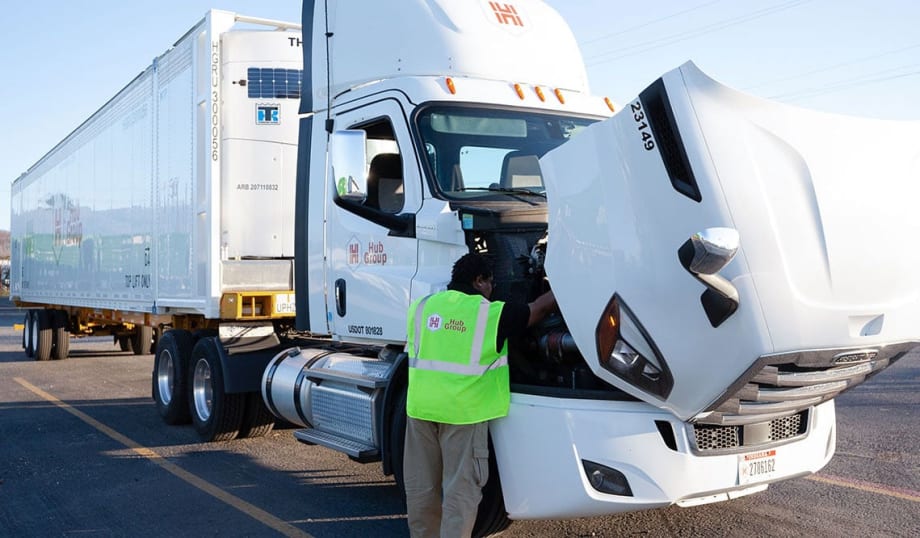
Hub Group's Gerry Mead said Mead said virtual training provided by vendors has in some cases been superior to in-person training.
Photo: Hub Group
As devastating as the COVID-19 pandemic has been, there have been beneficial changes made to fleet maintenance and parts procurement practices that will last long after the pandemic has ended. During the Motor and Equipment Manufacturers’ Heavy Duty Aftermarket Dialogue webinar Jan. 25, fleet panelists agreed there were many operational changes made by their companies and suppliers that they hope will become permanent.
Mari Roberts, senior director of transportation with Frito-Lay, the biggest private fleet in the U.S., noted her fleet uptime and PM compliance reached record highs over the past year, “which was the year we needed it the most.” She said the fleet saw surging demand for the products it delivers as consumers stocked pantries, and that its operations never shut down.
“At the beginning, our strategy was as long as we take care of our drivers, they’ll take care of everything else,” she said.
That was the same approach taken by Quality Transport, a 20-truck fleet based in North central Illinois. “Once we realized this was going to be a major operational challenge, we immediately went into taking care of the drivers," said Amanda Schuier, senior vice president. "One goal was to not lay off any of our drivers, and we have been successful with that.”
An unplanned benefit at Quality Transport has been that the company has fast-tracked investments in its technologies since the onset of the pandemic. A new dispatch system was rolled out, trailer tracking was deployed, and the fleet’s electronic logging devices were swapped out for a better system. Communication at the fleet has actually improved as employees have embraced technologies, Schuier added, and that extends to suppliers who have gotten creative to ensure the uninterrupted supply of needed parts.
“I hope that sense of community we established during this pandemic doesn’t go away,” she said. “I have never felt so in-tune with our employees as a whole as I do right now.”
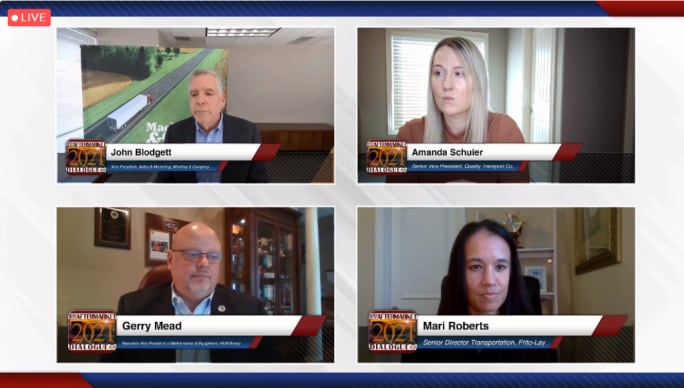
Three fleet executives talked about parts and maintenance during the virtual Heavy Duty Aftermarket Dialogue.
Photo: Screen capture
Gerry Mead, executive vice president of maintenance and equipment with Hub Group, said he was impressed at how agile employees were when adapting to working from home. He was equally pleased with how parts suppliers were able to keep the fleet running. “We didn’t miss a beat,” he said.
Schuier cited the example of an ELD provider that offered reference cards drivers could carry in their trucks providing helpful information for navigating the pandemic. “We took that card and laminated it and put it in all our drivers’ trucks along with personal protective equipment,” she said. “It made that company stick out to me…and made me feel like they were in it with me.”
Virtual training, meetings
When it comes to processes implemented during the pandemic that will remain in place, Mead said virtual training provided by vendors has in some cases been superior to in-person training. Everyone had a clear view of the lesson, unlike in person classes when those at the back can’t see what’s being demonstrated. Having an instructor available to take questions via video is better than watching a pre-recorded video or reading a bulletin, he added.
Internally, to keep technicians from walking the shop floor looking for parts and risking unnecessary interactions, Mead said those working the parts counter would deliver parts right to the vehicle being worked on.
“We saw an increase in productivity,” said Mead. “It’s something we’re going to continue. The parts person, instead of sitting behind the counter, delivers those parts as they come in so we can keep the technicians turning wrenches.”
Virtual driver meetings have also proven to be more effective than in-person gatherings, Roberts added. Drivers with long commutes appreciate not having to drive into the office for a meeting and participation in those meetings has increased, as drivers can park and call in while on the road.
Online parts ordering increasing
Online parts buying has also increased during the pandemic, a trend likely to continue.
“That’s where it’s at,” said Mead. “That’s the way of the future. We are doing it where we can and where companies have built the portals.” He said parts suppliers that aren’t developing online ordering portals will fall behind as the new generation of shop employees prefer online ordering.
Each of the three fleets represented on the panel is also working to bring more maintenance in-house.
“No one is going to love your truck like you love it,” reasoned Mead.
The biggest challenge in doing so, he added, is ensuring high-usage parts are always readily available. “There are some parts we need faster and we need to make sure suppliers know what they are and that they’re on the shelf ready for us to get our hands on within hours,” he said.
James Menzies is editor of Today's Trucking, where this article first appeared. He has been covering the Canadian trucking industry for more than 18 years and holds a CDL. This content is used with permission through an editorial sharing agreement.
More Maintenance

Color Match Smarter: Tools That Restore & Perform
For fleet managers and collision repair professionals keeping heavy-duty trucks on the road, getting the color right the first time isn't just about appearance — it's about efficiency, turnaround time, and bottom-line results. Discover how today's digital color tools are transforming the repair process from guesswork to precision.
Read More →
Wrong Repair Prompts Recall of Freightliner, Western Star 4x2 Trucks
DTNA is recalling more than 2,400 trucks that received an incompatible software fix instead of the hardware repair required to address brake valve corrosion.
Read More →
Truck Drivers Need More Than Another Alert
Fleets have more visibility into truck health, safety events, and driver activity than ever. The next challenge is turning all that information into useful guidance for the person who has to decide what to do next.
Read More →
The Maintenance Checks Trucking Fleets Should Prioritize Before Fall Freight Picks Up
Making it through August isn’t the same as being ready for the next several months of operation. Find out what systems may have suffered from summer heat and need to be checked out before fall.
Read More →
What Three Fleets Are Doing Differently When Buying Truck Parts in 2026
With freight improving but costs still climbing, fleet maintenance executives explain how they're balancing price, quality, and supplier relationships.
Read More →
Paccar Recalls 2027 Trucks Built This Summer for Possible Electrical Problem
The nearly 6,000 Kenworth and Peterbilt trucks in the recall could potentially lose engine power, among other things.
Read More →
Will API PC-12 Oil Change Trucking Fleet Maintenance?
The new API PC-12 heavy-duty engine oil category reflects the changing demands of modern diesel engines. But fleets like Foodliner are looking to getting their own data before making decisions on adopting the new oils and questions such as extending oil drain intervals.
Read More →
Brake Safety Week to Focus on Drums and Rotors
Commercial vehicle inspectors are focusing on truck brakes during CVSA's Brake Safety Week, August 23-29.
Read More →Possible Battery-Cable Fires Prompt Recall of 15,000+ International MV and HV Trucks
On the recalled vehicles, manufacturing variations can cause the battery interconnect cable to contact the auxiliary stud and hold down the bracket.
Read More →
Rush, MCT Team Up to Grow Refrigeration Service Network
The joint venture will operate MCT's network of Carrier Transicold dealerships and mobile service locations, with the companies promising greater service capacity and uptime for refrigerated fleets.
Read More →