





Related: Where Are We in the Business Cycle?
Commentary: Welcome to the Year of the Consumer
On what should we base a 2019 forecast? Start with what makes up almost 70% of our economy: the U.S. consumer.
December 21, 2018
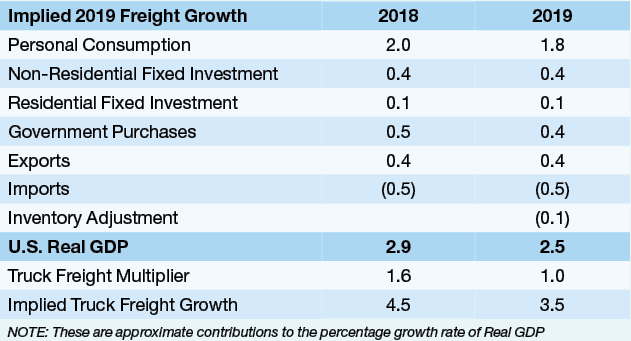
On what should we base a 2019 forecast? Start with what makes up almost 70% of our economy: the U.S. consumer.
Source: Tahoe Ventures, LLC Estimates
3 min to read
As we exit 2018, there are many potential concerns: recent stock market volatility; rising interest rates; trade wars and higher raw material costs; risk to global currency exchange rates; a rapid drop in energy prices; slowing auto and housing demand; and global growth concerns.
So upon what should we base a 2019 forecast? We’ll start with what makes up almost 70% of our economy: the U.S. consumer. In our view, the U.S. consumer is sitting on solid ground. Unemployment is very low at about 3.7%, and wage growth is close to 3%, while inflation is only rising at about 2%, meaning disposable income is rising. Armed with a steady job and rising wages, the consumer should be spending, and in fact, that is what was happening in 2018, to the tune of 2.7% growth. We expect that to continue in 2019. In 2018 the consumer accounted for about 2 points of 2018 GDP growth, and we believe in 2019, that will continue, supporting 1.8 to 1.9 points of GDP growth.
Next, we look to the 18% of GDP that represents investment. Think of non-residential fixed investment as corporate capital expenditures – investments in tools, machinery, and commercial real estate. While that varies quite a bit over an economic cycle, with corporate profits on a high-single-digit growth path, we believe that component of GDP will remain relatively stable, contributing nearly 0.4 points to our GDP forecast. Rising interest rates will slow down the growth of housing investment, but continued employment and income will result in home purchasing, albeit for lower dollar amounts because of the higher cost of money. This only contributes 0.1 points to our forecast. So we are at 2.3-2.4% Real GDP growth so far.
Next on the list: government purchases. You can think of this as money spent on running our country, on our military, or on special government programs (excluding transfer payments such as Social Security). Military spending seems to be on the way up in 2019. In our view, there is the possibility of an infrastructure spending package, but we’ll leave that out for now. So we look for a slight increase from 1.7% growth to 2.5% growth. This will add between 0.4-0.5 points to our GDP forecast in 2019.
The last of the key figures is net exports, which is the sum of imports (negative to GDP growth) and exports (positive to GDP growth). Despite negative headlines regarding our potential trade war with China, it is the trade with Canada and Mexico that drives our economic engines, and the outlook for trade with our neighbors is steady. We have recently become a net exporter of energy, and while manufacturing industries may be hurt by the rise in raw material prices, and farm exports will be impacted by the U.S. dollar, we look for net exports to detract about 0.1-0.2 points from our GDP forecast.
So, adding all of this up, and taking a modest 0.1-0.2 points off for potential inventory adjustment for product pre-shipped ahead of potential tariffs, we get a real GDP forecast of 2.4%-2.6%. We’ll split it down the middle and call it 2.5%.
How do we convert this into a freight forecast? On average, total freight movements mirror Real GDP, with rail and ocean freight growing at slightly lower rates, and truck freight at a 100- to 150-basis-point premium. Using a more conservative 100 basis points, we believe truck freight demand will slow from 4.5% in 2018 to a strong, but slightly lower, 3.5% in 2019 – still strong enough to warrant continued equipment investment.
Jeff Kauffman has been a recognized transportation authority for almost 30 years, most notably heading freight transportation research for Merrill Lynch. Currently he is managing director for Loop Capital Markets and also heads Tahoe Ventures, a transportation consulting company. He can be reached at jkauffman@truckinginfo.com.
Subscribe to Our Newsletter
More Fleet Management

Sponsored•September 16, 2026
Color Match Smarter: Tools That Restore & Perform
For fleet managers and collision repair professionals keeping heavy-duty trucks on the road, getting the color right the first time isn't just about appearance — it's about efficiency, turnaround time, and bottom-line results. Discover how today's digital color tools are transforming the repair process from guesswork to precision.
Read More →
FMCSA Pauses Biennial-Update Enforcement Amid Motus Transition
Carriers whose updates were due on or after June 1 have more time, while FMCSA works to stabilize its new registration system and warns of phishing sites impersonating its new carrier registration system, Motus.
Read More →
Sponsored•September 14, 2026
2026 Blueprint for Countering Smarter Supply Chain Theft
Cargo theft is no longer just the cost of doing business. It's a multi-billion-dollar criminal enterprise exploiting vulnerabilities across your fleet, drivers, and supply chain.
Read More →


Sponsored•September 1, 2026
How Telematics Improves Visibility, Control, and Performance in Refrigerated Fleets
Explore how telematics help refrigerated fleets improve visibility, uptime, efficiency, compliance, and cargo protection across connected cold chain operations.
Read More →
What the U.S.-Canada Trade War Means for Trucking
Escalating U.S.-Canada tariffs could disrupt cross-border freight, reduce truck volumes, raise costs, and create new uncertainty for carriers on both sides of the border.
Read More →
What Are Trucking’s Top Concerns for 2026?
The American Transportation Research Institute wants to know what's worrying trucking fleet managers, drivers, and other stakeholders in its annual Industry Issues survey.
Read More →
American Trucking Associations Looks for a New Leader
ATA President and CEO Chris Spear abruptly left his job at the association on August 21, at a pivotal time for the trucking industry.
Read More →
Public Wi-Fi Cybersecurity Risks: How Truck Drivers and Fleets Can Protect Their Data
Public Wi-Fi can expose truck drivers and fleets to credential theft, malware, and other cyber threats. Here’s how to reduce the risk on the road.
Read More →
For Nicky Cupp, Fleet Innovation Starts With Frustration
HDT Truck Fleet Innovator Nicky Cupp turns everyday pain points at Fraley & Schilling into opportunities for better technology and smarter processes.
Read More →
Adam Buttgenbach’s Approach to Electric Trucks: Start With Where They Fit
HDT Truck Fleet Innovator Adam Buttgenbach helped PepsiCo build one of North America’s largest EV fleets by focusing on where electric trucks make operational sense.
Read More →