




Commentary: Inside a Senate Roundtable on Highway Funding
In late April, Tom Sanderson, CEO of the third-party logistics company Transplace, participated in a roundtable on Capitol Hill about highway funding. As we inch closer to the deadline and the Highway Trust Fund is heading into the red, he offers his impressions of that event.
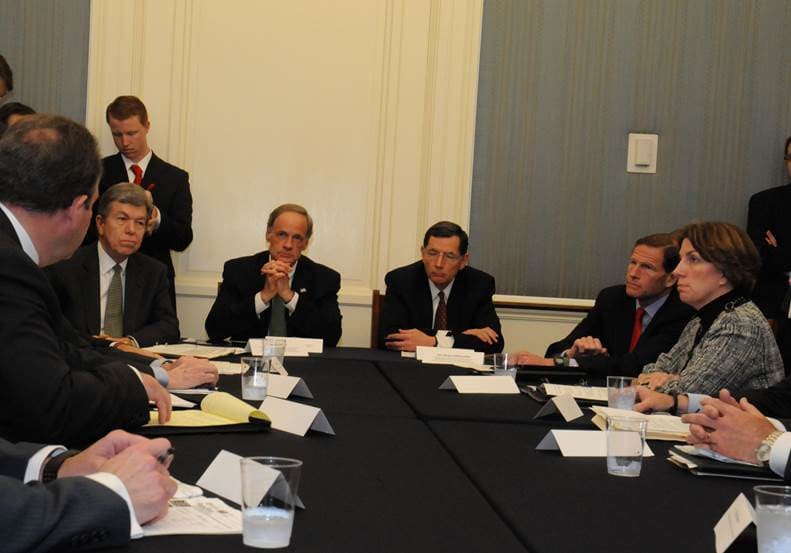
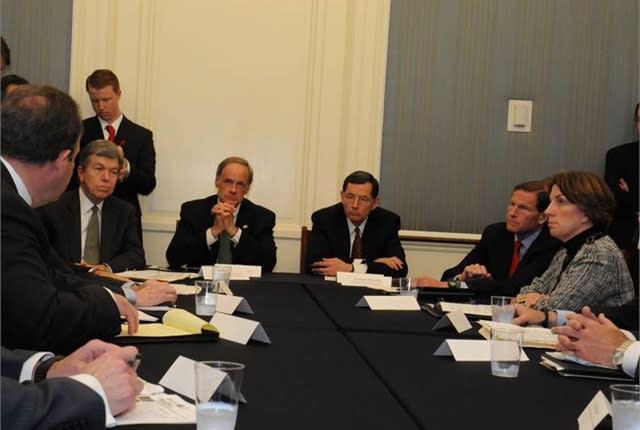
In late April, Tom Sanderson, CEO of the third-party logistics company Transplace, participated in a roundtable on Capitol Hill about highway funding. As we inch closer to the deadline and the Highway Trust Fund is heading into the red, he offers his impressions of that event:
I had the pleasure of participating in a roundtable at the Capitol Building with Senators Carper (D-DE), Barrasso (R-WY), Blumenthal (D-CT) and Blunt (R-MO) on April 30 along with seven other industry representatives. The topic was the needs of the freight industries in the next highway bill.
The previous highway bill, MAP-21, expires on September 30, and there are a number of proposals for a new four- to six-year highway bill. In an election year, the most likely result is an extension, especially considering that the previous highway bill was extended 10 times over a three-year period.
The roundtable exceeded my expectations. I found the senators very willing to listen to the points of view being expressed around the table. The meeting was scheduled for one hour, but lasted almost twice that long.
My primary point was that the federal gas and diesel taxes have not been raised since 1993, and since then the consumer price index has risen 62%, while fuel economy is up 14%, eroding much of the purchasing power of these critical user fees. The taxes raise about $38 billion per year, but the federal government spends about $50 billion per year, drawing the excess from the already depleted General Fund.
We built the entire Interstate Highway System with a user fee system, and that same principal should apply to its upkeep. The federal tax should be raised and indexed to inflation and fuel economy improvements, but also the public needs to be assured that this money will be spent repairing the highway system.
The Senators would welcome the return of earmarks (there were none in MAP-21), but a better mechanism would be an iron-clad guarantee that the federal dollars be spent on nothing other than the IHS repair and maintenance with each state deciding how best to spend the money. If the federal government is going to play a role in allocating money to specific projects it could be done along the lines of the Base Realignment and Closure (BRAC) commission, to ensure that the bridges and highways most in need of repair are fixed first.
Republicans could also demand a repeal of Davis-Bacon in exchange for supporting the tax increase. This 1931 prevailing wage law unnecessarily raises the cost of construction, is difficult to administer, and hampers competition. It does not seem likely at this point, but gaining truck productivity through an 88,000 pound GVW and the allowance of 33-foot trailers in double combinations would be a nice offset to higher taxes.
There has been a lot of noise about needing to shift to tolls or a vehicle miles tax (VMT) to compensate for rising fuel economy and the growing potential for electric vehicles. The numbers show that inflation, not fuel economy, is the primary cause of the shortage of funds.
Fuel taxes encourage fuel economy improvements, which is a good thing, and also add to the other subsidies for electric cars. The fuel tax is very efficient to collect, unlike tolls and VMTs, and very hard to avoid. The trucking industry already has to report vehicle miles for state fuel tax collection, but do we really want to develop a system for capturing that data for the 250 million cars and light trucks on the road?
It is certain that expansion of highway capacity will require tolls and public-private partnerships (PPPs). Tolling the existing IHS, as proposed by the Obama administration, is double taxation for roads that we already paid to build through user fees and currently pay to maintain through fuel taxes.
I was pleased to see that Senator Carper announced his continued support for increasing the federal gas and diesel tax in the weeks after our roundtable. The American Trucking Associations, the American Automobile Association, and the U.S. Chamber of Commerce all support increasing fuel taxes to fix our highways and bridges. The big question is, how do we convince the general public that the extra money raised will be spent repairing and maintaining the IHS?
In a statement following the event, Sen. Carper noted:
The U.S. transportation system moves more than 52 million tons of goods worth nearly $46 billion every day. Efficient, reliable, and affordable freight movement is important to nearly every type of business in the U.S. Businesses rely on freight movement for their supply chains as well as to get their goods to market both domestically and overseas.
Today my Senate colleagues and I, who lead two key transportation subcommittees, had a very productive discussion with the users of the freight network to better understand how we can help them to grow, create jobs, and contribute to our economic success. The expert input we collected today will be invaluable to me and my colleagues in Congress as we work to find a bipartisan agreement on how to craft and pay for transportation legislation that invests in freight projects with a strong return on investment.
The other participants in the roundtable were:
Mort Downey, Founding Chairman, Coalition for America's Gateways and Trade Corridors
Matthew Garrett, Director, Oregon Department of Transportation
Paul Trombino, Director, Iowa Department of Transportation
Amy Larson, President, National Waterways Conference, Inc.
Kevin Kolevar, Vice President of Government Affairs and Public Policy, Dow Chemical Corp.
Pat Thomas, Vice President of Global Public Affairs, UPS
Dean Wisem, Vice President of Network Strategy, BNSF Railway Compan
More Fleet Management

Why Private Fleets Are Taking More Freight
Private fleets are putting their own trucks on demanding customers and high-cost lanes as companies seek greater control over service, costs, and capacity.
Read More →
Color Match Smarter: Tools That Restore & Perform
For fleet managers and collision repair professionals keeping heavy-duty trucks on the road, getting the color right the first time isn't just about appearance — it's about efficiency, turnaround time, and bottom-line results. Discover how today's digital color tools are transforming the repair process from guesswork to precision.
Read More →
FMCSA Pauses Biennial-Update Enforcement Amid Motus Transition
Carriers whose updates were due on or after June 1 have more time, while FMCSA works to stabilize its new registration system and warns of phishing sites impersonating its new carrier registration system, Motus.
Read More →


2026 Blueprint for Countering Smarter Supply Chain Theft
Cargo theft is no longer just the cost of doing business. It's a multi-billion-dollar criminal enterprise exploiting vulnerabilities across your fleet, drivers, and supply chain.
Read More →
How Telematics Improves Visibility, Control, and Performance in Refrigerated Fleets
Explore how telematics help refrigerated fleets improve visibility, uptime, efficiency, compliance, and cargo protection across connected cold chain operations.
Read More →
What the U.S.-Canada Trade War Means for Trucking
Escalating U.S.-Canada tariffs could disrupt cross-border freight, reduce truck volumes, raise costs, and create new uncertainty for carriers on both sides of the border.
Read More →
What Are Trucking’s Top Concerns for 2026?
The American Transportation Research Institute wants to know what's worrying trucking fleet managers, drivers, and other stakeholders in its annual Industry Issues survey.
Read More →
American Trucking Associations Looks for a New Leader
ATA President and CEO Chris Spear abruptly left his job at the association on August 21, at a pivotal time for the trucking industry.
Read More →
Public Wi-Fi Cybersecurity Risks: How Truck Drivers and Fleets Can Protect Their Data
Public Wi-Fi can expose truck drivers and fleets to credential theft, malware, and other cyber threats. Here’s how to reduce the risk on the road.
Read More →
For Nicky Cupp, Fleet Innovation Starts With Frustration
HDT Truck Fleet Innovator Nicky Cupp turns everyday pain points at Fraley & Schilling into opportunities for better technology and smarter processes.
Read More →