




Charging Ahead in the Face of a Changing Trucking Landscape
A drayage fleet owner goes “all in” on electric trucks — then faces a changing regulatory landscape. Rudy Diaz shares how he’s adapting, growing, and staying grounded.

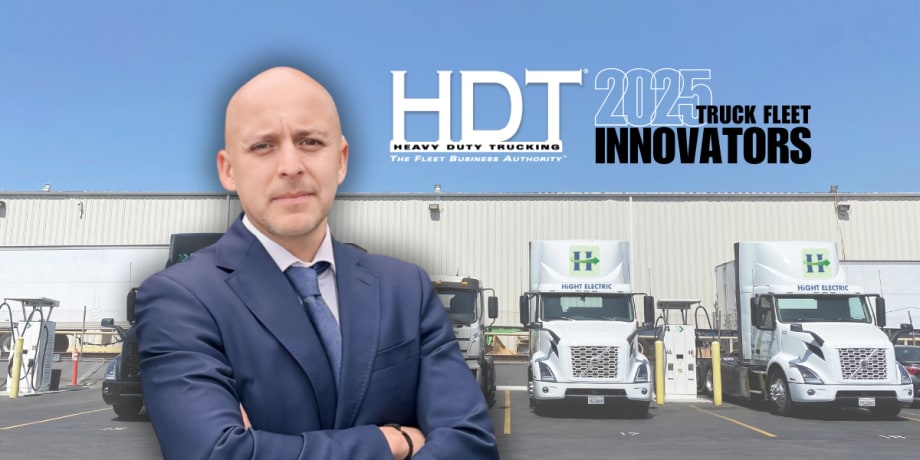
Diaz went “all in” on electric trucks in part because the funding and incentives available for early adopters provided about 90% of the cost of the new trucks.
HDT/Hight Logistics
Rudy Diaz is the founder, CEO, and president of Hight Logistics in Long Beach, California.
No, that’s not a typo. Rudy Diaz, an HDT Truck Fleet Innovator for 2025, named his company after his ninth-grade English teacher, Mr. Hight, who had a big influence on his life.
But the name also evokes the image of taking the company to new heights.
With 25 battery-electric trucks, Hight Logistics operates one of the biggest zero-emission fleets at the Southern California ports.
Building His Own Drayage Business
Diaz got his start in trucking at a drayage company in 2002. After working for several carriers, he struck out on his own in 2011.
“I told myself, ‘I can do this, I can provide good service.’ I wanted to give it a try and open up my own company.”
Hight Logistics was born, using drayage owner-operators to serve port customers. While the company has grown and evolved, Diaz says, its mission remains unchanged:
“To provide the best service that we can, to be mindful of our clients and our employees, and to do whatever we can to make sure that our customers' product and containers arrive on time and safely.”
Hight Logistics' Electric Truck Journey
Diaz was an early adopter of electric trucks, motivated partly by California’s aggressive zero-emission mandates. At first, the 2035 deadline to convert all drayage trucks seemed distant and overwhelming.
“That was a daunting thing,” he says. “In fact, I ignored it because I didn’t know where to start.”
But in 2021, a friend introduced him to Forum Mobility, a startup looking to offer turnkey electric-truck solutions.
Fortunately, Diaz says, Hight’s Long Beach facility had enough power access to install six chargers. By January 2023, the company was operating electric trucks. Today, he’s running 20 of them and has five more on order, a combination of Volvo and BYD.
“We wanted to comply to those mandates and be ahead of the curve versus behind the curve,” Diaz says.
But the motivation wasn’t just regulatory.
“I felt the responsibility as a person, as a business owner, to give back to the environment.”
The zero-emissions fleet also appeals to customers with sustainability goals and creates a cleaner work environment for employees.
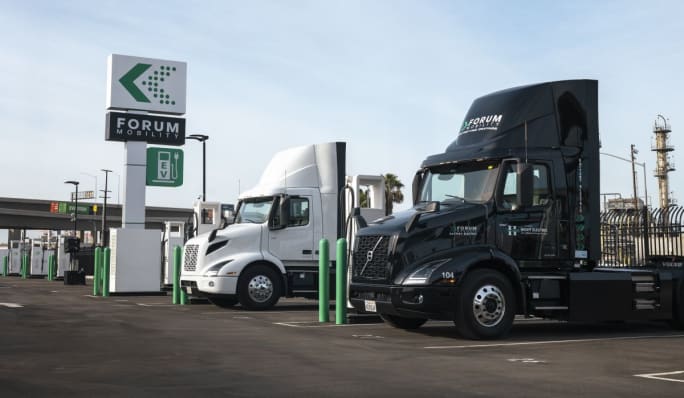
Hight Logistics worked with Forum Mobility on its foray into battery-electric trucks.
Photo: Forum Mobility
Changing Fleet Operations for Electric Trucks
But the move to electric required a change in the way his company operates. Diaz launched a new branch, Hight Electric, using employee drivers, which added a whole new level of complexity.
He faced the challenge of setting up a system for employee drivers while learning the ins and outs of operating electric trucks.
Drivers had to be educated on how to handle the truck. There was troubleshooting of the software and the systems to be learned.
“It’s a lot more involved than going to the fuel pump and just filling up your truck,” Diaz says.
Diaz went “all in” on electric trucks because the funding and incentives available for early adopters provided about 90% of the cost of the new trucks.
“It felt important to take advantage of that funding, because I knew that funding doesn't last forever.”
Still, Diaz had to build the EV side of the business from scratch, without the deep pockets or playbooks of mega-fleets.
“It’s like an ant lifting 10 times its weight, right? We don’t have the resources that an NFI has, a Schneider or a J.B. Hunt.”
“You do as you go and you learn as you go.”
Navigating ZEV Uncertainty in a Changing Regulatory Environment
The challenges continue, Diaz points out.
Recent developments at the federal level that killed California’s Advanced Clean Trucks and Advanced Clean Fleets regulations have led to uncertainty for those like Diaz who have been leaders in adopting electric trucks.
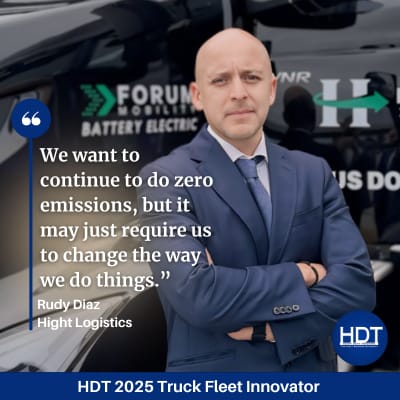
“So now I have this infrastructure that we built out, and trucks, but it's not mandated anymore,” he says. “I don’t know if we’re in a competitive disadvantage or competitive advantage, depending on how you see it.
Add to that the effects of this year's whiplash tariff policies and a sluggish economy, and Diaz says the situation has gone from challenging to frustrating.
“The challenge part we can deal with, but it's becoming frustrating. Just when you think you're getting back up, like a boxer, you get thrown back down.”
That doesn’t mean he has any intention of backing out, throwing his hands up in the air and returning the ZEV trucks.
“No, we've crossed that bridge,” he says. “It is clear to me that we want to continue to do zero emissions, but it may just require us to change the way we do things or the way we were moving forward, because the landscape has changed completely from a year ago.”
How Diaz is Dealing With the Uncertainty
So how does Diaz get through this uncertainty, both personally and as a business?
On a personal level, he says, "I try not to let my mind create scenarios that are not even there, right? Because our minds can just go and run, like a wild horse, and create thoughts and scenarios and doom and gloom.”
Meditation and regular exercise help him stay grounded and manage stress.
He’s also found that open dialogue, with employees and customers, helps with both his personal stress and his business.
Diaz uses the metaphor of a storm to communicate with employees about the current economic and industry challenges. He reassures them that, like storms, tough times will pass, but in the meantime, everyone must remain sharp and focused.
“We have to be at our best,” he tells employees. “And you play a part in that. I play a part. And if we’re in this together, we have to be sharp. Because our competition is trying to be at their best.”
Setting the Company Apart in a Competitive Drayage Market
In a competitive drayage market, Diaz sees differentiation as essential.
In addition to priding itself on personal customer service and reliable, on-time delivery, Hight offers:
Zero emissions transport options
Warehouse and transloading
Specialized chassis for moving loads beyond standard cargo containers
A gated and secured yard for customers to store containers.
Challenges as a Catalyst for Inspiring Change
Diaz tries to view these challenges as a catalyst for positive change.
“They can also make you wiser, make you stronger, make you more creative,” he says, both as a person and as a business.
"I look at these times and ask, ‘How do we get better, how do we improve, how do we become better than our competition, what do we need to do differently, how do we communicate to people?’”
This journey has been one of the most challenging things he’s done in his career, Diaz says, but it has helped him grow as a person.
“It’s been very difficult, but also very rewarding.”
More Fuel Smarts

How Volvo Updated Its D13 for EPA 2027 [Watch]
Volvo’s updated D13 promises lower emissions without sacrificing performance or fuel economy. Take a closer look at what changed inside the engine in this HDT Spotlight video.
Read More →
Diesel Price Spike Shortens Payback for Natural Gas Trucks, Report Says
Energy Vision estimates fleets could recover the higher purchase price of an RNG-fueled Class 8 tractor in 1.3 to 2.8 years under current fuel-price scenarios.
Read More →
Calstart Becomes Catalyst Mobility, Reflecting Broader Focus
Calstart is now Catalyst Mobility, reflecting the nonprofit’s growing national role in clean transportation, including zero-emission trucks, infrastructure and incentive programs.
Read More →

Record Diesel Prices Squeeze Trucking Fleets
Average U.S. diesel prices have climbed to nearly $6 a gallon, surpassing the 2022 record as tight refinery capacity and Middle East disruptions keep fuel costs elevated.
Read More →
How Fuel Delivery Shapes Engine Performance
Fuel delivery depends on more than what happens at the injector. For fleet, maintenance and technical professionals, looking at the full path from pump to injector can provide useful context for understanding engine performance.
Read More →
East Coast Port Launches $45M Electric Truck Push
The Port Authority of New York and New Jersey announced millions in incentives for zero-emission drayage trucks, yard tractors, and new charging hubs near the port.
Read More →
California Bill Could Shed Light on Electric Truck Prices
Why do battery-electric Class 8 trucks remain so expensive? A California bill headed to Gov. Gavin Newsom would give fleets and state agencies more visibility into what manufacturers charge.
Read More →
Detroit Opens Orders for EPA 2027 Engines
Detroit isn’t starting from scratch to meet EPA 2027 diesel emissions standards. Its Gen 6 DD13 and DD15 engines keep much of today’s platform while updating the fuel and aftertreatment systems.
Read More →
Zero-Emission Truck Corridor Planned for West Coast
California, Oregon, Washington, British Columbia and Baja California are coordinating plans for truck charging and hydrogen fueling from Canada to Mexico.
Read More →
A Closer Look at Kenworth’s Electric T880E Vocational Truck [Video]
Learn more about Kenworth's T880E battery-electric vocational truck at the Paccar Technical Center, including its range, applications, upfitting considerations, and PTO options, in this HDT Spotlight video.
Read More →