




Catching Hours-Of-Service Cheaters
A false log was No. 10 in the list of top 20 driver violations in 2015. As a motor carrier, you’re liable for false logs filled out by your drivers if you should have had the means to detect the violations.
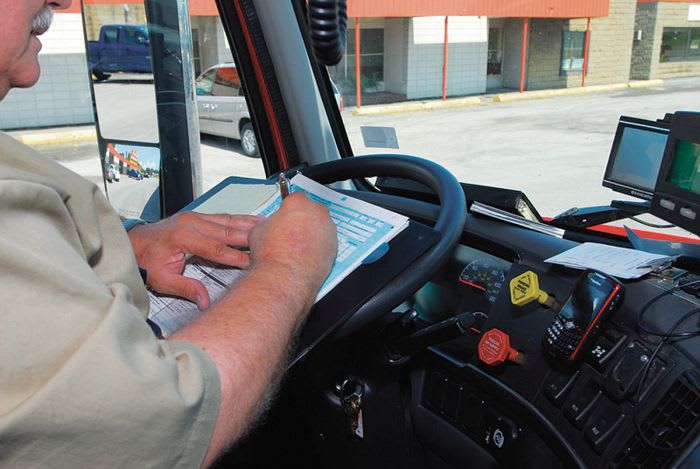
Drivers may falsify paper logs for various reasons. The best way to identify a false log is by comparing the log with related documents to verify whether the driver’s entires are indeed true and correct. Photos: Jim Park
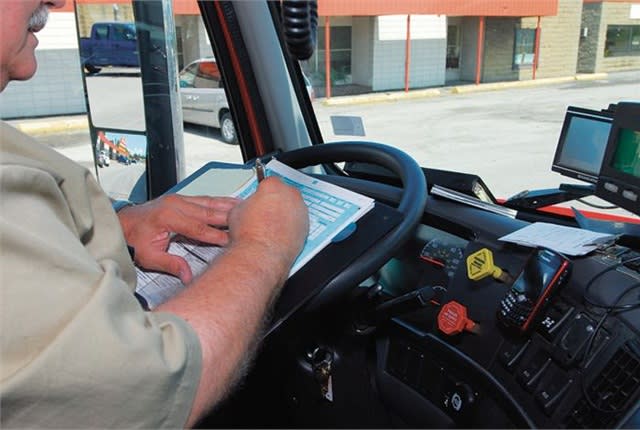
Drivers may falsify paper logs for various reasons. The best way to identify a false log is by comparing the log with related documents to verify whether the driver’s entires are indeed true and correct.Photos: Jim Park
A false log was No. 10 in the list of top 20 driver violations in 2015, with 31,575 violations reported by mid-December. As a motor carrier, you’re liable for false logs filled out by your drivers if you should have had the means to detect the violations.
What is the best way of identifying a false log? By comparing the log with related documents to verify whether the driver’s entries are indeed true and correct. In fact, Section 395.8(k) of the Federal Motor Carrier Safety Regulations requires motor carriers to retain “supporting” documents for at least six months.
Drivers may falsify paper logs for a number of reasons:
Needing to make an on-time delivery and not enough time was allotted
Needing to make up for lost time (such as a loading delay or staying too long at a truck stop)
Anxious to get home
Wanting to maximize mileage (especially if paid by the mile)
Getting behind on paperwork
While auditing a log for violations of the hours-of-service limits and form-and-manner violations is critical, the auditing process should not stop there. Looking for log falsification, as tedious as it can be, must be an integral step of log auditing.
A DOT interpretation provides a long list of possible supporting documents, including:
Fuel receipts/billing statements
Toll receipts/billing statements
Loading and unloading “check calls”
Pickup and delivery receipts/bills o
f lading
Dispatch records/call in logs
Payroll records
Scale clearance device records
Expense receipts (permits, scales, lumpers, lights, etc.)
Repair receipts
Customs paperwork
Roadside inspection reports and crash reports
Electronic communications/tracking records
Verifying entries on the log against paperwork such as the items listed above is the way to find false entries.
Verifying log entries is fairly simple
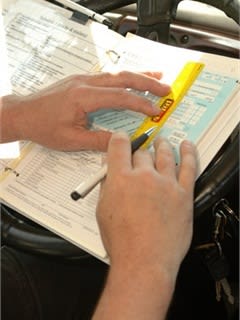
If you are using a log auditing program or system, make sure you know exactly what the system is checking. You may want to add manual steps to make sure you are doing a thorough job of identifying log falsification.
To begin, locate the date and time on a supporting document. Next, take the driver’s log for the day and check the driver’s location at the time provided on the supporting document. Do they correlate?
At times, this may require some interpretation. For example, take a toll receipt. Toll receipts do not have any on-duty time associated with them. Therefore, you will need to look back at the time the driver started driving and review the time and distance from the starting time to the toll location. Here is an example:
After completing a 10-hour break, a driver’s log shows “driving” starting at 8 a.m. at Metropolis, Ill. A toll billing statement or receipt, which is a supporting document, shows the driver paying a toll at Rockford, Ill., at 11 a.m.
The driver’s log shows that the driver arrived in Wausau, Wis., (with no breaks) for a delivery appointment at 4 p.m.
The distance from Metropolis, Ill. to Rockford, Ill., is 413 miles. Depending on the normal operating speed of the fleet, the traffic encountered, and the speed limits for the roads involved, the amount of driving time should be somewhere between 7 and 8.25 hours of driving.
When these data points are connected, it is obvious that the log is false. The driver would have had to have started driving well before 8 a.m. to be in Rockford at 11:00 a.m. A more likely starting time for the day was between 2:30 and 4 a.m. A likely scenario is that the driver cut the 10-hour break short to be able to make it to Wausau on time.
Another way to identify falsification is by checking the “point-to-point” mileages on the driver’s log. In the example above, the mileage guide places the mileage from Metropolis to Wausau at 615 miles. This converts to 10.25 to 12.5 hours of driving. In our example, the driver showed 8 hours of driving, which provides further verification that the log is false.
Using supporting documents that can be tied to on-duty time, such as pickup and delivery receipts, bills of lading, fuel receipts, customs clearance paperwork, and roadside inspection and crash reports, is an easier process. With these supporting documents it is simply a matter of checking that the on-duty time, or the “flag” indicating a short change in duty status, is at the appropriate time. (Be sure to account for any time zone changes.)
In some situations, you may need to allow a little leeway when matching supporting documents to logs. This may be the case when the time on the supporting document cannot be validated.
Selecting logs to verify entries
Since the verification process is time-consuming, it may not be possible to check all of your drivers’ logs for false entries. In that case, you might select logs to review based on criteria such as the following:
Drivers involved in a crash
Drivers placed out of service for hours-of-service violations
Drivers placed out of service for any reason
Drivers who received an hours-of-service violation on the road
Drivers with a history of hours-of-service violations
The “top performing” drivers from the previous month
New drivers
Drivers never audited before
Random selection
If you are using a log auditing program or system, make sure you know exactly what the system is checking. You may want to add manual steps to make sure you are doing a thorough job of identifying log falsification.
By following the steps outlined above, you should have higher-than-average odds of keeping this violation off of your company’s and drivers’ inspection and audit records.
Tom Bray is a senior editor of J.J. Keller & Associates, specializing in motor carrier safety and operations management.
More Drivers

Truck Drivers Need More Than Another Alert
Fleets have more visibility into truck health, safety events, and driver activity than ever. The next challenge is turning all that information into useful guidance for the person who has to decide what to do next.
Read More →
FMCSA Removes 110 Truck Driver Training Schools from Certified ELDT List
Federal regulators also are targeting more than 160 additional training providers and launching a nationwide audit of third-party CDL skills testers as part of a broader crackdown on trucking fraud.
Read More →
Hours of Service Pilot Programs: FMCSA Readies for 2027 Rollout
Two pilot programs could eventually reshape hours-of-service rules, giving truck drivers options to pause their 14-hour clock or use longer split sleeper rest periods.
Read More →
Medical Cards, English Proficiency Reshape Roadcheck Violations
Medical-card violations jumped to the top of the driver out-of-service list during CVSA’s 2026 International Roadcheck, while English-language proficiency violations appeared among the leading violations for the first time.
Read More →
Driver Trust Can Make or Break the Success of Fleet Safety Technology
New Teletrac Navman research suggests that onboarding, transparency about driver data, and positive feedback can play a significant role in how commercial drivers respond to safety and coaching technology.
Read More →
EEOC Sues KLLM Over Alleged Sex Discrimination in Driver Training
KLLM is facing a federal sex-discrimination lawsuit over policies the EEOC alleges put female truck driver trainees at a disadvantage.
Read More →
FMCSA Moves to Codify English Language Requirements for Commercial Drivers
By changing regulations on English-language proficiency requirements for commercial drivers, rather than relying on a guidance memo, the FMCSA said future administrations won't be able to walk back the Trump administration's stricter enforcement with just a memo.
Read More →
Drivers Put Western Star Trucks to the Test at Star Nation Experience
Watch to get an inside look at the Western Star trucks, technology, and community behind the Star Nation Experience 2026!
Read More →
Trump Administration Looks to Put More Veterans Behind the Wheel
The Freedom Haulers program pulls together existing and expanded programs at several federal agencies to recruit veterans to drive commercial heavy-duty trucks and cut the red tape for them to get a CDL, training, and employment.
Read More →
Putting Mack’s Command Steer to the Test
A test drive of Mack’s Command Steer active steering system evaluates how it can make truck driving easier and less tiring.
Read More →