




Can 'Electric Highways' Help with Zero Emissions Truck Goals?
In Germany, they’ve been testing trucks that get electricity from overhead electric lines, similar to how many trains work. But unlike trains or streetcars, these trucks can also operate on regular roads.

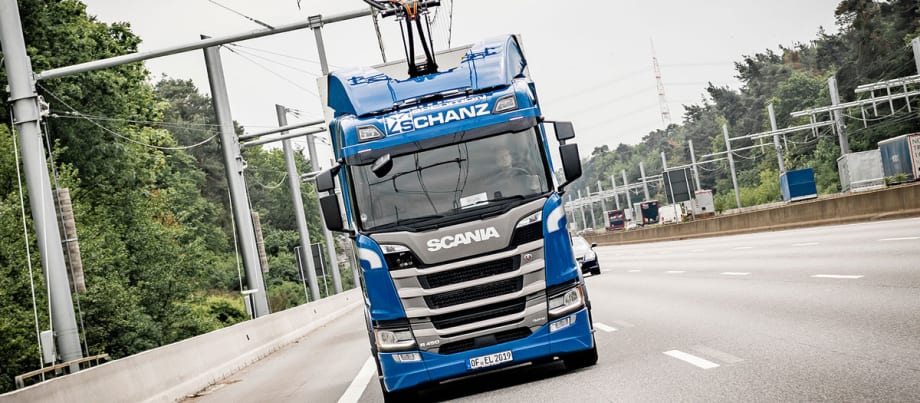
A truck from Schanz Spedition makes the same run up to five times a day, the kind of regular route that would make the most sense for this technology.
Photo: Scania/Traton
One of the stumbling blocks for widespread adoption of battery-electric trucks has been, well, the batteries. They’re heavy (meaning less payload), expensive, and use materials such as lithium that raise environmental concerns associated with the extraction and processing, not to mention disposal once they reach the end of their lives.
In Germany, they’ve been testing a technology that would require fewer/smaller batteries: Trucks that get electricity from overhead electric lines, similar to how many trains work. Think of it as a high-tech version of the classic electric streetcar. But unlike trains or streetcars, these trucks can also operate on regular roads.
A pilot project on what’s called the eHighway in Hesse, Germany (near Frankfurt), has been ongoing for a little more than a year. The results must be encouraging, because in late July, Continental and Siemens announced a deal “to supply trucks across europe with electricity from overhead lines.”
Continental Engineering Services and Siemens Mobility said they will collaborate in the development and production of the pantographs — the equipment on top of the truck that is raised to collect the electricity from the overhead catenary lines. Siemens already makes these for rail applications.
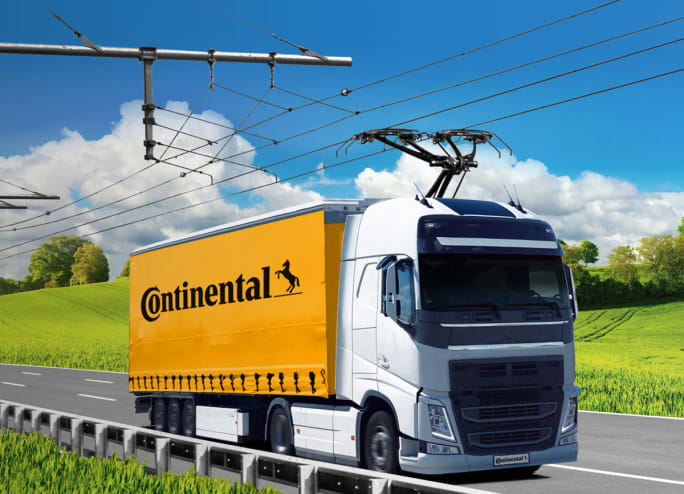
Continental and Siemens will collaborate in the development and production of pantographs — the equipment on top of the truck that is raised to collect the electricity from the overhead catenary lines.
Photo: Continental
On the e-highway, hybrid trucks equipped with pantographs have been operating in daily traffic along electrified segment on the A5 motorway. The trucks are being operated by real trucking and logistics companies, including Schanz, Meyer Logistics, Contargo, Merck, and German building materials supplier company Knauf.
Traton, formerly Volkswagen Truck & Bus, is providing the Scania trucks for the project. The Hesse test track is currently 10 kilometers long and set to increase to a total of 17 kilometers starting in 2022. In addition to the e-highway in Hesse, there also are tests planned on two other German highways.
An Aug. 3 article in the New York Times features a ride-along in one of the trucks, operated by family-owned trucking firm Schanz Spedition. This truck makes the same run up to five times a day, the kind of regular route that would make the most sense for this technology.
“Hasso Grünjes, who oversees Siemens’ involvement in the project, said it would make sense to first electrify heavily traveled routes, such as the one between the Dutch port of Rotterdam and Duisburg, in Germany’s industrial heartland; or the highway connecting the German ports of Hamburg and Lübeck,” the Times reports. “Large numbers of trucks do nothing but drive back and forth between those destinations, Mr. Grünjes said. Trucking companies that use the routes would save money on fuel, their biggest cost, and easily justify the investment in trucks with rooftop pantographs.
“But the onus would be on the German government to build the overhead cables, which cost an estimated 2.5 million euros per kilometer, or about $5 million per mile.
“Germany’s Ministry for Environment, which is funding the three electrified highways in Germany, is comparing the results with studies of trucks using hydrogen fuel cells and trucks using batteries. In three or four years, the ministry said in a statement, a decision will be made what technology to support.”
Keys to eHighway Success
An article on the Traton website outlined three factors critical for success to take this overhead charging technology from testing to an infrastructure project:
The interaction between the overhead line technology and the battery. After every trip, the drivers record how well they managed to couple with the overhead line even in heavy traffic, and how long the battery charge lasted after that. (This, presumably, is an area where the Siemens-Continental project will be involved.)
Economic efficiency. Right now, the variable costs would be several times higher than diesel. But with advances in battery technology, which are widely expected, the vehicles would become more economical.
Investments required by the public sector. The German Federal Ministry for the Environment — which is financing the test section — said an overhead line would only be installed on the most heavily used 4,000 kilometers of the almost 12,300 kilometers of autobahn.
The partnership between Siemens and Continental will help fine-tune the development of the rail-based pantographs for use in trucks. Now, Continental says, it is just a matter of developing the current collectors especially for trucks, so that they can be offered to commercial vehicle manufacturers cost-effectively and in any desired number of units.
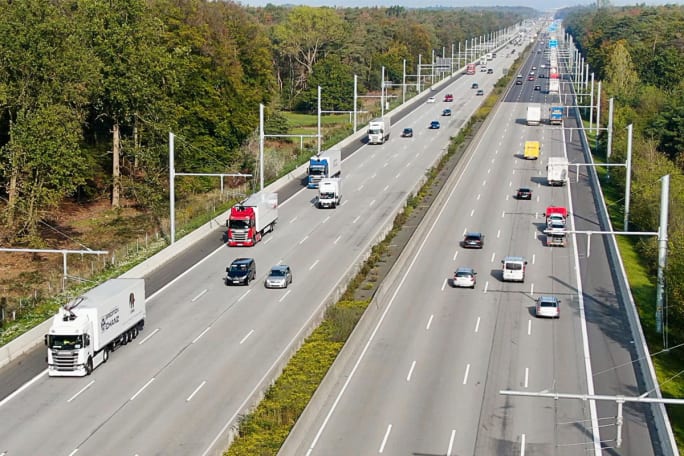
Traton and its Scania brand are involved in testing technology where trucks get electricity from overhead electric lines.
Photo: Traton
“We are transferring the principle of rail electrification to the road,” said Christoph Falk-Gierlinger, managing director of CES, in a news release. “The current collectors will be developed and produced in accordance with automotive standards. The partnership between Continental Engineering Services and Siemens Mobility is a major step toward climate-neutral freight transport.”
By electrifying the core network and supplying electricity to the trucks driving there with electric drives (e.g. battery, hybrid, hydrogen), “a huge and quick contribution to climate protection can be achieved,” according to Continental.
Would E-Highways Work in the U.S.?
In 2017, Siemens tested the pantograph concept in a six-month southern California demonstration project, running three trucks along a one-mile stretch of electric highway — one battery-electric truck, a clean natural-gas hybrid-electric truck, and a diesel-hybrid truck.
The test took place in Carson, California, near the ports of Los Angeles and Long Beach, an area where state and local officials have focused a great deal of regulatory and government-incentive-based attention on reducing truck emissions. It’s also a logical place for such technology because there are heavily used stretches of road in and out of the ports that would be targets for the overhead charging infrastructure.
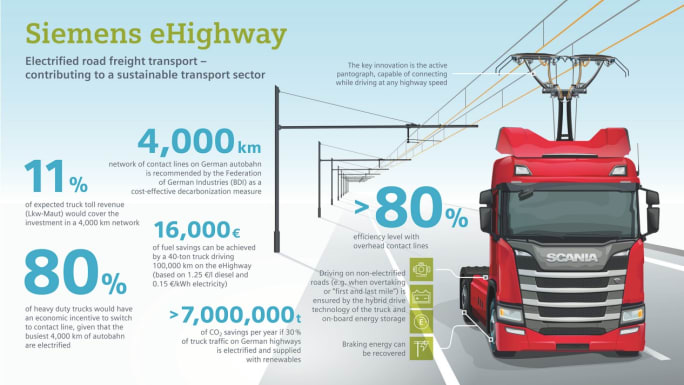
Infographic: Siemens
In its final report, Siemens concluded that the project showed that the eHighway system can be implemented in an existing road infrastructure as a potential zero-emission goods transport technology. The project also demonstrated that different drive configurations can be used in combination with the eHighway system, it said, meaning that rather than an alternative to other clean technologies, it could be used in combination.
“Parallel developments in energy storages (e.g. batteries) or alternate on-board supplies (e.g. fuel cells) will not deteriorate the eHighway concept but increase the overall efficiency on non-electrified sections.”
The report also noted that the pantograph and truck technology would need further development, but that’s exactly what’s happening in Europe.
More Fuel Smarts

New California Law Could Shed Light on Electric Truck Prices
Why do battery-electric Class 8 trucks remain so expensive? A California bill signed by Gov. Gavin Newsom would give fleets and state agencies more visibility into what manufacturers charge.
Read More →
How Volvo Updated Its D13 for EPA 2027 [Watch]
Volvo’s updated D13 promises lower emissions without sacrificing performance or fuel economy. Take a closer look at what changed inside the engine in this HDT Spotlight video.
Read More →
Diesel Price Spike Shortens Payback for Natural Gas Trucks, Report Says
Energy Vision estimates fleets could recover the higher purchase price of an RNG-fueled Class 8 tractor in 1.3 to 2.8 years under current fuel-price scenarios.
Read More →

Calstart Becomes Catalyst Mobility, Reflecting Broader Focus
Calstart is now Catalyst Mobility, reflecting the nonprofit’s growing national role in clean transportation, including zero-emission trucks, infrastructure and incentive programs.
Read More →
Record Diesel Prices Squeeze Trucking Fleets
Average U.S. diesel prices have climbed to nearly $6 a gallon, surpassing the 2022 record as tight refinery capacity and Middle East disruptions keep fuel costs elevated.
Read More →
How Fuel Delivery Shapes Engine Performance
Fuel delivery depends on more than what happens at the injector. For fleet, maintenance and technical professionals, looking at the full path from pump to injector can provide useful context for understanding engine performance.
Read More →
East Coast Port Launches $45M Electric Truck Push
The Port Authority of New York and New Jersey announced millions in incentives for zero-emission drayage trucks, yard tractors, and new charging hubs near the port.
Read More →
Detroit Opens Orders for EPA 2027 Engines
Detroit isn’t starting from scratch to meet EPA 2027 diesel emissions standards. Its Gen 6 DD13 and DD15 engines keep much of today’s platform while updating the fuel and aftertreatment systems.
Read More →
Zero-Emission Truck Corridor Planned for West Coast
California, Oregon, Washington, British Columbia and Baja California are coordinating plans for truck charging and hydrogen fueling from Canada to Mexico.
Read More →
A Closer Look at Kenworth’s Electric T880E Vocational Truck [Video]
Learn more about Kenworth's T880E battery-electric vocational truck at the Paccar Technical Center, including its range, applications, upfitting considerations, and PTO options, in this HDT Spotlight video.
Read More →