




California Reefers
The California Air Resources Board is following through on its promise to clamp down on emissions from reefer diesel

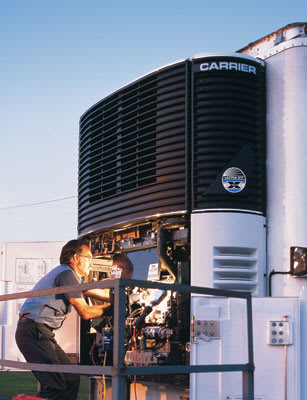
The California Air Resources Board is following through on its promise to clamp down on emissions from reefer diesels
. They're putting out the "unwelcome" sign to units that don't burn cleanly enough. Because so many operators of what CARB calls transport refrigeration units, or TRUs, send rigs into California to deliver goods and pick up produce and other perishables, the new, strict rules will affect most reefers in the U.S., and many in Canada and Mexico.
CARB acted after getting a waiver from the U.S. Environmental Protection Agency that allows California authorities to set reefer standards stricter than those written by the feds, just as CARB has done for years on automotive emissions. Requesting the waiver was CARB's response to a complaint by industry groups that delayed implementation of the new reefer rules by six and a half months. The effective date is now July 17.
(Editor's note: After we went to press with this issue, CARB delayed the implementation date. Low-Emission TRU In-Use Performance Standards for 2001 and older TRU engines -- originally scheduled for this month -- have been delayed until December 31.)
Instead of following EPA's Tier limits for reefer-diesel exhaust, CARB has set phase-out dates for older, existing equipment. Particulates are the main target, but NOx should also be reduced.
Basically, TRUs bought today are good for seven years of operation in California. Those older than seven years must be upgraded. That means that this month, units built for the 2001 model-year or older are banned unless they've been upgraded to meet limits for current engines. On Dec. 31, '02- and earlier-model units are banned unless they're modified, and so on, up to 2013, when the most stringent EPA Tier limits are due.
Compliant TRUs must display decals showing a registration number issued by CARB. Instructions can be found on the Web at www.arb.ca.gov/diesel/tru.htm.) Carrier Transicold and Thermo King also will assist owners with TRU registrations.
There are several ways to meet the new rules:
* Avoid sending non-compliant TRUs into California, or if you're headquartered there, send or sell older equipment outside the state.
* Lease or rent legal TRUs and trailers. Many leasing companies are stocking up on new trailers with CARB-compliant reefers.
* Modify existing TRUs or replace them.
* Use "alternative technologies."
Natural gas fuel, electric standby mode or chemically cooled units would qualify. Natural gas engines are not yet available for reefers, electric-equipped TRUs need a high-voltage socket to plug into and while on the road must still use their diesels, and chemical TRUs are still rare and costly.
Options for modification of non-complying TRUs include:
* Remove the old diesel and install a new compliant engine;
* Install an approved diesel particulate filter on the existing engine's exhaust;
* Install a complete new reefer unit on the existing trailer or truck body; or
* Buy a new reefer unit on a new trailer or truck body.
The older the unit, the less sense it makes to modify it, because the compressor, evaporator and other components aren't as efficient as newer designs. Money spent on a new engine might save some fuel, but a DPF won't pay for itself except that the useful life of the rest of the TRU and vehicle can be extended.
Times being what they are, builders of reefers, trailers and truck bodies would prefer to sell you new equipment. They also have products that are far more efficient, and can equip them with electric standby systems that keep the reefers legal while they're parked at docks. And they might even cut you a deal that's hard to ignore.
From the July 2009 issue of Heavy Duty Trucking.
More Equipment

How Volvo Updated Its D13 for EPA 2027 [Watch]
Volvo’s updated D13 promises lower emissions without sacrificing performance or fuel economy. Take a closer look at what changed inside the engine in this HDT Spotlight video.
Read More →
Michelin Tire Improves Efficiency and Durability for Regional Fleets
The Michelin X Multi Energy D2 is a regional haul drive tire engineered to help fleets improve fuel efficiency, durability and traction in demanding stop-and-go operations.
Read More →
ZF Expands Commercial Vehicle Push in North America
ZF is expanding its North American commercial-vehicle presence with new transmission applications, electrification, trailer technology and autonomous-driving systems.
Read More →
Tesla Wants a Self-Driving Semi. Are Cameras Enough?
Could Tesla’s camera-only autonomous driving technology work on an 80,000-pound Semi? In this commentary, HDT's Deborah Lockridge takes a look at Tesla, Cybercab, and how autonomous trucks see the road.
Read More →
Kodiak: Driverless Long-Haul Truck Launch on Track for 2026
Kodiak AI says its driverless long-haul safety case is 93% complete and it remains on track to begin commercial operations by year-end 2026.
Read More →
What DOT’s Automated Vehicle Strategy Means for Trucking
The U.S. Department of Transportation issued a new automated-vehicle strategy that outlines plans for driverless-truck regulations, cross-state freight corridors, and federal safety standards.
Read More →
East Coast Port Launches $45M Electric Truck Push
The Port Authority of New York and New Jersey announced millions in incentives for zero-emission drayage trucks, yard tractors, and new charging hubs near the port.
Read More →
PlusAI Going Public to Fund Autonomous Truck Launch
A SPAC deal could provide PlusAI with up to $300 million as it works toward a 2027 commercial launch of factory-built autonomous trucks.
Read More →
NHTSA Moves to Rewrite Truck Fuel-Economy Rules
The National Highway Traffic Safety Administration says it lacks authority to regulate medium- and heavy-duty truck engines separately from complete vehicles, but the existing standards have not yet been eliminated.
Read More →
Detroit Opens Orders for EPA 2027 Engines
Detroit isn’t starting from scratch to meet EPA 2027 diesel emissions standards. Its Gen 6 DD13 and DD15 engines keep much of today’s platform while updating the fuel and aftertreatment systems.
Read More →