





HDT's 2023 Truck Fleet Innovator awards are sponsored by East.
Bison's Garth Pitzel on the Carrier's Safety Transformation
Bison Transport has taken home the Truckload Carriers Association safety award for large fleets for 13 years in a row — but go back a couple of decades and you would find a very different safety culture.
May 22, 2023

Credit:
HDT-Canva Image from Bison photos
6 min to read
Some 23 years ago, Bison Transport believed that compliance with safety regulations would indeed make them a safer fleet. But it wasn’t working, says Garth Pitzel, associate vice president of safety and driver development at the Manitoba, Canada-based carrier.
“We’d have a bad year [in] accidents and workplace injuries, and then we’d have a really bad year, and then we’d have a terrible year and then we would have an OK year. If you graphed it, the results were up and down,” he recalls. “We said, ‘We can't live by that. We have to do this differently.’
That was in 2000. Today, Bison has taken home the Truckload Carriers Association Grand Prize fleet safety award for large carrier fleets for 13 years in a row and has won it 16 times overall.
When Bison decided to transform its business and become a company that was both compliant and safe, Pitzel says, “We said we were going to design what we thought was the best safety toolbox a professional driver could have, give them the best and safest equipment, give them the best training and skills development, and give them the best policy to support safe driving.”
For instance, Bison’s “right to decide” policy applies to anyone in the business, not just drivers. “But for our drivers, it’s decide when to drive and when not to. They’re the only ones that can make that decision. I can shut a truck down because they don’t have hours, but at the end of the day, I don't know the condition of the equipment, I don't know the condition of the roads, I don't know the weather — and most importantly, I don’t know the condition of the driver.”
When Pitzel explains the right to decide policy in orientation, he says, “if you ever feel you're being told to drive, when you don’t feel you should drive, ask to be transferred to my cell phone. I'll take that call 24 hours a day, seven days a week. I haven’t had to take that call in many, many years.”
It’s All About People
Shortly after Bison brought home the TCA award, Pitzel says, a driver stopped him to say congratulations.
“And I said, ‘I should be congratulating you. You're the one that does it every mile.’ He said, ‘But you designed it.’ I said, ‘Well, it's a team effort. But you guys and gals are the ones that are supporting it.’ We're fortunate we have 2,200 drivers believing in what we are talking about. And, and that's really what it is about.”
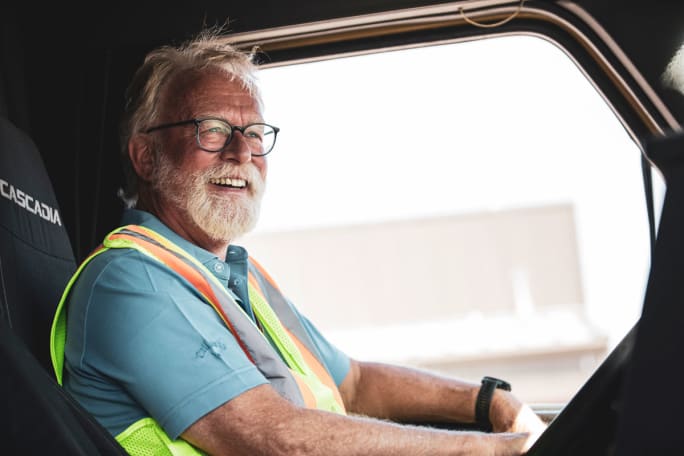
Bison Transport transformed its safety program by focusing on protecting people.
Photo: Bison Transport
How do you get people to believe and support it? “Instead of talking about the protection of our assets, like our truck, trailer, and customers’ freight, we talk about the protection of our people. Yes, we're going to protect all of the assets, but our people are an asset, too, right? So when we talk about safety and security, we're talking about people. To me, that helps the buy-in.
“If I talk to a driver and say, ‘Don’t get into an accident, because you’re going to cost us money, you’re going to tick our customer off because their freight’s not going to get there,’ Or you just say, ‘Your responsibility is to make sure you make it home safely,’ which are they going to believe in? Which are they going to support?”
Pitzel emphasizes that no one person is responsible for the company’s safety achievements, “It’s all of us that that are truly living and breathing this every day. I just get to be the head cheerleader.”
Driver Training
Another change, which Pitzel calls “a fundamental shift,” was paying more attention to the individual needs of each driver when it comes to training.
“Before, we used to paint every driver the same with the same paintbrush, give them the same training and away we went. Well, we don't do that on the office side, so why should we do that on the driver side? If you’re going to invest 10 hours of training into a driver, that could [cover] all their strengths, and you haven’t improved their weaknesses. So the goal all along was to be able to deliver training to the specific needs of each individual driver, and I think that's key.”
A new approach to training also allowed Bison to grow a solid pool of safe, professional drivers.
“Today, 70% of the drivers we hire don't meet our hiring criteria and go through an additional formalized training program through our driver finishing program,” Pitzel says. “The training program has allowed us to bring in drivers that we wouldn’t have necessarily traditionally hired and put them through formalized training programs so that they have the competency levels of that professional driver. Bison Transport wouldn’t necessarily be the company it is or the size that it is, if we didn't take that approach.”
“If the driver has the right attitude and the right aptitude, we can teach them to become a professional driver.”
The Role of Safety Technology at Bison
Safety technology plays an important role as well, Pitzel says, but the company focuses on those that are proactive, not reactive. “We’re not going to put every bell and whistle on our vehicles just for the sake of having it,” he says.
Bison was one of the first adopters of following-distance technology.
“We monitor the heck out of it, because we believe if the driver has time to react to the scenario, they'll be able to react to it. So we spend a lot of time talking about that in our training.”
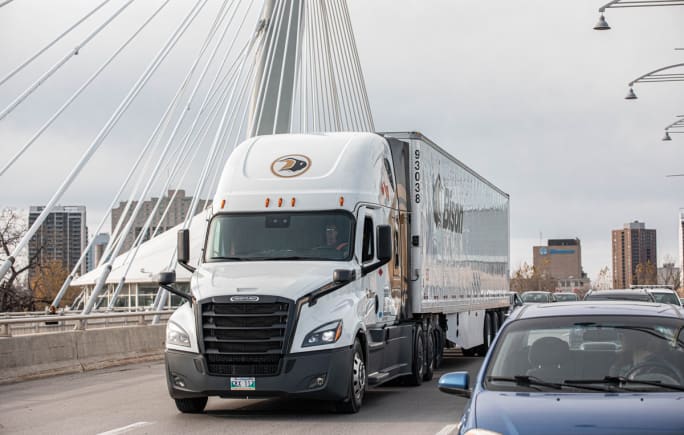
Bison Transport believes in using proactive safety technology.
Photo: Bison Transport
That technology has changed greatly since they first implemented it in 2005, he notes, with active emergency braking and so on.
“And at the end of the day, in theory, that technology should never, ever come into play. If the driver is doing what they're supposed to do, that should never be deployed.”
Bison also is using cameras that monitor drivers’ eyes for distracted driving and fatigue and gives an audible and haptic warning (a vibration in the seat.)
Driver Recruiting and Retention
How does a strong safety program affect driver recruiting and retention?
“In the '90s and early 2000s, our safety program was the number one reason drivers were leaving our business, because we were just focused about compliance,” Pitzel says. “Today, the number one reason that our drivers come to our business because of our safety program.”
So it’s probably not surprising that Bison has a number of awards from the TCA’s Best Fleets to Drive For program, as well.
“As I stated to the audience in the award ceremony, we, the industry, have a moral responsibility to our professional drivers in both nations to ensure that they make it home safely to their families.”
Subscribe to Our Newsletter
More Safety & Compliance
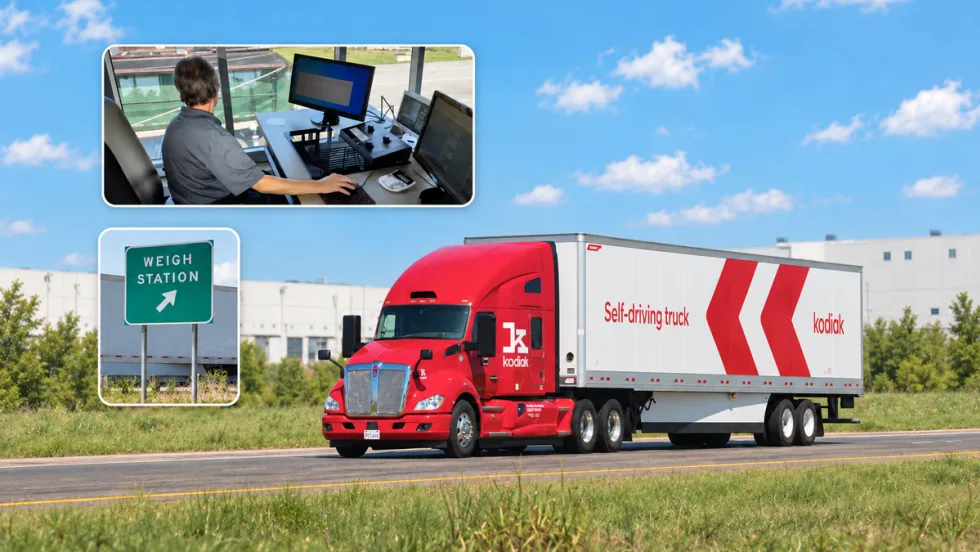
PrePass, Kodiak Connect Driverless Trucks to Roadside Enforcement
The system will allow enforcement agencies to verify Enhanced Inspection information and decide whether Kodiak’s autonomous trucks can bypass roadside screening sites.
Read More →
From One Generation to the Next: How Mentorship Builds Safer Truck Drivers
After three decades in trucking, Harold Perry shares what he's learned about driver safety, mentorship, and helping the next generation build confidence behind the wheel.
Read More →
FMCSA Pauses Biennial-Update Enforcement Amid Motus Transition
Carriers whose updates were due on or after June 1 have more time, while FMCSA works to stabilize its new registration system and warns of phishing sites impersonating its new carrier registration system, Motus.
Read More →
ZF Expands Commercial Vehicle Push in North America
ZF is expanding its North American commercial-vehicle presence with new transmission applications, electrification, trailer technology and autonomous-driving systems.
Read More →
Truck Drivers Need More Than Another Alert
Fleets have more visibility into truck health, safety events, and driver activity than ever. The next challenge is turning all that information into useful guidance for the person who has to decide what to do next.
Read More →
Tesla Wants a Self-Driving Semi. Are Cameras Enough?
Could Tesla’s camera-only autonomous driving technology work on an 80,000-pound Semi? In this commentary, HDT's Deborah Lockridge takes a look at Tesla, Cybercab, and how autonomous trucks see the road.
Read More →
What DOT’s Automated Vehicle Strategy Means for Trucking
The U.S. Department of Transportation issued a new automated-vehicle strategy that outlines plans for driverless-truck regulations, cross-state freight corridors, and federal safety standards.
Read More →
NYC Expands Speed, Pedestrian Safety Tech Across Fleet
New York City is expanding intelligent speed assistance and pedestrian-alert systems across its municipal fleet, moving the technologies from pilot programs into vehicle procurement and retrofit requirements.
Read More →
FMCSA Removes 110 Truck Driver Training Schools from Certified ELDT List
Federal regulators also are targeting more than 160 additional training providers and launching a nationwide audit of third-party CDL skills testers as part of a broader crackdown on trucking fraud.
Read More →
Beyond DOT Compliance: What Makes a Trucking Fleet Truly Safe?
A trucking fleet can follow every rule and still make unsafe decisions. The real test comes when safety conflicts with freight, productivity, or cost.
Read More →