




Becker Trucking Capitalizes on a Happy Workforce
After the 2008 recession, Becker Trucking changed its focus and started hiring drivers more suited to the work it wanted to do - with satisfying results.

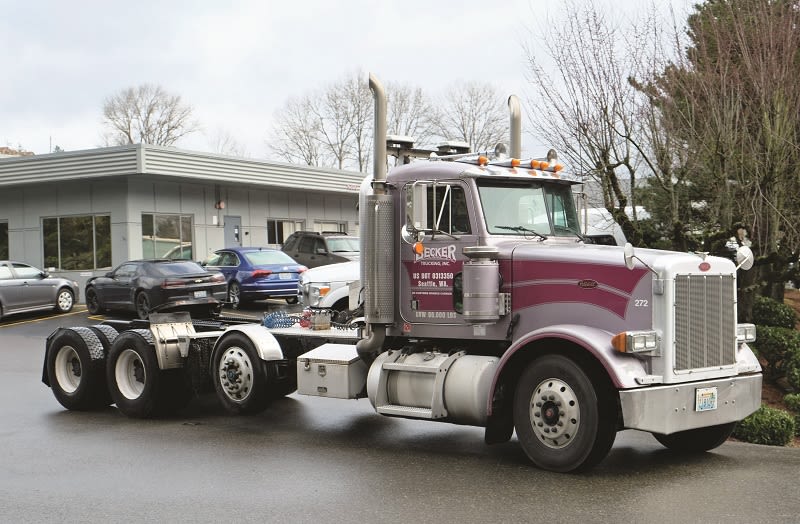
Becker Trucking operates about 50 trucks and 150 trailers, many of which are specialized and high-GVW equipment on dedicated runs.
Photos: Jim Park
When you’re a little fish in a big pond, it pays to be flexible. Becker Trucking of Tukwila, Washington, has been in the less-than-truckload business since 1925, serving points in the Northwest with about 50 trucks running from terminals in Seattle and Portland. It has seen its share of ups and downs over the years, but today it’s enjoying the fruits of several sound business decisions.
The recession of 2008 saw several big LTL players move into the Northwest in search of more volume, depressing rates and idling trucks and drivers. At one point, Becker was leaving about 10% of its trucks parked against the fence on any given day. The interminable recovery didn’t help. Rather than fight to regain market share in the now-crowded LTL market, Becker decided to go after work other companies were having difficulty getting done.
“We made a conscious decision to change what we were doing,” says Terminal Manager Tracy Wilhelm. “As the economy picked up, companies faced shortages of drivers. We had the drivers and the equipment, but the LTL business wasn’t what we needed it to be, so we changed course.”
Becker ramped up its dedicated division and approached companies about delivering their freight with Becker tractors and Becker drivers, and the turnaround was underway. Wilhelm says the mix of work at Becker 10 years ago was 40% LTL, 40% flatbed and 20% dedicated truckload. Today, it’s 10% LTL, 30% flatbed, and 60% dedicated.
Becker has put a lot of effort into recruiting the right drivers for the operation, and it seems to be paying off. The company added drivers last year, while many others struggled to keep those they have.
Becker hires mostly older drivers who are looking for steady work and a respectful environment. The average driver there is probably 45 years or older, Wilhelm says.
“We interviewed lots of drivers last year, and we selected just a few, but we think we hired the right ones for the company,” Wilhelm says. “Our niche is this is a good place to work. We’ll treat you well, you’ll make a good wage, and you won’t hate coming to work. It’s the little personal touches like remembering their kids’ birthdays and not making a big deal about taking time off when the need arises, as it always does with families. I’ve been here 23 years; I don’t think I’m in the top 10 when it comes to years of service.”
The change in direction was a good move for the company. With the big guys slugging it out in a crowded market, Becker Trucking is now eating their lunch because it has the drivers — and happy ones at that.
Fleet Snapshot
Who: Becker Trucking
Where: Tukwila, Washington
Fleet: 50 tractors, 3:1 trailer-to-tractor ratio
Operations: LTL network serving the Northwest from terminals in Seattle and Portland, Oregon. Flatbed and specialty operations and contract haulage.
Fun Fact: Current owner Frank Riordan is president of the Washington Trucking Association.
Challenge: Adapt to a changing marketplace by capitalizing on corporate strengths: a happy and dedicated workforce, operational flexibility, and lean management.
Related: Money Is Not the Only Thing That Speaks to Truck Drivers
More Drivers

Truck Drivers Need More Than Another Alert
Fleets have more visibility into truck health, safety events, and driver activity than ever. The next challenge is turning all that information into useful guidance for the person who has to decide what to do next.
Read More →
FMCSA Removes 110 Truck Driver Training Schools from Certified ELDT List
Federal regulators also are targeting more than 160 additional training providers and launching a nationwide audit of third-party CDL skills testers as part of a broader crackdown on trucking fraud.
Read More →
Hours of Service Pilot Programs: FMCSA Readies for 2027 Rollout
Two pilot programs could eventually reshape hours-of-service rules, giving truck drivers options to pause their 14-hour clock or use longer split sleeper rest periods.
Read More →
Medical Cards, English Proficiency Reshape Roadcheck Violations
Medical-card violations jumped to the top of the driver out-of-service list during CVSA’s 2026 International Roadcheck, while English-language proficiency violations appeared among the leading violations for the first time.
Read More →
Driver Trust Can Make or Break the Success of Fleet Safety Technology
New Teletrac Navman research suggests that onboarding, transparency about driver data, and positive feedback can play a significant role in how commercial drivers respond to safety and coaching technology.
Read More →
EEOC Sues KLLM Over Alleged Sex Discrimination in Driver Training
KLLM is facing a federal sex-discrimination lawsuit over policies the EEOC alleges put female truck driver trainees at a disadvantage.
Read More →
FMCSA Moves to Codify English Language Requirements for Commercial Drivers
By changing regulations on English-language proficiency requirements for commercial drivers, rather than relying on a guidance memo, the FMCSA said future administrations won't be able to walk back the Trump administration's stricter enforcement with just a memo.
Read More →
Drivers Put Western Star Trucks to the Test at Star Nation Experience
Watch to get an inside look at the Western Star trucks, technology, and community behind the Star Nation Experience 2026!
Read More →
Trump Administration Looks to Put More Veterans Behind the Wheel
The Freedom Haulers program pulls together existing and expanded programs at several federal agencies to recruit veterans to drive commercial heavy-duty trucks and cut the red tape for them to get a CDL, training, and employment.
Read More →
Putting Mack’s Command Steer to the Test
A test drive of Mack’s Command Steer active steering system evaluates how it can make truck driving easier and less tiring.
Read More →