





You can dig more deeply into this issue in this article from Laser Focus World.
Are Lidar Lasers for Autonomous Vehicles Safe?
While not proven conclusively, there is some speculation that some lidars could damage camera-based sensors on autonomous vehicle systems or cause eye damage.
March 11, 2021
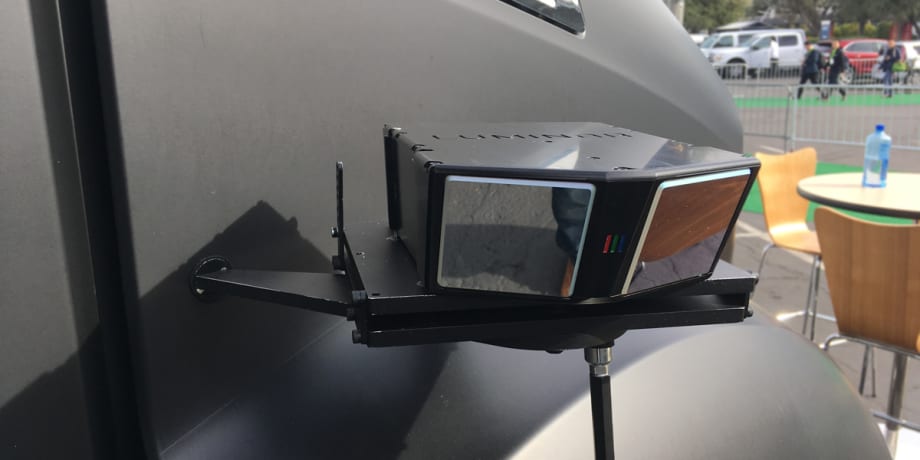
While not proven conclusively, there is some speculation that some lidars could damage camera-based sensors on autonomous vehicle systems or cause eye damage.
Photo: Jim Park
3 min to read
Lidar is a key technology being used in the development of autonomous vehicles. But there are concerns about the potential effects of the lasers it uses on cameras and the human eye.
Lidar, a sort-of acronym for “light detection and ranging,” uses laser beams to sweep across the environment and deduce objects and their distance and speed. Developers of autonomous trucks are using lidar, along with cameras and radar, to allow the vehicles to “see” the world around them.
Automotive lidars fire laser pulses in the near-infrared spectrum to produce a cloud-point representation of the vehicle’s surroundings. The lidar unit measures the time elapsed between the pulse and when the pulse returns to the unit to measure the distance to an object.
However, the lidars used to guide autonomous light-duty vehicles, such as passenger cars, emit light energy with a wavelength of 905 nanometers, which is known to cause eye damage at certain intensities. To prevent eye damage, the U.S. and other countries restrict the 905-nm lidar's power output, which limits its effective range to about 200-300 feet.
While that distance may be suitable for a car operating at 20-30 mph, it's not good enough at highway speeds, where ranges of 600-1,000 feet are needed to identify hazards and provide a safe stopping distance. To overcome that limitation, some lidar companies have turned to a 1,550-nm laser that's said to be 40 times more powerful with a range of up to 1,000 feet. And they’re safer for eyes, as well.
“If lidars use 1,550-nm lasers, the ocular fluid inside the eyeball prevents the laser light from reaching the retina at the back of the eye, which is by far the most sensitive part of the eye,” says Jeff Hecht, a contributing editor at Laser Focus World who has written numerous articles on lasers and vision safety. “The ocular fluid is largely clear at visible wavelengths and out to about 1,300 or 1,400 nm but becomes nearly opaque (think welder's glass) at 1,550 nm.”
A high-power laser emitting 1,550 nanometers could burn the cornea at the front of the eye, but it would not reach the retina, Hecht says. “On the other hand, 905-nm light does reach the retina and could cause eye damage. I wouldn’t want one of those in my car or truck.”
There is also a question about whether the 1,550-nm lasers used in some truck lidar systems can damage some types of camera sensors, particularly those used by robotic vehicles to visualize the world around them.
An incident occurred at the CES electronics show in 2019 in Las Vegas where a camera sensor was reportedly damaged by a 1,550-nm lidar unit, but it was never proven conclusively.
“Camera sensors in general are known to be more susceptible to damage than the human eye,” warns the International Laser Display Association. The group explains on its website that the “extent of damage can vary widely, depending on distance from the source, beam direction and power.”
Several factors could impact a lidar’s effect on nearby cameras, such as the intensity and duration of the pulse. Shorter pulses can measure distance more accurately, but they require higher power intensity, and that can affect camera sensors.
None of this has yet been proven conclusively, but it could have implications for the reliability of camera-based perception systems on autonomous vehicles.
Subscribe to Our Newsletter
More Equipment

How Volvo Updated Its D13 for EPA 2027 [Watch]
Volvo’s updated D13 promises lower emissions without sacrificing performance or fuel economy. Take a closer look at what changed inside the engine in this HDT Spotlight video.
Read More →
Michelin Tire Improves Efficiency and Durability for Regional Fleets
The Michelin X Multi Energy D2 is a regional haul drive tire engineered to help fleets improve fuel efficiency, durability and traction in demanding stop-and-go operations.
Read More →
ZF Expands Commercial Vehicle Push in North America
ZF is expanding its North American commercial-vehicle presence with new transmission applications, electrification, trailer technology and autonomous-driving systems.
Read More →
Tesla Wants a Self-Driving Semi. Are Cameras Enough?
Could Tesla’s camera-only autonomous driving technology work on an 80,000-pound Semi? In this commentary, HDT's Deborah Lockridge takes a look at Tesla, Cybercab, and how autonomous trucks see the road.
Read More →
Kodiak: Driverless Long-Haul Truck Launch on Track for 2026
Kodiak AI says its driverless long-haul safety case is 93% complete and it remains on track to begin commercial operations by year-end 2026.
Read More →
What DOT’s Automated Vehicle Strategy Means for Trucking
The U.S. Department of Transportation issued a new automated-vehicle strategy that outlines plans for driverless-truck regulations, cross-state freight corridors, and federal safety standards.
Read More →
East Coast Port Launches $45M Electric Truck Push
The Port Authority of New York and New Jersey announced millions in incentives for zero-emission drayage trucks, yard tractors, and new charging hubs near the port.
Read More →
PlusAI Going Public to Fund Autonomous Truck Launch
A SPAC deal could provide PlusAI with up to $300 million as it works toward a 2027 commercial launch of factory-built autonomous trucks.
Read More →
NHTSA Moves to Rewrite Truck Fuel-Economy Rules
The National Highway Traffic Safety Administration says it lacks authority to regulate medium- and heavy-duty truck engines separately from complete vehicles, but the existing standards have not yet been eliminated.
Read More →
Detroit Opens Orders for EPA 2027 Engines
Detroit isn’t starting from scratch to meet EPA 2027 diesel emissions standards. Its Gen 6 DD13 and DD15 engines keep much of today’s platform while updating the fuel and aftertreatment systems.
Read More →