




Analysis: Moving Trends Could Shift Freight Patterns
Shifting populations in the U.S. could mean a change where you deliver freight, finds Business Contributing Editor Evan Lockridge.

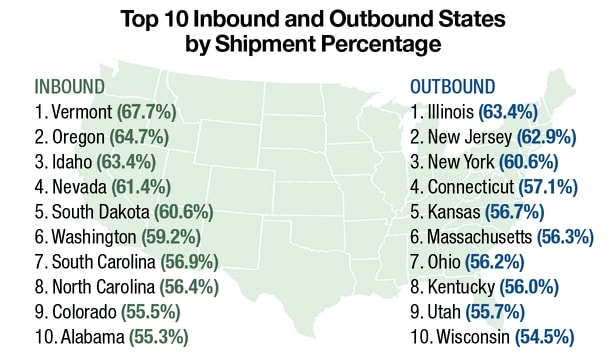
New to the 2017 top inbound list were Colorado and Alabama, while Massachusetts and Wisconsin were new to the outbound list. Source: United Van Lines’ 41st Annual National Movers Study
New to the 2017 top inbound list were Colorado and Alabama, while Massachusetts and Wisconsin were new to the outbound list. Source: United Van Lines’ 41st Annual National Movers Study
Common sense says a shop owner who locates a business where there is a healthy, growing population is more likely to be successful. However, those population patterns are shifting, and it could mean a change in where you deliver freight.
Americans are moving westward, flocking to the Mountain and Pacific West, while the Northeast and Midwest continue to lose residents, according to United Van Lines’ 41st Annual National Movers Study, which has been tracking customers’ state-to-state migration patterns annually since 1977. For 2017, the study is based on household moves handled by United within the 48 contiguous states and Washington, D.C.
The study ranks states based on the inbound and outbound percentages of total moves in each state. United classifies states as “high inbound” if 55% or more of the moves were going into a state, “high outbound” if 55% or more moves were coming out of a state, or “balanced” if the difference between inbound and outbound was negligible.
It found that in 2017, more residents moved out of Illinois than any other state, with 63% of the moves being outbound. Vermont had the highest percentage of inbound migration in 2017, with nearly 68% of moves being inbound.
As a region, the Mountain West continues to increase in popularity, with 54% of moves being inbound. The West is represented on the high-inbound list by Oregon, Idaho, Nevada, Washington, and Colorado.
The southern states also saw a high number of people moving in, with 52% of total moves being inbound.
“This year’s data reflects longer-term trends of movement to the western and southern states, especially to those where housing costs are relatively lower, climates are more temperate, and job growth has been at or above the national average, among other factors,” said Michael Stoll, economist and professor in the Department of Public Policy at the University of California, Los Angeles. “We’re also seeing continued migration to the Pacific Northwest and Mountain West as young professionals and retirees leave California.”
The Mountain West was the most popular destination for retirees, with one in four of those moving indicating they chose to move to this location for retirement. Top regions attracting those taking new jobs included the Midwest and Pacific West.
Even though the South had a high inbound ratio, it was also the region with the largest exodus of residents finding jobs elsewhere. Across all regions, nearly one in five of those who moved in 2017 moved to be closer to family.
The Northeast continues to experience a moving deficit, with New Jersey (62.9% outbound), New York (61%) and Connecticut on the list of top outbound states for the third consecutive year. Illinois (63.4%), which has been in the top five for nine years, moved up one spot on the outbound list to number one, knocking off New Jersey, which had held the top spot for five consecutive years. New additions to the 2017 top outbound list include Massachusetts and Wisconsin.
More Fleet Management

Why Private Fleets Are Taking More Freight
Private fleets are putting their own trucks on demanding customers and high-cost lanes as companies seek greater control over service, costs, and capacity.
Read More →
Color Match Smarter: Tools That Restore & Perform
For fleet managers and collision repair professionals keeping heavy-duty trucks on the road, getting the color right the first time isn't just about appearance — it's about efficiency, turnaround time, and bottom-line results. Discover how today's digital color tools are transforming the repair process from guesswork to precision.
Read More →
FMCSA Pauses Biennial-Update Enforcement Amid Motus Transition
Carriers whose updates were due on or after June 1 have more time, while FMCSA works to stabilize its new registration system and warns of phishing sites impersonating its new carrier registration system, Motus.
Read More →


2026 Blueprint for Countering Smarter Supply Chain Theft
Cargo theft is no longer just the cost of doing business. It's a multi-billion-dollar criminal enterprise exploiting vulnerabilities across your fleet, drivers, and supply chain.
Read More →
How Telematics Improves Visibility, Control, and Performance in Refrigerated Fleets
Explore how telematics help refrigerated fleets improve visibility, uptime, efficiency, compliance, and cargo protection across connected cold chain operations.
Read More →
What the U.S.-Canada Trade War Means for Trucking
Escalating U.S.-Canada tariffs could disrupt cross-border freight, reduce truck volumes, raise costs, and create new uncertainty for carriers on both sides of the border.
Read More →
What Are Trucking’s Top Concerns for 2026?
The American Transportation Research Institute wants to know what's worrying trucking fleet managers, drivers, and other stakeholders in its annual Industry Issues survey.
Read More →
American Trucking Associations Looks for a New Leader
ATA President and CEO Chris Spear abruptly left his job at the association on August 21, at a pivotal time for the trucking industry.
Read More →
Public Wi-Fi Cybersecurity Risks: How Truck Drivers and Fleets Can Protect Their Data
Public Wi-Fi can expose truck drivers and fleets to credential theft, malware, and other cyber threats. Here’s how to reduce the risk on the road.
Read More →
For Nicky Cupp, Fleet Innovation Starts With Frustration
HDT Truck Fleet Innovator Nicky Cupp turns everyday pain points at Fraley & Schilling into opportunities for better technology and smarter processes.
Read More →