




Analysis: Mining for Economic Gold
There are largely overlooked nuggets of information buried in the numbers about the economy and trucking that could be the most telling sign of where conditions are headed, writes Evan Lockridge in his Econ Watch column from the March issue of Heavy Duty Trucking magazine.

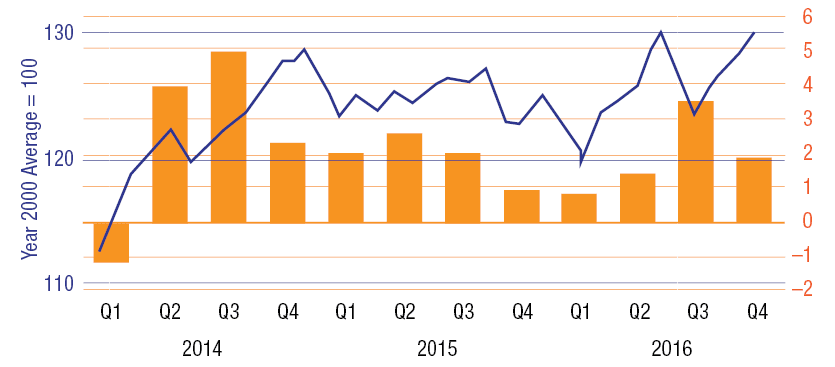
This graph shows the comparative performance of the Transportation Services Index (blue) and Gross Domestic Product (orange) over each quarter in the last three years.
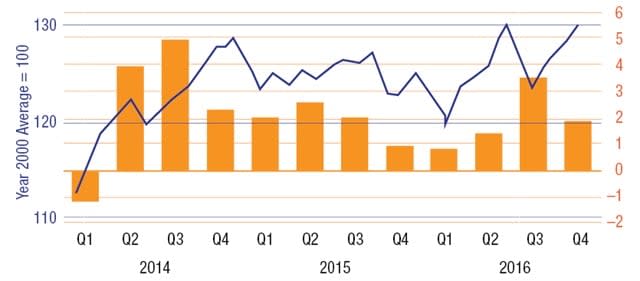
This graph shows the comparative performance of the Transportation Services Index (blue) and Gross Domestic Product (orange) over each quarter in the last three years.
Every once in a while, there are largely overlooked nuggets of information buried in the numbers about the economy and trucking that could be the most telling sign of where conditions are headed. Some of those recent nuggets make it almost impossible not to reasonably hope this year will be a good one.
U.S. for-hire freight movements – including trucking, rail, inland waterways, pipelines and air freight – were up during the fourth quarter of 2016 by 2.9% from the third quarter. It’s a perfect example of how the health of trucking is tied to the overall economy.
This increase in for-hire shipments took place as growth in the gross domestic product – the widest measure of economic activity – slowed to an annual rate of 1.9% in the fourth quarter, down from 3.5% in the third quarter, in the first of three estimates released in late January.
The fourth quarter slowdown in GDP growth was preceded by a third-quarter dip in for-hire freight movement of 1.1%. And the rapid GDP growth in the third quarter was preceded by a strong increase in freight movements in the second quarter of 2.5%.
In other words, when for-hire freight movements are good in any given quarter, like they were in the final quarter of 2016, it helps set the stage for improvements in the GDP for the following quarter, in this case, the first quarter of 2017.
When you consider the fourth-quarter increase in for-hire freight movements was the largest gain since the final quarter of 2011, that’s reason for optimism for first-quarter GDP numbers.
Going the other way, however, GDP doesn’t always tell the whole story when it comes to trucking. Take imports. The National Retail Federation projects U.S. imports will be 4.7% higher in the first half of 2017 than a year earlier. While that means more containers to be moved by truck, imports are subtracted by Uncle Sam when calculating the nation’s GDP, while exports are an addition to the formula. The slower fourth-quarter GDP growth was largely due to increased imports, while exports posted the biggest drop in about two years. That’s why MacKay & Company counts imports as positive in its proprietary measure of economic activity that moves by truck, Truckable Economic Activity. And so far, TEA looks to have gotten off to a strong start this year, according to Robert Dieli, president of economic research and management consulting firm RDLB Inc.
Meanwhile, the NRF is forecasting retail sales, which make up a big component of the GDP, to grow between 3.7% and 4.2% this year over 2016 (minus autos, gasoline and restaurants). Online sales alone could jump as much as 12% year-over-year after posting strong numbers last year. In January, retail sales jumped again, with many analysts saying it bodes well for economic growth later in the year.
There are indications that other parts of the economy are also doing well. The nation’s manufacturing sector in January posted its best performance in around two years. Employment continues increasing, hitting what some economists even consider “full employment.”
And while it’s impossible to ignore that many trucking companies posted disappointing fourth quarter and even full-year 2016 financial results, there was still a lot of money made in trucking last year – it just wasn’t as good as 2015. Several publicly held fleets said in releasing their earnings reports that they believe things are turning for the better this year.
More Fleet Management

Color Match Smarter: Tools That Restore & Perform
For fleet managers and collision repair professionals keeping heavy-duty trucks on the road, getting the color right the first time isn't just about appearance — it's about efficiency, turnaround time, and bottom-line results. Discover how today's digital color tools are transforming the repair process from guesswork to precision.
Read More →
FMCSA Pauses Biennial-Update Enforcement Amid Motus Transition
Carriers whose updates were due on or after June 1 have more time, while FMCSA works to stabilize its new registration system and warns of phishing sites impersonating its new carrier registration system, Motus.
Read More →
2026 Blueprint for Countering Smarter Supply Chain Theft
Cargo theft is no longer just the cost of doing business. It's a multi-billion-dollar criminal enterprise exploiting vulnerabilities across your fleet, drivers, and supply chain.
Read More →


How Telematics Improves Visibility, Control, and Performance in Refrigerated Fleets
Explore how telematics help refrigerated fleets improve visibility, uptime, efficiency, compliance, and cargo protection across connected cold chain operations.
Read More →
What the U.S.-Canada Trade War Means for Trucking
Escalating U.S.-Canada tariffs could disrupt cross-border freight, reduce truck volumes, raise costs, and create new uncertainty for carriers on both sides of the border.
Read More →
What Are Trucking’s Top Concerns for 2026?
The American Transportation Research Institute wants to know what's worrying trucking fleet managers, drivers, and other stakeholders in its annual Industry Issues survey.
Read More →
American Trucking Associations Looks for a New Leader
ATA President and CEO Chris Spear abruptly left his job at the association on August 21, at a pivotal time for the trucking industry.
Read More →
Public Wi-Fi Cybersecurity Risks: How Truck Drivers and Fleets Can Protect Their Data
Public Wi-Fi can expose truck drivers and fleets to credential theft, malware, and other cyber threats. Here’s how to reduce the risk on the road.
Read More →
For Nicky Cupp, Fleet Innovation Starts With Frustration
HDT Truck Fleet Innovator Nicky Cupp turns everyday pain points at Fraley & Schilling into opportunities for better technology and smarter processes.
Read More →
Adam Buttgenbach’s Approach to Electric Trucks: Start With Where They Fit
HDT Truck Fleet Innovator Adam Buttgenbach helped PepsiCo build one of North America’s largest EV fleets by focusing on where electric trucks make operational sense.
Read More →