




Related: For-Hire Freight Movements Rise Again, Tying Record High
Analysis: Freight Rate Thaw May Be in the Works
Data suggests that freight rates for truckload linehaul and intermodal movements may finally be headed higher, after being frozen in lower territory the last couple of years, says Business Contributing Editor Evan Lockridge in his February Hotline column.

Evan Lockridge・Former Business Contributing Editor
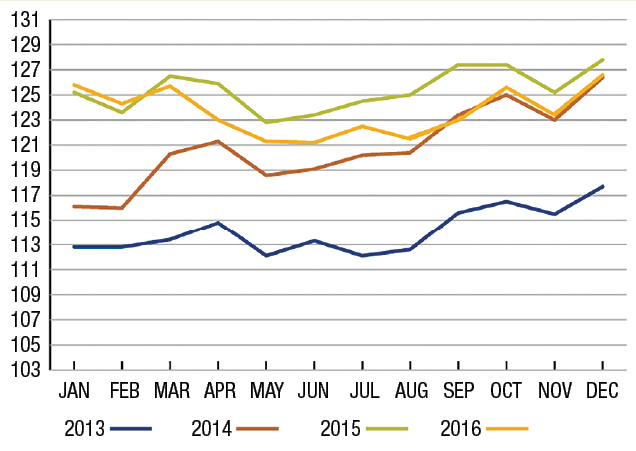
The Cass Truckload Linehaul Index shows while freight rates weren’t as good last year as they were in 2015, they were mostly better than in 2014 and appear to be heading higher this year. Source: Cass Information Systems Inc., and Avondale Partners
3 min to read
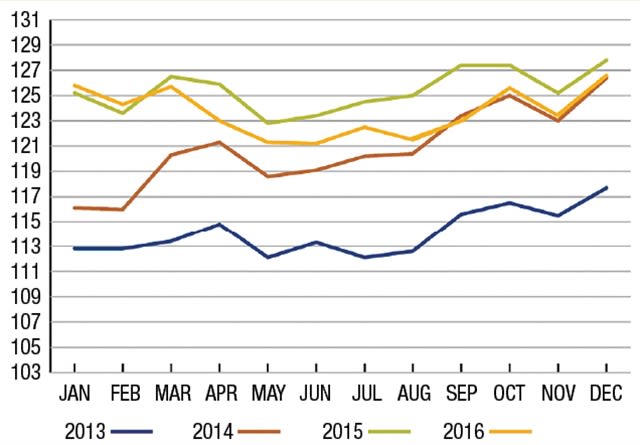
The Cass Truckload Linehaul Index shows while freight rates weren’t as good last year as they were in 2015, they were mostly better than in 2014 and appear to be heading higher this year.Source: Cass Information Systems Inc., and Avondale Partners
There are real hopes that freight rates for truckload linehaul and intermodal movements may finally be headed higher, after being frozen in lower territory the last couple of years.
The most recent Cass Truckload Linehaul Index, which tracks monthly changes in linehaul rates, fell 0.9% in December, marking 10 straight monthly declines. But analysts at the investment firm Avondale Partners said there is cause for optimism.
That’s because the December reading improved 2.6% compared to the month before. That marked the index’s biggest month-over-month gain of 2016 and its highest reading since December 2015.
“The current strength being reported in spot rates is leading us to believe that our current -3% to 1% truckload pricing forecast may need to be improved or moved to a slightly more positive outlook,” Avondale said.
The intermodal sector, which suffered much of last year and the year before, at least compared to 2014, is expected to see some improvements as well. The Cass Intermodal Price Index, which measures changes in total intermodal per-mile costs (including fuel), increased 1.5% in December compared to a year earlier. That’s after rising 0.3% and 0.4% in November and October, respectively, while posting a 2.8% December hike from November. December marked the third consecutive year-over-year gain after 21 straight months of declines.
The good news is Avondale expects intermodal pricing to improve year-over-year until late into 2017. The bad news is pricing isn’t expected to reach the high levels of three years earlier.
On top of this, the Cass Freight Index, which measures monthly expenditures for shipments across multiple modes, was down far less in December compared to much larger declines earlier in the year. That was due to steady increase in fuel prices over the last six months and what Avondale Senior Transportation Analyst Donald Broughton said are “some improvements in the pricing power of truckers and intermodal shippers.”
“If the winter of the overall freight recession we’ve been in for more than a year and a half in the U.S. is not yet over, it is certainly showing promising signs of thawing,” said Broughton.
Broughton and Avondale are not alone in their optimism. American Trucking Associations Chief Economist Bob Costello late last month said he sees “positive signs for truck tonnage.” Although the group reported truck tonnage in December was down 6.2% from the month before, it was up 2.5% for all of last year.
Costello attributed the gain to “continued spending by consumers, larger wage gains, and solid home construction. Factory output will continue to be soft, but it should be better this year than last year. And most importantly, the supply chain continues to make progress reducing bloated inventories, which will help truck volumes going forward.”
Sounding a similar note is DAT Analyst Mark Montague. He has gone so far to say that an 18-month downturn in freight, triggered by the collapse of worldwide oil prices at the end of 2014, is officially over.
While the news indicates that at least initially 2017 won’t be as good as a couple of years earlier, the year still looks promising for trucking and the economy. And that certainly beats the chill in the air the industry felt last year.
Subscribe to Our Newsletter
More Fleet Management

Sponsored•September 16, 2026
Color Match Smarter: Tools That Restore & Perform
For fleet managers and collision repair professionals keeping heavy-duty trucks on the road, getting the color right the first time isn't just about appearance — it's about efficiency, turnaround time, and bottom-line results. Discover how today's digital color tools are transforming the repair process from guesswork to precision.
Read More →
FMCSA Pauses Biennial-Update Enforcement Amid Motus Transition
Carriers whose updates were due on or after June 1 have more time, while FMCSA works to stabilize its new registration system and warns of phishing sites impersonating its new carrier registration system, Motus.
Read More →
Sponsored•September 14, 2026
2026 Blueprint for Countering Smarter Supply Chain Theft
Cargo theft is no longer just the cost of doing business. It's a multi-billion-dollar criminal enterprise exploiting vulnerabilities across your fleet, drivers, and supply chain.
Read More →


Sponsored•September 1, 2026
How Telematics Improves Visibility, Control, and Performance in Refrigerated Fleets
Explore how telematics help refrigerated fleets improve visibility, uptime, efficiency, compliance, and cargo protection across connected cold chain operations.
Read More →
What the U.S.-Canada Trade War Means for Trucking
Escalating U.S.-Canada tariffs could disrupt cross-border freight, reduce truck volumes, raise costs, and create new uncertainty for carriers on both sides of the border.
Read More →
What Are Trucking’s Top Concerns for 2026?
The American Transportation Research Institute wants to know what's worrying trucking fleet managers, drivers, and other stakeholders in its annual Industry Issues survey.
Read More →
American Trucking Associations Looks for a New Leader
ATA President and CEO Chris Spear abruptly left his job at the association on August 21, at a pivotal time for the trucking industry.
Read More →
Public Wi-Fi Cybersecurity Risks: How Truck Drivers and Fleets Can Protect Their Data
Public Wi-Fi can expose truck drivers and fleets to credential theft, malware, and other cyber threats. Here’s how to reduce the risk on the road.
Read More →
For Nicky Cupp, Fleet Innovation Starts With Frustration
HDT Truck Fleet Innovator Nicky Cupp turns everyday pain points at Fraley & Schilling into opportunities for better technology and smarter processes.
Read More →
Adam Buttgenbach’s Approach to Electric Trucks: Start With Where They Fit
HDT Truck Fleet Innovator Adam Buttgenbach helped PepsiCo build one of North America’s largest EV fleets by focusing on where electric trucks make operational sense.
Read More →