




An Eastern Star?
Amidst endless chatter about electric power and even fuel cells, the good old internal combustion engine clearly isn't going away any time soon
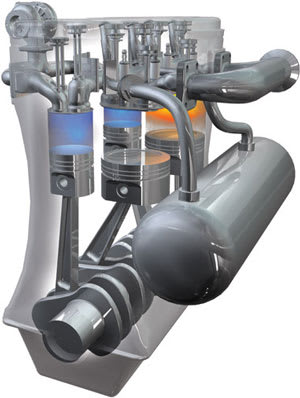
Amidst endless chatter about electric power and even fuel cells, the good old internal combustion engine clearly isn't going away any time soon.
I refer you to the flurry of new engine designs we've seen lately. In my archly humble opinion, one of the most interesting is a split-cycle motor coming out of the Scuderi Group in West Springfield, Mass. The company is a seemingly well-funded development outfit that's intent on re-engineering the conventional four-stroke engine. Its global patent portfolio contains more than 476 patent applications filed and 154 issued in 50 countries.
And its SSC motor, the Scuderi Split Cycle, is even more intriguing now that it's achieved a 35 percent fuel-consumption decrease in a Nissan Sentra in an elaborate computer simulation. That testing was done by an independent third party, Scuderi Group boss Sal Scuderi tells me, using proper, accepted protocols.
His sights aren't set only on little cars, I hasten to add, and the engine design can just as easily have heavy-duty applications running diesel and other fuels. The company hasn't done those simulations yet, but they're coming. Scuderi's plan is not to manufacture engines, by the way, rather to license his technology. So far, interest has come mainly from the four-wheel world. Only one truck maker -- unnamed, but not North American -- has sniffed around.
So how does the motor work? Well, start thinking Miller cycle, a long accepted design that leaves the intake valve open longer than in the conventional four-stroke 'Otto' cycle engine that we know and love. You end up with what's almost a fifth stroke because the compression stroke really happens in two cycles. A Miller cycle engine needs a supercharger, I believe.
Scuderi calls his split cycle variation on that theme "the perfect Miller-cycle engine", though there's no fifth stroke. Last month he presented two technical papers on his split-cycle motor and its valve-control system at the SAE Congress in Detroit.
The basic idea here is simple enough -- it's really all about firing after top dead center, not precisely at top dead center -- a radical approach that's been hard to achieve, Scuderi told me in a phone interview a few weeks back. He's done it, however, and has discovered that adding a turbocharger to his engine works great. That's the latest breakthrough.
He quotes studies that show boosting the engine with a turbocharger decreases the BSFC (brake-specific fuel consumption) up to 14 percent while a simultaneous increase occurs in the engine's power BMEP (or brake mean effective pressure) by 140 percent. At the same time, he says, the engine can be reduced in size by just under 30 percent.
Like conventional four-stroke designs, the combustion cycle of the Scuderi engine has two high-pressure strokes -- compression and power -- and two low-pressure strokes -- intake and exhaust. The power stroke is positive work, Scuderi explains, or the energy that's produced by the expanding gases to create mechanical work. The intake, compression and exhaust strokes are all negative work, or the energy that the engine consumes in the process. By separating the compression cylinder from the power cylinder and by using a standard turbocharger to convert recovered exhaust-gas energy into compressed air energy, the size of the compression cylinder can be downsized to achieve substantial reductions in negative compression work.
"The Scuderi Engine gains a massive advantage from turbocharging, Miller-like valve-control strategies, and extended expansion that is simply not possible with conventional engine designs," says Scuderi. "The net result is a smaller, higher-performing engine that yields significant gains in volumetric efficiency and power as well as reducing BSFC."
The Scuderi engine divides the four strokes of a combustion cycle between two paired cylinders -- the left cylinder functions as an air compressor, handling intake and compression, while the right cylinder handles combustion and exhaust. Key to Scuderi's split-cycle design is that it compresses the air before it fires. By optimizing the split-cycle concept, the engine when fully developed will reduce NOx emissions up to 80 percent and improve fuel efficiency by as much 50 percent compared to a conventional gasoline engine. The engine requires one crankshaft revolution to complete a single combustion cycle and is projected to have higher torque, better thermodynamic efficiency and lower emissions than what is possible with today's engines.
Scuderi says he'll provide more details on the Nissan Sentra Study at the Engine Expo 2011 in Stuttgart, Germany, May 17-19.
Here's a video explaining the Scuderi basics:
For more information: www.ScuderiEngine.com
To listen to an audio podcast of Sal Scuderi discussing the recent lab breakthrough visit: www.scuderiengine.com/turbocharging
To hear the first prototype running visit:
www.youtube.com
More Equipment

ZF Expands Commercial Vehicle Push in North America
ZF is expanding its North American commercial-vehicle presence with new transmission applications, electrification, trailer technology and autonomous-driving systems.
Read More →
Tesla Wants a Self-Driving Semi. Are Cameras Enough?
Could Tesla’s camera-only autonomous driving technology work on an 80,000-pound Semi? In this commentary, HDT's Deborah Lockridge takes a look at Tesla, Cybercab, and how autonomous trucks see the road.
Read More →
Kodiak: Driverless Long-Haul Truck Launch on Track for 2026
Kodiak AI says its driverless long-haul safety case is 93% complete and it remains on track to begin commercial operations by year-end 2026.
Read More →
What DOT’s Automated Vehicle Strategy Means for Trucking
The U.S. Department of Transportation issued a new automated-vehicle strategy that outlines plans for driverless-truck regulations, cross-state freight corridors, and federal safety standards.
Read More →
East Coast Port Launches $45M Electric Truck Push
The Port Authority of New York and New Jersey announced millions in incentives for zero-emission drayage trucks, yard tractors, and new charging hubs near the port.
Read More →
PlusAI Going Public to Fund Autonomous Truck Launch
A SPAC deal could provide PlusAI with up to $300 million as it works toward a 2027 commercial launch of factory-built autonomous trucks.
Read More →
NHTSA Moves to Rewrite Truck Fuel-Economy Rules
The National Highway Traffic Safety Administration says it lacks authority to regulate medium- and heavy-duty truck engines separately from complete vehicles, but the existing standards have not yet been eliminated.
Read More →
Detroit Opens Orders for EPA 2027 Engines
Detroit isn’t starting from scratch to meet EPA 2027 diesel emissions standards. Its Gen 6 DD13 and DD15 engines keep much of today’s platform while updating the fuel and aftertreatment systems.
Read More →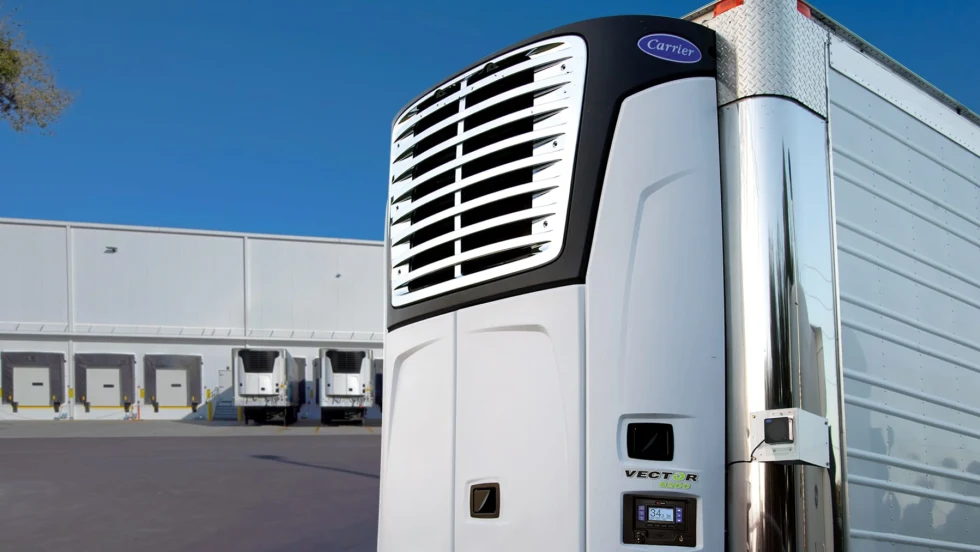
Carrier Transicold Adds All-Electric TRU for Stationary Cold Storage
Carrier Transicold’s new Vector 8200 all-electric transport refrigeration unit gives fleets a diesel-free option for temporary refrigerated and frozen trailer storage.
Read More →
A Closer Look at Kenworth’s Electric T880E Vocational Truck [Video]
Learn more about Kenworth's T880E battery-electric vocational truck at the Paccar Technical Center, including its range, applications, upfitting considerations, and PTO options, in this HDT Spotlight video.
Read More →