




An All-Too-Common Conflict
Successful trucking depends on successful relationships - in every corner of our game. Nowhere is this more true than in the hyper-difficult connection between drivers and dispatchers

Successful trucking depends on successful relationships - in every corner of our game. Nowhere is this more true than in the hyper-difficult connection between drivers and dispatchers.
It's a toss-up as to which job is tougher, but I think they both rank at the top of the list.
There are countless scenarios where conflict is possible, but the one most fraught with potential for long-lasting friction arises when the driver is caught between the priorities of the safety department and dispatch, or the shop and dispatch.
Here's an example - a true story:
In a major snowstorm, driver Bob has just finished unloading. It's mid-afternoon Friday and he's sitting in the truck dealing with a bit of paperwork, wondering if he should just park it in the customer's yard for a spell. The weather's that bad.
The snow's falling hard but it's cozy in the cab. Bob hauls out his Thermos and pours himself a mug of coffee, then digs around for the last of the cookies his wife made for him. He'd like to be home early tonight after a few days on the road, and the terminal's only 50 miles away. But he's got hours and he could use the miles, so he plans on calling dispatch to see if there's a local load.
Then he gets a sat message: "ET, come home." The safety manager says the storm's bad and anybody in the region should park it or head home if it's close.
Seconds later dispatch sends him a pickup, 80 miles in the wrong direction. Oh, crap.
"These guys aren't talking to one another," Bob mutters to himself. "What the heck do I do now?"
His well-honed instincts say it's time to forget trucking today, but he fears the dispatcher will call him a wuss. Worse, he might hold a grudge.
The thing is, Bob and John have never tried to build any sort of relationship. Neither guy has invested anything, so there's no foundation of good will to get them through this thing. Same goes for John and the safety dude. Nobody knows or understands anybody else.
In the end Bob says the weather's too bad to go trucking, pointing out the safety message, so he trundles back to the terminal and then on home. There's a bad taste in his mouth and John sits at his keyboard fuming. Nobody's happy.
Bob left the company two weeks later in the wake of a permanently soured relationship. A valuable, experienced driver was lost - all because it wasn't clear who really had control that snowy Friday afternoon, safety or dispatch.
Is there a solution to this most common of problems? Probably not in any hard and fast way, people being people, but one thing's for sure: As an owner or manager, you can't sit back and simply hope your staff know what to do when such situations arise.
Chances are, internal systems and policies are the place to start. Maybe they don't exist, maybe they're ignored, maybe they're not supported by the people in the cushy offices.
At the very least I think you need to make a weather policy and stand by it. You might also change things a little -- or maybe a lot -- to establish clear lines of communication between the various players working at the sharp end. The secret is to take the doubt away as much as you can, make the decisions automatic, impersonal, and there for all to see.
You'll sail much more smoothly if you do.
From the February 2012 issue of HDT.
More Fleet Management

How Telematics Improves Visibility, Control, and Performance in Refrigerated Fleets
Explore how telematics help refrigerated fleets improve visibility, uptime, efficiency, compliance, and cargo protection across connected cold chain operations.
Read More →
What the U.S.-Canada Trade War Means for Trucking
Escalating U.S.-Canada tariffs could disrupt cross-border freight, reduce truck volumes, raise costs, and create new uncertainty for carriers on both sides of the border.
Read More →
What Are Trucking’s Top Concerns for 2026?
The American Transportation Research Institute wants to know what's worrying trucking fleet managers, drivers, and other stakeholders in its annual Industry Issues survey.
Read More →

American Trucking Associations Looks for a New Leader
ATA President and CEO Chris Spear abruptly left his job at the association on August 21, at a pivotal time for the trucking industry.
Read More →
Public Wi-Fi Cybersecurity Risks: How Truck Drivers and Fleets Can Protect Their Data
Public Wi-Fi can expose truck drivers and fleets to credential theft, malware, and other cyber threats. Here’s how to reduce the risk on the road.
Read More →
For Nicky Cupp, Fleet Innovation Starts With Frustration
HDT Truck Fleet Innovator Nicky Cupp turns everyday pain points at Fraley & Schilling into opportunities for better technology and smarter processes.
Read More →
Adam Buttgenbach’s Approach to Electric Trucks: Start With Where They Fit
HDT Truck Fleet Innovator Adam Buttgenbach helped PepsiCo build one of North America’s largest EV fleets by focusing on where electric trucks make operational sense.
Read More →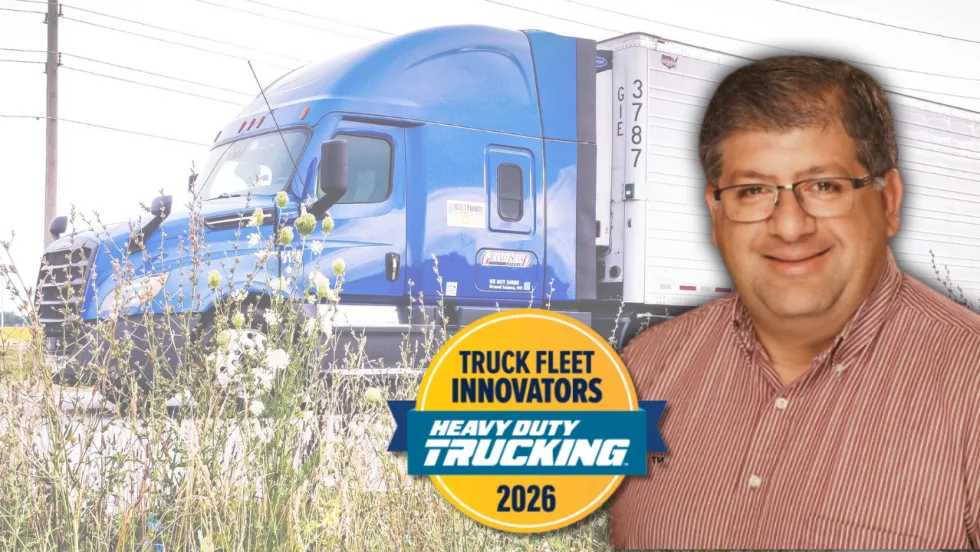
Deen Albert: Let Automation Do the Math, People Make the Decisions
HDT Truck Fleet Innovator Deen Albert makes sure people are still at the heart of operations at Grand Island Express, even while adopting artificial intelligence tools. AI-assisted dispatch helped boost revenue 25% with the same number of trucks.
Read More →
Trimble’s New AI Agent Takes Aim at Fleet Back-Office Busywork
Arc Agent works across Trimble TMS products to automate repetitive tasks such as freight orders, maintenance, invoices, fuel costs and more.
Read More →
How HDT’s 2026 Truck Fleet Innovators Are Rethinking Fleet Operations
Meet five trucking leaders who are challenging assumptions, solving operational problems, and putting innovative ideas to work.
Read More →