




5 Tips to Prevent Wheel Separation
Research into past incidents shows inadequate maintenance is the root cause of most wheel separation incidents.

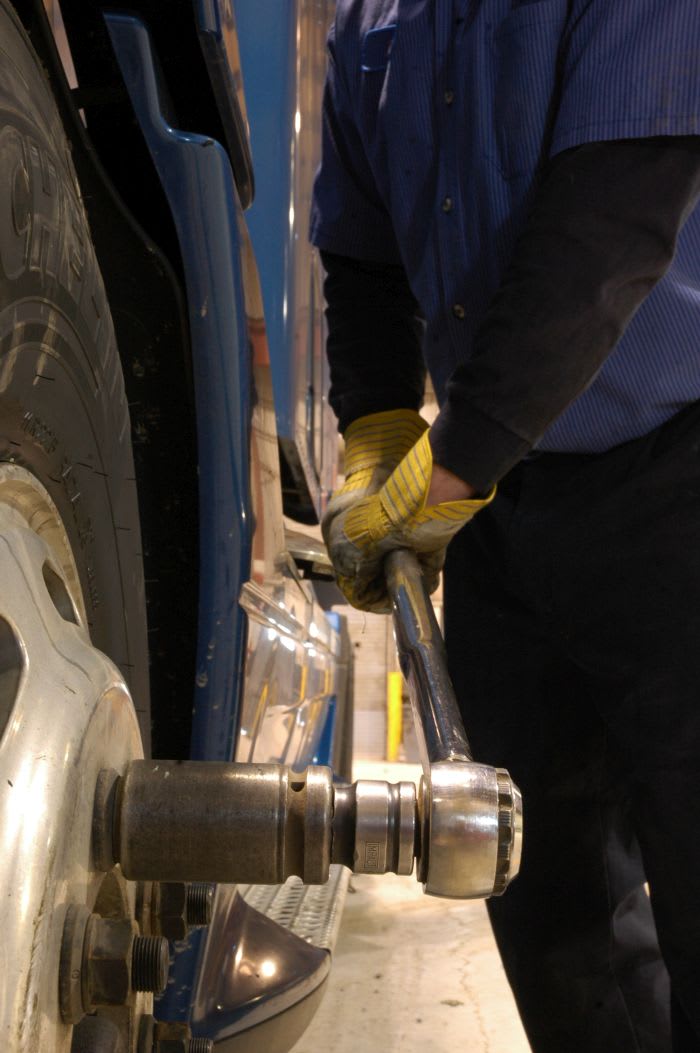
Impact wrenches are fine for running wheel nuts up onto the studs, but a torque wrench must be used to set the nuts. Retorquing is highly recommended, but few, apparently, get around to it. Photos: Jim Park
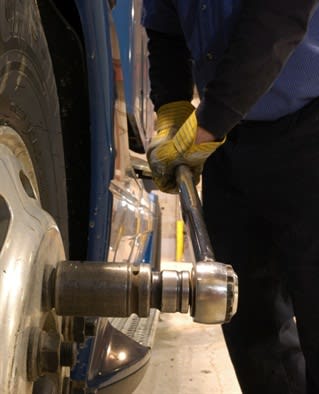
Impact wrenches are fine for running wheel nuts up onto the studs, but a torque wrench must be used to set the nuts. Retorquing is highly recommended, but few, apparently, get around to it. Photos: Jim Park
Keeping your wheels where they belong is simply a matter of process. Manufacturers issue procedure manuals and update bulletins all the time. The American Trucking Associations’ Technology & Maintenance Council has several Recommended Practices related to wheel ends and preventing wheel separation.
Yet wheels manage to part company with their trucks at an estimated rate of two or three per day across the country.
Here are five reminders of what needs to be done when servicing truck tires and wheels to ensure they do not separate from the truck.
1. Bearing installation and adjustment
With several types of wheel bearing and hub systems on the market, it’s imperative that technicians use correct procedures for the system in question. TMC’s RP 618A, “Wheel Bearing Adjustment Procedures,” speaks to these differences, and provides guidelines for manual bearing adjustment, which list an acceptable bearing end-play of anywhere between .001” and .005”.
Bearing manufacturer Timken strongly suggests establishing accurate and repeatable wheel bearing installation/adjustment procedures to ensure consistency across the fleet. In its Commercial Vehicle Tech Tips guide on bearing adjustment, it emphasizes the use of dial indicators to verify adjustment — as does bearing maker SKF and TMC’s RP 618A. But according to several industry sources, that part of RP 816A’s nine-step adjustment procedures is often left out, despite being one of the most critical parts of the process.
“That’s a recommendation for an ideal situation,” admits SKF National Sales Manager John Heffernan. “Getting techs to use torque wenches was a huge step for the industry. Use of dial indicators is growing and more fleets are adopting the practice, but we still have a long way to go.”
Additionally, Heffernan says techs often incorrectly install pre-set or LMS type hub systems, torquing the nut down and then backing it off, as they would when installing conventional single-or double-nut systems.
“That can damage the spacer and the bearings,” he says. “Fleets should work with the techs to ensure they understand how to install the various types of wheel end systems they use.”
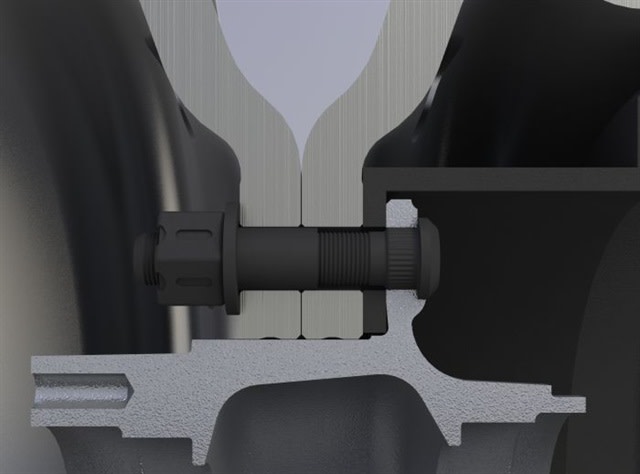
Mating surfaces between the hub and the wheel discs must be thoroughly cleaned of rust and debris to prevent loss of clamping force should the foreign material become displaced.
2. Wheel and hub preparation
Before you even think about putting the wheel back on the truck, the contact surfaces between the hub and the inner and outer wheels must be absolutely free of dirt, rust, grease and other contaminants.
“A buildup of foreign material on the wheel end mounting surfaces causes extra thickness in the joint,” explains Brandon Uzarek, Accuride’s field engineer for wheels. “The foreign material may settle or work its way out of the joint, causing the tension in the bolt to decrease, resulting in a loss of clamping force.”
Extra care is needed with painted steel wheels. For one thing, rust can develop under the paint if the finish is broken, causing flaking. This material can drop out over time, reducing the clamping force. The coating thickness on a painted wheel is important, too, as coatings thicker than 3-3.5 mils can affect the mounting surfaces and between the bolt holes.
“Excessive coating thickness can lead to a loss of clamping force and eventually loose nuts and possibly a wheel loss,” cautions Jeff Redding, national equipment and coatings manager at wheel refinisher IMI.
The contact areas must be rigorously cleaned with a wire brush to remove all foreign material before mounting the wheel. Wheel studs should cleaned with a wire brush as well to rid the thread grooves of rust and foreign material that can affect the torque on the nut.
3. Proper fastener torque
Tighter is not better. Many technicians try to achieve maximum clamping force by applying more than 500 ft-lbs. of torque without realizing the possible consequences.
“If a wheel stud is subjected to excessive torque, it is possible to stretch the stud past its yield point,” cautions Uzarek. “If this occurs, the joint will act as if it is under-torqued and there will be low clamping force.”
The best way to avoid this condition is to snug the nuts and then bring them up to their final torque with a calibrated torquing device. “Impact guns are not recommended,” Uzarek stresses.
TMC’s RP 237A, “Torque Checking Guidelines for Disc Wheels,” shows torque fastener recommendations ranging from 300 to 900 ft-lbs., depending on the wheel type, fastener and procedure. There is no one-size-fits-all here. Refer to this RP for proper torque ratings and procedures or consult with the manufacturer.
“Torque is critical due to the fact the stud stretches like a spring,” notes J. David Walters, manager of warranty and field service at Alcoa. “If the correct torque is not applied you will not get the correct clamp load. Over torque is the most common [mistake] in the industry.”
4. Re-using previously installed components
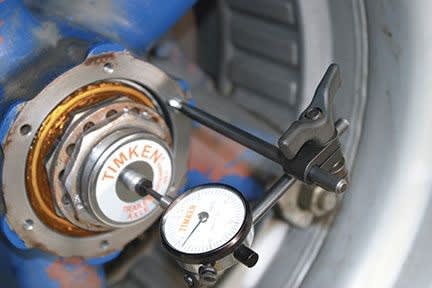
Most everyone close to wheel and bearing installation and adjustment advocate the use of dial indicators to measure correct bearing endplay.
Some wheel-end parts can be re-used — provided they are thoroughly inspected and still in good condition and within spec. Studs and nuts can be reused as long as there’s no evidence of thread damage or stretching of the stud due to over-torquing. A couple of drops of oil on a clean stud and between the nut and the flange can help with restoring torquability to new condition. Bearings, however, require special attention.
“Bearings should be examined for drag on the rollers and the overall condition of the bearing assembly,” says Heffernan. “Even the tiniest burr on a bearing roller can cause havoc with the mating surfaces.”
The bolted joint will not stay new forever, especially with environmental factors that add dirt, debris, and corrosion to the wheel end, warns Uzarek.
“When the wheel end condition deteriorates, the clamping force drops and eventually the nuts, bolts, and other components will have to be replaced,” he says.
5. Daily inspections
Drivers and maintenance staff have a role to play here, and need to be trained how to keep a watchful eye out for developing problems.
For example, lubricant leaking from an inner wheel seal leaves oily streaks on the inside of the inner tire. This is a sign if lubricant loss that can lead to overheated and failed bearings.
“During visual inspection, drivers and maintenance personnel should keep an eye out for abnormal tire wear, evidence of lubrication leaks and lubricant contamination,” says Erik Binns, segment business leader for wheel end engineered products at Stemco. “Hubcap window discoloration and gasket striation associated with high temperature operation should also be noted.”
Missing oil caps on the hub caps can allow contamination into the bearings, water, sand, etc., which can lead to bearing failure.
Fastener tightness cannot be verified without proper tools, but drivers can look for tell-tale signs a fastener may be coming loose, such as rivulets of rust extending outward from a wheel stud, or signs of slippage on the wheel around the flange nut.
Inexpensive nut position indicators are available that show the position of the nut relative to an adjacent nut. Movement of the indicator warns that a nut is coming loose.
Drivers should physically touch the hubs to get a sense of how hot they are running. Warm to the touch is normal. Hot to the touch means something is wrong.
And one final note: Retorquing the wheel somewhere between 10 and 100 miles after wheel service is performed is critically important, but probably the least observed off all these wheel installation procedures.
And that’s how you keep your wheels where they belong.
More Safety & Compliance

From One Generation to the Next: How Mentorship Builds Safer Truck Drivers
After three decades in trucking, Harold Perry shares what he's learned about driver safety, mentorship, and helping the next generation build confidence behind the wheel.
Read More →
FMCSA Pauses Biennial-Update Enforcement Amid Motus Transition
Carriers whose updates were due on or after June 1 have more time, while FMCSA works to stabilize its new registration system and warns of phishing sites impersonating its new carrier registration system, Motus.
Read More →
ZF Expands Commercial Vehicle Push in North America
ZF is expanding its North American commercial-vehicle presence with new transmission applications, electrification, trailer technology and autonomous-driving systems.
Read More →
Truck Drivers Need More Than Another Alert
Fleets have more visibility into truck health, safety events, and driver activity than ever. The next challenge is turning all that information into useful guidance for the person who has to decide what to do next.
Read More →
Tesla Wants a Self-Driving Semi. Are Cameras Enough?
Could Tesla’s camera-only autonomous driving technology work on an 80,000-pound Semi? In this commentary, HDT's Deborah Lockridge takes a look at Tesla, Cybercab, and how autonomous trucks see the road.
Read More →
What DOT’s Automated Vehicle Strategy Means for Trucking
The U.S. Department of Transportation issued a new automated-vehicle strategy that outlines plans for driverless-truck regulations, cross-state freight corridors, and federal safety standards.
Read More →
NYC Expands Speed, Pedestrian Safety Tech Across Fleet
New York City is expanding intelligent speed assistance and pedestrian-alert systems across its municipal fleet, moving the technologies from pilot programs into vehicle procurement and retrofit requirements.
Read More →
FMCSA Removes 110 Truck Driver Training Schools from Certified ELDT List
Federal regulators also are targeting more than 160 additional training providers and launching a nationwide audit of third-party CDL skills testers as part of a broader crackdown on trucking fraud.
Read More →
Beyond DOT Compliance: What Makes a Trucking Fleet Truly Safe?
A trucking fleet can follow every rule and still make unsafe decisions. The real test comes when safety conflicts with freight, productivity, or cost.
Read More →
Hours of Service Pilot Programs: FMCSA Readies for 2027 Rollout
Two pilot programs could eventually reshape hours-of-service rules, giving truck drivers options to pause their 14-hour clock or use longer split sleeper rest periods.
Read More →