




5 Enforcement Metrics Fleets Should Monitor
Find out which five safety enforcement metrics your trucking fleet must track on a routine basis.

Find out which five safety metrics your fleet must track on a routine basis.
Image: HDT Graphic
There's no shortage of ways motor carriers can find themselves sideways with the Federal Motor Carrier Safety Administration, the federal agency that regulates interstate highway transportation.
Serious accidents, driver complaints, and violations from roadside inspections are just a few things that can trigger an FMCSA audit. Bad audits can have serious consequences, and poor safety performance is often the driving force in nuclear verdicts against motor carriers after a serious accident.
Inexplicably, many carriers do not track the key safety metrics used by:
- the FMCSA to prioritize carrier for an audit,
- the plaintiff's bar to paint carriers as bad actors, and
- some shippers and brokers to select their carrier partners.
Most of these metrics are publicly available for all to see and offer detailed insight into a carrier's compliance (or lack thereof) with federal and state safety regulations. What follows is a list of the top 5 metrics every motor carrier should be tracking on a routine basis.
1. Inspection Selection System (ISS)
The Inspection Selection System or ISS program is one the FMCSA and its state law enforcement partners use to target motor carriers' vehicles for roadside inspections. In essence, the ISS dictates how frequently a carriers' vehicles will be stopped for roadside inspections.
The ISS scores carriers from 1 to 100, depending on their safety performance data such as roadside inspection violations. Carriers who perform poorly from a safety perspective will have a higher ISS score.
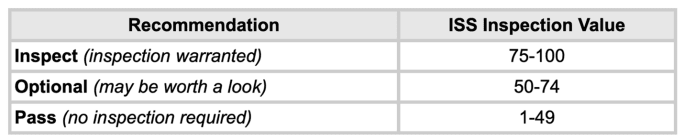
Those with a score of between 75 and 100 are placed in the mandatory "inspect" category, meaning that law enforcement is encouraged to conduct roadside inspections of any vehicle bearing that carrier's USDOT number whenever possible, regardless of whether any unlawful behavior is observed roadside.
Carriers with a score of between 50 and 74 are placed in the "optional" category, leaving it up to law enforcement whether to conduct roadside inspections or not. And carriers with a score of between 1 and 49 are in the "pass" category, meaning the law enforcement need not conduct a roadside inspection of the carrier's vehicles unless they physically observe unlawful behavior.
Because ISS scores dictate the frequency at which a carriers’ vehicles and drivers are stopped for inspection, they can have a tremendous impact on productivity/
Source: FMCSA
Because ISS scores dictate the frequency at which a carriers’ vehicles and drivers are stopped for inspection, they can have a tremendous impact on productivity. If for no other reason than this, it’s important that carriers regularly check their ISS scores and work to improve them. ISS scores are available through the carrier’s FMCSA portal and Safety Measurement System (SMS) accounts.
ISS scores are tied very closely to SMS scores, and carriers can generally improve both through better roadside performance (e.g. fewer violations from roadside inspections). The full ISS scoring methodology is available.
2. Accident Rate
Motor carriers should also track accident rate, which is expressed as the number of DOT-recordable accidents the carrier has incurred per million miles traveled.
A carrier's accident rate is important because the FMCSA considers it — along with any violations discovered — during a compliance review to calculate the carrier's safety rating. The industry average accident rate for most carriers is 0.74 accidents per million miles. According to the FMCSA's safety rating methodology, a carrier with an accident rate of more than 1.5 accidents per million miles (for non-urban carriers) or 1.7 accidents per million miles (for urban carriers) over the course of a 12-month period will fail that portion of the audit, which could lead to a downgraded safety rating.

Brandon Wiseman
To calculate a carrier's accident rate, the FMCSA will compare the number of DOT-recordable accidents reported by the carrier on its accident register for the past 12 months to the mileage its fleet has traveled over that same time period, which is typically listed on the carrier's biennial MCS-150 filing.
By way of example, if a carrier had four recordable accidents in 2019 and traveled a total of 2 million miles that year, its accident rate would be two accidents per million miles, which would cause it to fail the accident portion of an audit if it were selected for one.
Carriers can improve their accident rate one of two ways: increase their mileage and/or decrease their accident frequency. To this end, carriers should familiarize themselves with the FMCSA's Crash Preventability Demonstration Program and should petition to remove from their account any accidents that are non-preventable on their drivers' part. Doing so, and keeping their mileage up to date, will help improve their accident rate.
3. Out-of-Service (OOS) Rates
Another critical metric carriers should be watching are vehicle and driver out-of-service rates. These rates, which are publicly available on each carrier’s SAFER profile, indicate how frequently a carrier’s vehicles and drivers are being placed out-of-service (i.e., prohibited from operating) for serious violations during roadside inspections.
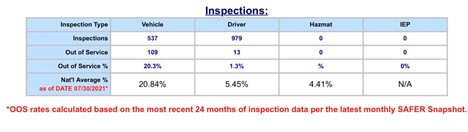
Sample of OOS data.
Source: FMCSA
The SAFER system displays carrier out-of-service rates next to the applicable industry averages. Higher-than-average OOS rates can lead to FMCSA audits and lost business.
The key to improving OOS rates is to minimize significant roadside violations. The Commercial Vehicle Safety Alliance publishes its out-of-service criteria each year, which dictates the types of violations that will result in drivers or vehicles being placed OOS. Common examples include operating without a CDL when one is required and defective lighting devices.
4. Safety Measurement System (SMS)
Since 2010, the FMCSA has used its Compliance, Safety, Accountability system to prioritize federally regulated motor carriers for enforcement action. The Safety Measurement System (SMS) is one major component of CSA, which ranks carriers against their peers in seven categories known as the BASICs.
A carrier’s CSA/SMS scores are primarily a function of the number, type, and severity of regulatory violations uncovered during roadside inspections and/or compliance reviews. Carriers that perform worse than a certain percentage (e.g. 65%) of their peers in the BASIC categories are placed higher on FMCSA’s prioritization list and are more likely to receive warning letters, fines, and compliance reviews.
For this reason—and because poor SMS scores can also lead to increased insurance premiums and loss of business—it is imperative that carriers understand how their scores are calculated and consistently monitor and work to improve them. The agency’s SMS methodology is available.
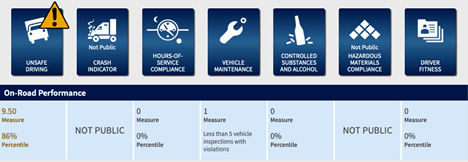
Sample of SMS scores.
Source: FMCSA
5. Safety Fitness Determination
A carrier’s Safety Fitness Determination (aka safety rating) is an evaluation of its compliance with the FMCSA's safety fitness standards, which appear in 49 C.F.R. Part 385. To meet those standards, motor carriers must demonstrate that they have adequate and effective safety management controls in place to comply with the federal motor carrier safety regulations (FMCSRs) and hazardous materials regulations (HMRs) (if applicable).
The FMCSA only issues safety ratings to carriers that have undergone a comprehensive on- or off-site compliance review. These audits are conducted by either the FMCSA or one of its state enforcement partners. Motor carriers are prioritized for these audits based, in part, on their SMS scores.
For carriers whose compliance the FMCSA has specifically evaluated through an on- or off-site audit, there are three possible safety ratings:
- Satisfactory. The highest rating available, a satisfactory safety rating means the carrier has adequate safety management controls in place to ensure that its operations are conducted in compliance with the FMCSRs and HMRs (as applicable).
- Conditional. A conditional safety rating means the carrier lacks adequate safety management controls to ensure compliance with the FMCSRs and/or HMRs, which could result in one or more of the safety fitness standard issues listed above.
- Unsatisfactory. An unsatisfactory safety rating means the carrier lacks adequate safety management controls to ensure compliance with the FMCSRs and/or HMRs, which has resulted in one or more of the safety fitness standard issues listed above.
Carriers who receive an unsatisfactory rating following an audit will receive an operational out-of-service order, sidelining their entire fleet. And although carriers who receive conditional ratings can continue to operate, many shippers and brokers refuse to do business with a conditionally-rated carrier and some insurers significantly raise their rates if not refuse to insure them altogether.
There's No Excuse
With so many industry stakeholders scrutinizing carriers' safety metrics, there's no excuse for carriers to not monitor those metrics themselves. These metrics play a major role in a carrier's susceptibility to enforcement and heightened exposure in highway accident litigation. Closely tracking and acting on these metrics will significantly minimize exposure.
Brandon Wiseman is a partner with Childress Law and president of Trucksafe Consulting, a provider of DOT safety consulting services, resources and training content.
More Safety & Compliance

FMCSA Pauses Biennial-Update Enforcement Amid Motus Transition
Carriers whose updates were due on or after June 1 have more time, while FMCSA works to stabilize its new registration system and warns of phishing sites impersonating its new carrier registration system, Motus.
Read More →
ZF Expands Commercial Vehicle Push in North America
ZF is expanding its North American commercial-vehicle presence with new transmission applications, electrification, trailer technology and autonomous-driving systems.
Read More →
Truck Drivers Need More Than Another Alert
Fleets have more visibility into truck health, safety events, and driver activity than ever. The next challenge is turning all that information into useful guidance for the person who has to decide what to do next.
Read More →
Tesla Wants a Self-Driving Semi. Are Cameras Enough?
Could Tesla’s camera-only autonomous driving technology work on an 80,000-pound Semi? In this commentary, HDT's Deborah Lockridge takes a look at Tesla, Cybercab, and how autonomous trucks see the road.
Read More →
What DOT’s Automated Vehicle Strategy Means for Trucking
The U.S. Department of Transportation issued a new automated-vehicle strategy that outlines plans for driverless-truck regulations, cross-state freight corridors, and federal safety standards.
Read More →
NYC Expands Speed, Pedestrian Safety Tech Across Fleet
New York City is expanding intelligent speed assistance and pedestrian-alert systems across its municipal fleet, moving the technologies from pilot programs into vehicle procurement and retrofit requirements.
Read More →
FMCSA Removes 110 Truck Driver Training Schools from Certified ELDT List
Federal regulators also are targeting more than 160 additional training providers and launching a nationwide audit of third-party CDL skills testers as part of a broader crackdown on trucking fraud.
Read More →
Beyond DOT Compliance: What Makes a Trucking Fleet Truly Safe?
A trucking fleet can follow every rule and still make unsafe decisions. The real test comes when safety conflicts with freight, productivity, or cost.
Read More →
Hours of Service Pilot Programs: FMCSA Readies for 2027 Rollout
Two pilot programs could eventually reshape hours-of-service rules, giving truck drivers options to pause their 14-hour clock or use longer split sleeper rest periods.
Read More →
New Guide Offers Pet Safety Tips for Truck Drivers
Hundreds of thousands of pets travel in truck cabs. A new safety guide from Volvo Trucks and the Center for Pet Safety offers practical advice for truck drivers who bring dogs and cats along for the ride.
Read More →