




3 Trucking Insurance Options to Consider
While some insurance will always be dictated by regulations (like liability insurance) or shipper demands (cargo insurance), other choices are driven by unique business needs and concerns. Here are three examples.
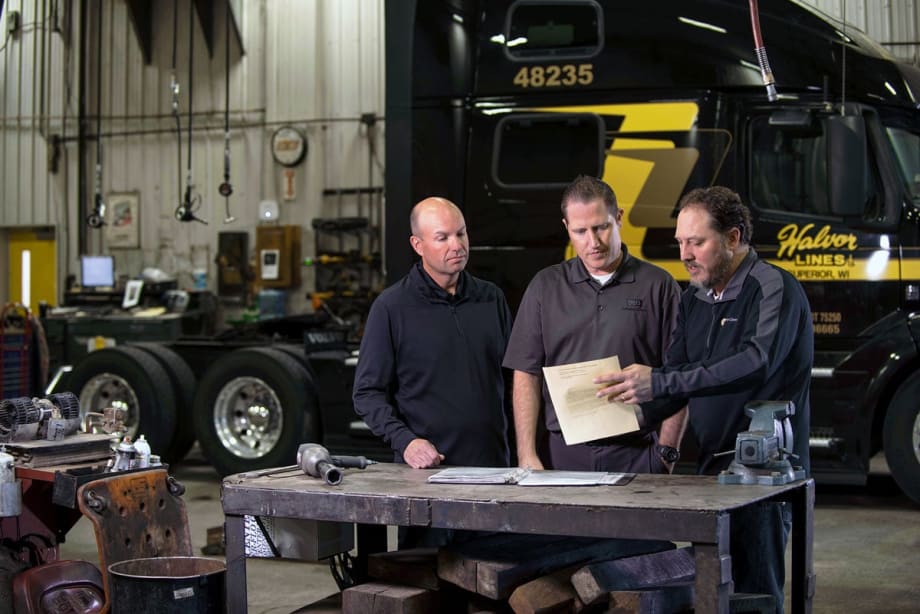
Halvor Lines' Chief Risk Officer Adam Lang, right, with Halvor CEO Jon Vinje and insurance representative Chad Hoppenjan from Cottingham and Butler, posing for a promotional photo for Halvor’s insurance captive pre-COVID.
Photo: Halvor Lines
Insurance is one of the few products you buy in the hopes that it’s never used. But when disaster strikes, an appropriate level of coverage can define the difference between a speedy recovery and economic ruin.
While some coverage will always be dictated by regulations (like commercial auto liability insurance) or individual shipper demands (cargo insurance), other choices are driven by unique business needs and concerns. Here are three examples that might deserve a closer look by trucking operations.
1. Cyber Security Coverage
Trucking companies are increasingly becoming the victims of cyberattacks, including the ransomware that requires payment in exchange for unlocking digital files. Even the FBI has issued a warning about hackers tapping into vulnerable ELDs.
It’s more than an inconvenience. Depending on the files that are locked away, the business of assigning loads can come to a screeching halt. Worse yet, personal information can be stolen, sold, and repurposed for other criminal activities.
“Nearly every fleet office and every vehicle these days is connected, and every connecting point is a point of sale for a hacker,” says Vishal Kundi, CEO of Boxx Insurance. Every connected device a driver brings to work introduces another vulnerable digital path.
To compound matters, hackers are not always the professionals who lurk under the cover of the dark web. The fastest-growing segment of attackers are rogue employees, he says. Maybe they were put on furlough, or feel disaffected with the company
“It’s not the hack that’s what will kill your business. It’s how you manage it,” Kundi says. “You may pay, but not get the data back.”
One of the challenges is that there’s no standard form of cyber insurance. “Will it pay for the ransom, or will it pay just for the recovery of the data?” Kundi says, referring to one key question.
The level of required coverage will depend on the business, too.“How many client records or employee records do you have?” Kundi asks, noting that it can cost $200 to $300 to address each record lost in a privacy breach. The costs involve everything from notifying customers and regulators, to rebuilding the records themselves.
“Truckers have a ton of employee information, and they’ve got a ton of contract information for part-time drivers.”
Add the costs of business interruption to that, and it explains why many smaller Boxx customers are still securing between $1 million and $5 million in coverage.
2. Enhanced Disability Coverage
When owner-operators are told they need to purchase private disability coverage, Glenn Caldwell knows they usually focus on two topics: How much it costs, and how much it will pay in the event of an injury. But Caldwell, vice-president – corporate development at NAL Insurance, says another key consideration will be the “exclusions” that determine which medical conditions and situations will not be covered.
“Do the research and implement a plan that’s going to fully be there,” he says. “Sadly, many times a fleet doesn’t find out until after a claim hits the auto policy that the program [an owner-operator] accepted has limitations.”
It’s also easier to make the case for an extra $5 or $10 a month than to ask for an extra $200 a month after a major motor vehicle accident injury claim hits the auto policy, Caldwell adds.
It’s all about reading the fine print. Insurers approach topics like “pre-existing” medical conditions in different ways. A change in blood pressure medication, for example, might be the only thing needed to deny coverage for a heart attack that occurs on the road in the U.S.
“Some of the higher-value benefit plans cover all stable pre-existing conditions as long as a doctor hasn’t said you can’t travel or there’s something underlying there,” Caldwell says. “It’s always about asking the questions.”
The level of payments can vary dramatically, too. A cheaper plan might cap payments for physiotherapy sessions at $30 per visit. Those won’t make much of a dent in a bill that approaches $800.
In terms of securing accident disability coverage, Caldwell recommends looking for features such as first-day accident disability, meaning there’s no waiting or elimination period. Benefits should also be paid based on gross earnings rather than net, and apply 60 days per injury in the case of strains and sprains, he adds.
“Read your policy. Make sure you understand. If you don’t, make sure you speak to your broker.”
3. An Insurance Captive
One strategy to help control insurance-related costs but still secure the appropriate coverage is to join an insurance captive – an insurance company owned and controlled by a group of fleets. It presents the added potential of sharing in dividends as well.
Coverage like this isn’t meant to protect against the massive liability-related losses that follow so-called nuclear verdicts, but it can offer the protective layer to address the smaller losses that are relatively common in trucking – such as physical damage and property damage.
While traditionally limited to larger fleets, or even businesses large enough to form their own captive, interest has expanded among mid-sized fleets, says Avi Goldberg, a transportation insurance broker at Marsh Canada.
One of the reasons for that growing interest is today’s “hard” market, as costs increase and some insurance providers reconsider whether they’re even interested in underwriting certain types of business in the first place.
“There’s not a lot of excess liability carriers in the market for transportation,” Goldberg says as an example, referring to the coverage used to build up limits on top of an original policy, closing gaps in coverage and offering fleets some added protection. “If you want $5 million or $10 million liability limits, it’s very difficult.”
But insurers can be enticed by companies that join together.
Every captive sets the requirements for those who are allowed to join. The 20 members in a captive managed by Marsh Canada, for example, demonstrate a commitment to risk management. “So we have certain standards and certain conditions that the members put together.”
Given that one fleet’s losses will affect the prices paid by other businesses within the captive, there’s a greater interest in sharing best practices. Outside a captive, fleets might keep information about everything from mileage to losses under wraps, he explains. “They compete against each other. They price against each other.”
But knowing such details can lead to a safer operation and fewer losses. It’s why a safety group within the Marsh-managed captive meets twice a year. Rather than leaving decisions to a single risk manager, fleets can tap into the insights of 20 peers.
Each captive’s structure is ultimately dictated by its members, so any review should consider obligations as well as the coverage. There will be unique requirements concerning collateral that needs to be presented, as well as exit conditions.
The costs are not limited to premiums alone, either. Captive members purchase shares as a price of membership. There may also be an expectation of topping up the funds if premiums are exhausted.
Any captive that doesn’t incorporate a cap of some sort is a risky proposition for everyone involved, he adds, providing another reason to read the fine print and any re-insurance agreements.
Expect the type of coverage to grow along with the interest in the entities themselves. Goldberg expects captives to expand into areas such as employee benefits and business interruption insurance.
It’s all about ensuring everyone is well covered.
John G. Smith is the editorial director of Newcom Media's trucking and supply chain publications – including Today's Trucking, trucknews.com, and others. A version of this article first appeared on trucknews.com and was used with permission from Newcom Media as part of a cooperative editorial agreement.
More Safety & Compliance

FMCSA Pauses Biennial-Update Enforcement Amid Motus Transition
Carriers whose updates were due on or after June 1 have more time, while FMCSA works to stabilize its new registration system and warns of phishing sites impersonating its new carrier registration system, Motus.
Read More →
ZF Expands Commercial Vehicle Push in North America
ZF is expanding its North American commercial-vehicle presence with new transmission applications, electrification, trailer technology and autonomous-driving systems.
Read More →
Truck Drivers Need More Than Another Alert
Fleets have more visibility into truck health, safety events, and driver activity than ever. The next challenge is turning all that information into useful guidance for the person who has to decide what to do next.
Read More →
Tesla Wants a Self-Driving Semi. Are Cameras Enough?
Could Tesla’s camera-only autonomous driving technology work on an 80,000-pound Semi? In this commentary, HDT's Deborah Lockridge takes a look at Tesla, Cybercab, and how autonomous trucks see the road.
Read More →
What DOT’s Automated Vehicle Strategy Means for Trucking
The U.S. Department of Transportation issued a new automated-vehicle strategy that outlines plans for driverless-truck regulations, cross-state freight corridors, and federal safety standards.
Read More →
NYC Expands Speed, Pedestrian Safety Tech Across Fleet
New York City is expanding intelligent speed assistance and pedestrian-alert systems across its municipal fleet, moving the technologies from pilot programs into vehicle procurement and retrofit requirements.
Read More →
FMCSA Removes 110 Truck Driver Training Schools from Certified ELDT List
Federal regulators also are targeting more than 160 additional training providers and launching a nationwide audit of third-party CDL skills testers as part of a broader crackdown on trucking fraud.
Read More →
Beyond DOT Compliance: What Makes a Trucking Fleet Truly Safe?
A trucking fleet can follow every rule and still make unsafe decisions. The real test comes when safety conflicts with freight, productivity, or cost.
Read More →
Hours of Service Pilot Programs: FMCSA Readies for 2027 Rollout
Two pilot programs could eventually reshape hours-of-service rules, giving truck drivers options to pause their 14-hour clock or use longer split sleeper rest periods.
Read More →
New Guide Offers Pet Safety Tips for Truck Drivers
Hundreds of thousands of pets travel in truck cabs. A new safety guide from Volvo Trucks and the Center for Pet Safety offers practical advice for truck drivers who bring dogs and cats along for the ride.
Read More →