





How to Get the Most from Your Batteries
3 Steps to an Effective Battery Recharging Program
Many believe that a battery is junk once it has been totally discharged, but that’s absolutely not true, argues Larry Rambeaux of Purkeys Electric.
February 18, 2022
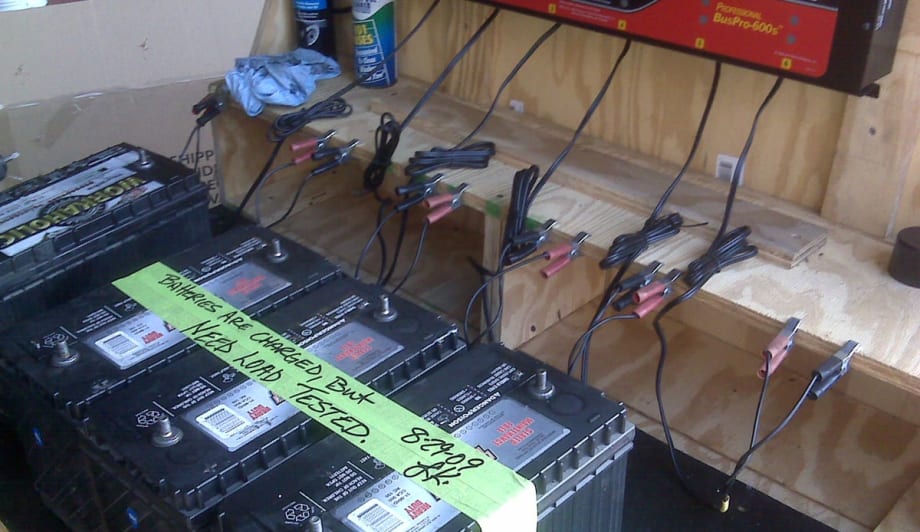
Recharged batteries need to sit for 24 hours and then be retested to assure they are holding the charge. There’s no point in reinstalling a dead or dying battery.
Photo: Purkeys
3 min to read
Many believe that a battery is junk once it has been totally discharged, but that’s absolutely not true, argues Larry Rambeaux, sales application engineer at Purkeys Electric.
“Flooded-cell batteries can be recharged and tested,” he says. “If they pass the tests, they are good to go back onto a truck.”
Using an established procedure, all batteries pulled from in-service trucks can be tested. Then it can be determined if they can be returned to service, returned for warranty, scrapped, or set aside for trucks the fleet is selling off.
Rambeaux recommends designating an area as a “battery room” and limiting access to that area except for the technician on shift in charge of batteries. Otherwise, it’s too easy for a technician looking for a battery to take one from the wrong pile and put it back on a truck. When it fails a few weeks later, the obvious reaction would be, “‘those recharges failed us again, we need to quit doing this. All they’re doing is costing us money.’ That wouldn’t happen if the sorting and charging program is done properly,” he says.
Step 1: Triage
Technician places all removed batteries on Pallet 1 to be sorted by the assigned battery person. Batteries are sorted by physical condition, age, and manufacturer. Once inspected, clean all terminals with a battery brush and install proper lead adapters.
All batteries that pass the initial inspection should be recharged. Damaged batteries are set aside for scrap or warranty.
Step 2: Charging and testing
Once charged, all batteries should be load tested and assigned to one of three pallets:
Pallet 2: Batteries that pass the load test and are placed on 24-hour hold before being load-tested again.
Pallet 3: Batteries that fail the load test and are under warranty awaiting processing.
Pallet 4: Batteries that fail the load test and are not under warranty. Designated as scrap.
Step 3: Sorting and Matching
Good used batteries (batteries that test well after 24 hours) should be put together in matched sets using the following criteria to go back on a tractor. Sort by:
Age (should be within 6 months)
Manufacturer
CCA (should be within 50 CCA)
That 24-hour hold before retesting is critical. Rambeaux says about 10% of them will have some internal problem, such as a low-grade short that will cause a loss of charge.
“It you let them sit for 24 hours, those problems will show up,” he says. “Those are the batteries that give recharge programs a bad name.”
It’s also an opportunity to cull some of the oddball batteries from the system, such as the ones you acquired on a road service. Even if they test good, they won’t have any warranty. You won’t want to put it back on an over-the-road truck, so Rambeaux suggests using them for trade trucks, or maybe yard or local trucks.
This article first appeared as a sidebar to "How to Get the Most from Your Batteries" in the Jan/Feb 2022 issue of Heavy Duty Trucking.
Subscribe to Our Newsletter
More Maintenance

Truck Drivers Need More Than Another Alert
Fleets have more visibility into truck health, safety events, and driver activity than ever. The next challenge is turning all that information into useful guidance for the person who has to decide what to do next.
Read More →
The Maintenance Checks Trucking Fleets Should Prioritize Before Fall Freight Picks Up
Making it through August isn’t the same as being ready for the next several months of operation. Find out what systems may have suffered from summer heat and need to be checked out before fall.
Read More →
What Three Fleets Are Doing Differently When Buying Truck Parts in 2026
With freight improving but costs still climbing, fleet maintenance executives explain how they're balancing price, quality, and supplier relationships.
Read More →
Paccar Recalls 2027 Trucks Built This Summer for Possible Electrical Problem
The nearly 6,000 Kenworth and Peterbilt trucks in the recall could potentially lose engine power, among other things.
Read More →
Will API PC-12 Oil Change Trucking Fleet Maintenance?
The new API PC-12 heavy-duty engine oil category reflects the changing demands of modern diesel engines. But fleets like Foodliner are looking to getting their own data before making decisions on adopting the new oils and questions such as extending oil drain intervals.
Read More →
Brake Safety Week to Focus on Drums and Rotors
Commercial vehicle inspectors are focusing on truck brakes during CVSA's Brake Safety Week, August 23-29.
Read More →
Possible Battery-Cable Fires Prompt Recall of 15,000+ International MV and HV Trucks
On the recalled vehicles, manufacturing variations can cause the battery interconnect cable to contact the auxiliary stud and hold down the bracket.
Read More →
Rush, MCT Team Up to Grow Refrigeration Service Network
The joint venture will operate MCT's network of Carrier Transicold dealerships and mobile service locations, with the companies promising greater service capacity and uptime for refrigerated fleets.
Read More →
ConMet Expands Aftermarket Brake Drum Lineup With TruCast
A new heavy-duty truck brake drum option in the aftermarket gives customers more flexibility within the ConMet product family.
Read More →
Mack Expands Premium Service Contract Coverage to Medium-Duty MD
With a service contract, inspections, preventive maintenance and repairs can be handled in a single visit instead of multiple ones.
Read More →