




3 Electric Truck Infrastructure Issues that Must be Resolved
Matt Horton, CEO of Voltera Power, talks about the way forward for developing electric truck charging facilities and three of the biggest hurdles facing the establishment of a transportation-focused electric grid in North America.

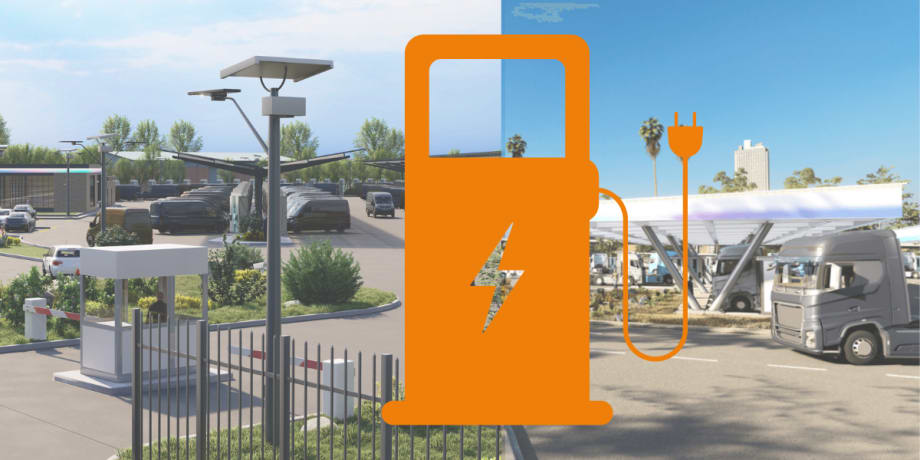
"The biggest challenge we have is getting power to the sites — sites that are convenient for truckers and other users."
Photo: Canva/Voltera
Despite the tremendous technology gains made by truck OEMs over the past several years, the deployment of new battery-electric trucks has been stymied by serious infrastructure issues across North America. Jim Park, equipment editor, sat down with Voltera CEO Matt Horton on the HDT Talks Trucking podcast to explore the issues holding back the large-scale deployment of electric trucks in North America.
Where is all of this new, clean, electric power going to come from? Can we set up a massive infrastructure in time? Or are we setting a deadline we can’t realistically hope to meet? And who is going to pay for this massive transformation?
1. Charging Deserts
“The opportunity to move transportation off of fossil fuel and combustion engines to clean, electric propulsion is one of the biggest opportunities out there today,” Horton said. “It’s something in medium-term that is going to save us emissions, but also give us economic savings as well.”
That said, Horton admitted that the path forward will not be an easy one.
“It’s not straightforward,” he said. “It’s really quite challenging to make all of these things happen. One of the biggest challenges we hear constantly from truckers and companies in this space is that there are vehicles available. But they have nowhere to charge them. And until that changes, it’s going to be difficult to roll out vehicles in the numbers we want.”
How viable a solution are electric trucks in remote parts of North America? In North Dakota, for example. Or New Hampshire? Or Rhode Island? Are there charging opportunities in those places, too? Or will the spotlight remain fixed on California until these issues are resolved?
“It’s interesting,” Horton said. “In many respects, California is one of the hardest markets to roll out infrastructure. But it is also the state that has had the most focus on this for the longest period of time. So there is generally more charging infrastructure in the state of California.”
But there are “charging deserts” in many places in North America, Horton added. These are areas where charging infrastructure for both cars and trucks is largely nonexistent.
"This is especially challenging for big, heavy-duty vehicles that have very high power requirements,” he said. “But there are solutions for almost every region of the country. Some areas do have extra challenges, for sure. But we have found that it just takes some time, some focus, and attention and a supportive environment from policymakers to make it happen.”
2. A Totally Different World
North America — for the most part — has adequate infrastructure available to meet its electric power needs today. But the transition that we’re facing in moving our transportation sector over to battery electric vehicles, is akin to moving into a totally different world when it comes to infrastructure, Horton said.
“We need to rewire the edge of our grid, to be able to connect with all of these vehicles that are coming into the stream,” he explained. “It takes a lot of work. It’s very doable. These are things that we know how to do. In some cases, there will be new substations. New transformers. New transmission equipment that will be needed.
"But the biggest challenge we have is getting power to the sites — sites that are convenient for truckers and other users. So finding the right locations where the truckers need to be, and finding the overlap with available power, is probably the biggest challenge. The reality is we don’t find that in most places.”
3. Who is Going to Pay?
Right now, costs to enter the electric truck market with a large number of trucks is highly expensive. And that’s not even taking into account contacting your local power utility to see about getting public or private infrastructure installed to support the vehicles. It’s a massive problem, and one that Horton said Voltera Power is striving hard to help fleets navigate.
“What a customer needs to do is to go out and buy vehicles and buy infrastructure,” he said. “And that requires a huge up-front payment. What we offer is the ability to get rid of that upfront payment and spread the payments out over time and take what was a big capital expenditure and just make it part of your operating costs.”
That approach works well for fleets, Horton said, because BETs are so efficient and use so much less energy per mile. And in most places, the electricity energy that you’re using is much less expensive than diesel. "So you typically have a really nice savings per mile on the cost of fuel and a savings per mile on the cost of your maintenance."
Diesel trucks are cheaper to purchase upfront, but more expensive to operate in the long term. BETs are exactly the opposite, Horton explained. he said Voltera helps fleets deal with those upfront costs by flattening out those capital expenditures so that the subsequent operating costs feel very much like what fleets experience with diesel trucks today.
Learn about these infrastructure issues — and others — with Jim Park and Matt Horton on HDT Talks Trucking: Navigating Battery-Electric Truck Charging Challenges.
More Fuel Smarts

How Volvo Updated Its D13 for EPA 2027 [Watch]
Volvo’s updated D13 promises lower emissions without sacrificing performance or fuel economy. Take a closer look at what changed inside the engine in this HDT Spotlight video.
Read More →
Diesel Price Spike Shortens Payback for Natural Gas Trucks, Report Says
Energy Vision estimates fleets could recover the higher purchase price of an RNG-fueled Class 8 tractor in 1.3 to 2.8 years under current fuel-price scenarios.
Read More →
Calstart Becomes Catalyst Mobility, Reflecting Broader Focus
Calstart is now Catalyst Mobility, reflecting the nonprofit’s growing national role in clean transportation, including zero-emission trucks, infrastructure and incentive programs.
Read More →

Record Diesel Prices Squeeze Trucking Fleets
Average U.S. diesel prices have climbed to nearly $6 a gallon, surpassing the 2022 record as tight refinery capacity and Middle East disruptions keep fuel costs elevated.
Read More →
How Fuel Delivery Shapes Engine Performance
Fuel delivery depends on more than what happens at the injector. For fleet, maintenance and technical professionals, looking at the full path from pump to injector can provide useful context for understanding engine performance.
Read More →
East Coast Port Launches $45M Electric Truck Push
The Port Authority of New York and New Jersey announced millions in incentives for zero-emission drayage trucks, yard tractors, and new charging hubs near the port.
Read More →
California Bill Could Shed Light on Electric Truck Prices
Why do battery-electric Class 8 trucks remain so expensive? A California bill headed to Gov. Gavin Newsom would give fleets and state agencies more visibility into what manufacturers charge.
Read More →
Detroit Opens Orders for EPA 2027 Engines
Detroit isn’t starting from scratch to meet EPA 2027 diesel emissions standards. Its Gen 6 DD13 and DD15 engines keep much of today’s platform while updating the fuel and aftertreatment systems.
Read More →
Zero-Emission Truck Corridor Planned for West Coast
California, Oregon, Washington, British Columbia and Baja California are coordinating plans for truck charging and hydrogen fueling from Canada to Mexico.
Read More →
A Closer Look at Kenworth’s Electric T880E Vocational Truck [Video]
Learn more about Kenworth's T880E battery-electric vocational truck at the Paccar Technical Center, including its range, applications, upfitting considerations, and PTO options, in this HDT Spotlight video.
Read More →