Despite the COVID-19 pandemic that shut down spending in many industries in 2020, the demand for trucking remained strong. So did the demand for drivers. Don't miss the latest driver trends from HDT's 2021 Fact Book.
Heavy Duty Trucking’s annual Fact Book issue is designed to provide a snapshot of the current state of the industry, where it’s been, and where it’s going. These numbers can help you in planning and benchmarking your fleet, and in telling trucking’s story to others.
Graphic: HDT
2 min to read
Despite the COVID-19 pandemic that shut down spending in many industries in 2020, the demand for trucking remained strong. So did the demand for drivers to keep operations going.
Ad Loading...
But meeting that demand, especially since the economy started recovering, has been difficult.
The American Trucking Associations recently reported that in the truckload sector, fleet sizes in the first half of the year are down 6% and 4.9% for large and small carriers, respectively. It attributed part of that to the inability to find drivers.
Ad Loading...
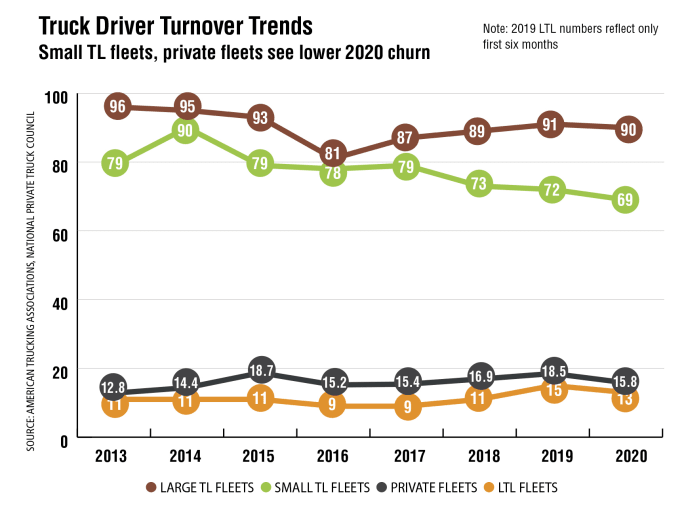
Despite the rollercoaster year that was 2020, the overall driver turnover rate for large truckload carriers was very similar to 2019, according to the American Trucking Associations. Carriers with more than $30 million in annual revenue averaged 90%, down one point from 2019, although it had dipped to 85% for the first six months of 2020. The annual average rate at smaller truckload fleets was 69% in 2020, down from 72% in the previous year.
In the National Private Truck Council’s annual benchmarking survey, reversing a two-year trend of higher driver turnover, respondents reported turnover falling to 15.8%, nearly three full percentage points down from 2019's 18.5% turnover rate. Turnover has averaged 14.25% over the 15-year history of the NPTC survey.
Source: American Trucking Associations, National Private Truck Council
Many drivers have long said that there's not really a driver shortage, simply a shortage of enough pay to make up for the demands of the job. And a recent FTR analysis found that with the extra COVID-19 unemployment benefits, "numerous former drivers could 'earn' almost as much doing nothing as they could working in a stressful job like driving a truck," says FTR's Avery Vise.
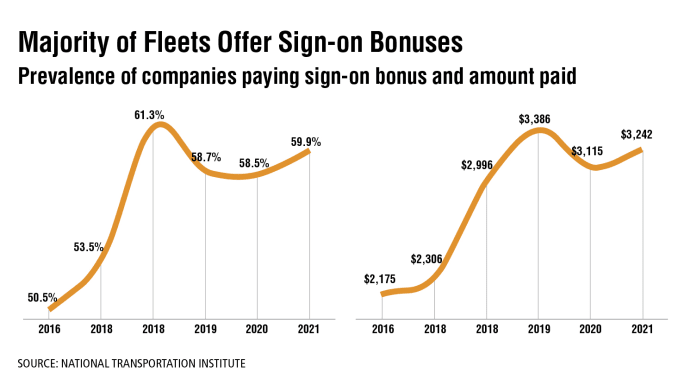
In addition to many fleets raising driver pay this past year, some fleets turned to large sign-on bonuses to sweeten the deal. In early 2021, Walmart offered a major $8,000 sign-on bonus for qualified Class A commercial truck drivers in select locations. Old Dominion also announced a large $5,000 sign-on bonus. Those deals are far more than the average of the year, though. Most fleets paid an average $3,242 sign-on bonus, according to the National Transportation Institute.
Overall, a majority of fleets offer sign-on bonuses, although neither as many nor as large as two or three years ago, according to the National Transportation Institute, which tracks more than 125 different attributes of pay packages for company truck drivers and owner-operator compensation. The problem is, sign-on bonuses may just cause drivers to chase the next bonus as soon as their minimum time required to collect the bonus is finished. NTI has found that drivers stay longer when they are recruited for the appropriate wage in that market, and pay is accelerated appropriately by tenure, by earnings, and outcomes that are necessary to be recognized in the job, such as safety incentives, fuel incentives, and productivity incentives.
Source: National Transportation Institute
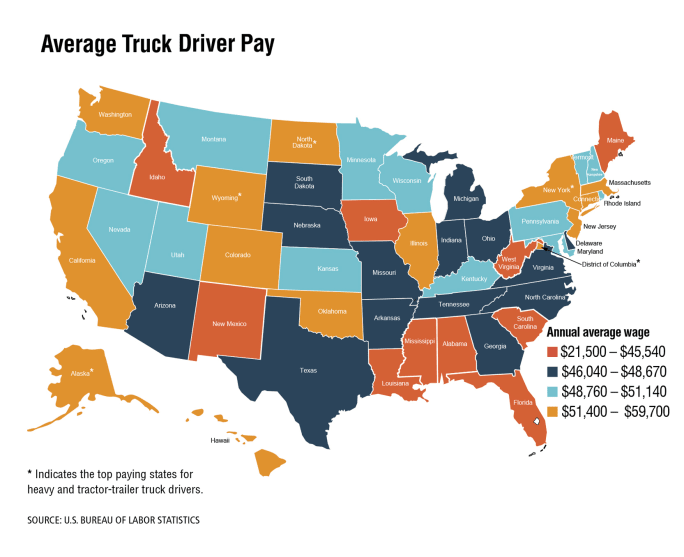
Competitive pay is perhaps the No. 1 factor in attracting and retaining. The most recent federal statistics available show Alaska, Washington, D.C., New York and Wyoming had the highest pay.
Federal statistics show the average annual wages of heavy and tractor-trailer truck drivers by state, as of May 2020 (most recent figures available). Compared to a year earlier, Minnesota and Nevada dropped out of the ranks of the highest-paying states, while California and Oklahoma moved up into that top tier.
Source: U.S. Bureau Of Labor Statistics
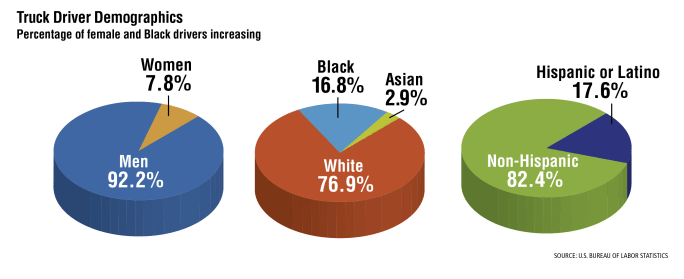
In this Bureau of Labor Statistics 2020 data for “driver/sales workers and truck drivers,” out of 3.36 million total employed, women remain by far the minority. Over the past decade, the percentage of women has risen from 4.6% in 2010, and the percentage of Black drivers has risen from 13.6% a decade ago. The percentage of Asian and Hispanic/Latino drivers has remained about the same.
Source: U.S. Bureau of Labor Statistics
Trucking is an increasingly data-driven industry. Numbers matter. There’s no end to the available software and analytics available to fleets today to help them analyze and improve their operations.
But sometimes you want to look at statistics and data to help give you the big picture, and this is what Heavy Duty Trucking’s annual Fact Book issue is all about. It’s designed to provide a snapshot of the current state of the industry, where it’s been, and where it’s going. These numbers can help you in planning and benchmarking your fleet, and in telling trucking’s story to others. And it can serve as a reference guide throughout the year.
This is the seventh year for the HDT Fact Book. Check out the other published sections of the Fact Book:
Fleets have more visibility into truck health, safety events, and driver activity than ever. The next challenge is turning all that information into useful guidance for the person who has to decide what to do next.
Federal regulators also are targeting more than 160 additional training providers and launching a nationwide audit of third-party CDL skills testers as part of a broader crackdown on trucking fraud.
Two pilot programs could eventually reshape hours-of-service rules, giving truck drivers options to pause their 14-hour clock or use longer split sleeper rest periods.
Medical-card violations jumped to the top of the driver out-of-service list during CVSA’s 2026 International Roadcheck, while English-language proficiency violations appeared among the leading violations for the first time.
New Teletrac Navman research suggests that onboarding, transparency about driver data, and positive feedback can play a significant role in how commercial drivers respond to safety and coaching technology.
By changing regulations on English-language proficiency requirements for commercial drivers, rather than relying on a guidance memo, the FMCSA said future administrations won't be able to walk back the Trump administration's stricter enforcement with just a memo.
The Freedom Haulers program pulls together existing and expanded programs at several federal agencies to recruit veterans to drive commercial heavy-duty trucks and cut the red tape for them to get a CDL, training, and employment.