





Don't miss the interactive timeline of HDT's history.
100 Years of Covering Trucking: '70s Through the '80s
Highlights of the past 100 years of HDT and the trucking industry as we celebrate our 100th birthday.
May 19, 2022

3 min to read
As Heavy Duty Trucking celebrates its 100th anniversary, we will be taking a look back at the last 100 years of trucking and how HDT covered it, both in print and online at Truckinginfo.com.
1970s: Regulations
The ’70s saw the dawn of a new age of federal safety and environmental regulations — while pressure was building to deregulate the economic aspects of the trucking industry.
New emissions regulations were coming from the brand-new U.S. Environmental Protection Agency and many individual states, leading HDT, in its June 1971 edition, to pose the question: “Just how can one truck be expected to meet all of the regulations?”
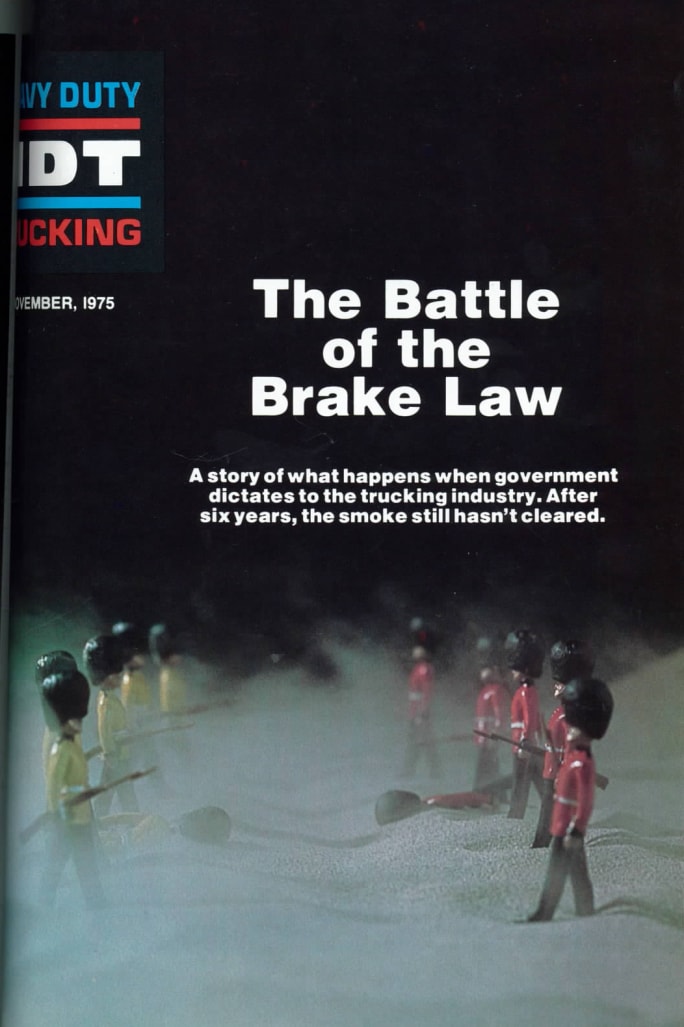
The newly created National Highway Traffic Safety Administration ran into trouble when it tried to require trucks to have antilock brakes. Federal Motor Vehicle Safety Standard 121 went into effect in January 1975. An award-winning November 1975 HDT cover story, “The Battle of the Brake Law,” covered the resulting debacle. HDT staff talked to hundreds of truck operators, maintenance men, attorneys, as well as makers of trucks, trailers and components to weave a tale of government forcing an industry to use technology that hadn’t been adequately tested.
The Supreme Court finally struck down the antilock brake provisions of “121,” as it became known, in 1978.
1970s: Drivers and Independents
The independent trucker was romanticized as a cowboy, an outlaw-with-a-heart-of-gold, in movies such as “Smokey and the Bandit” and songs such as “Convoy.”
Independents played a large role in the drama of the Arab Oil Embargo, when Arab nations withheld oil from the U.S. because of its support of Israel. Diesel prices jumped from 27 cents a gallon to as high as 45 cents. In December 1973 HDT reported, “price is no longer an object — it’s getting the stuff that matters.”
Truckstops limited sales. Owner-operators, angry that fleet customers got preference, blockaded highways in protest in late 1973 and staged a shutdown near the end of January 1974. Two drivers who defied the shutdown were killed.
In March, oil shipments resumed, but the Owner-Operator Independent Drivers Association got its start during the crisis.
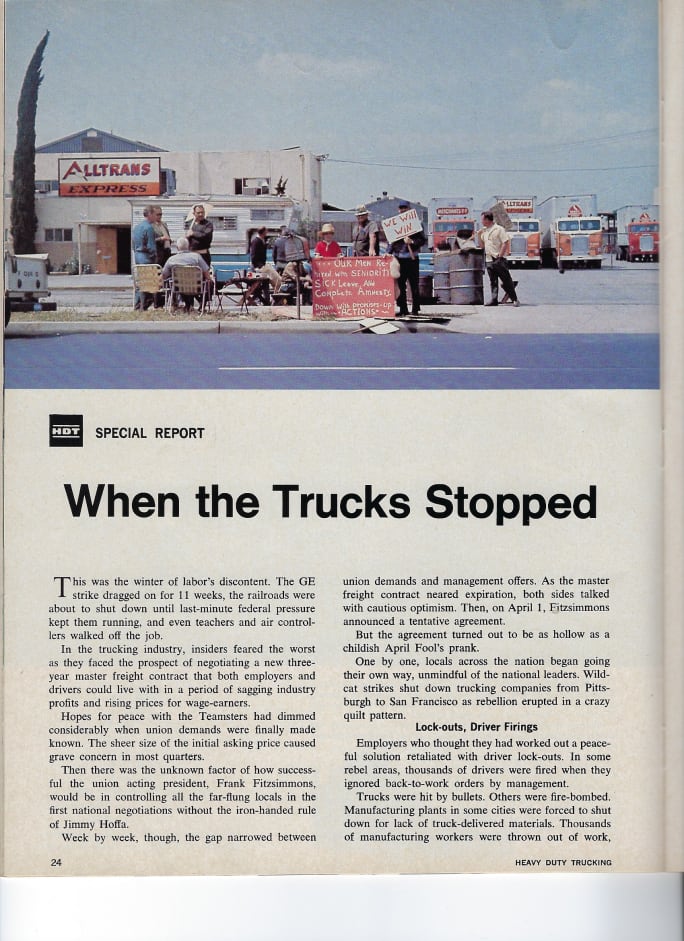
Things were volatile on the employee-driver side, as well. A 1970 feature, “When the Trucks Stopped,” detailed wildcat strikes, lockouts and driver firings, and HDT ran a “special report on trucking’s darkest month.”
Jimmy Hoffa remained Teamsters president while incarcerated. When released from prison in 1971, he was ordered to stay out of union affairs until 1980. He disappeared four years later. In 1978, Hoffa’s successor and 16 pension fund trustees were charged with misappropriation of funds.
Entering the ’80s, Teamsters membership started a decline from its peak of 3.2 million that would only be made worse by deregulation.
1980s: Deregulation
The Motor Carrier Act of 1980 deregulated trucking and created turmoil among established fleets. In one stroke, Congress had made millions of dollars in operating authority virtually worthless and created a stampede of new competitors.
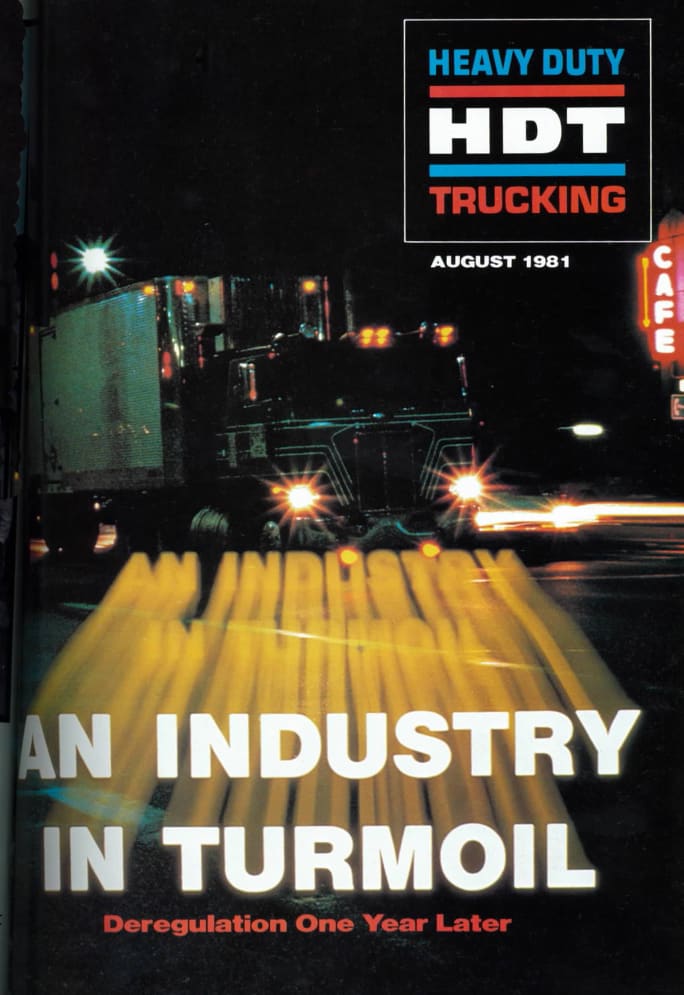
A year after deregulation, HDT’s “An Industry in Turmoil” cover story predicted, correctly, that many more trucking companies would not survive to the next business upturn.
“Trucking has rebounded from many economic recessions in the past. But this one is different,” the article said. “The rules changed in midstream when federal deregulation opened trucking industry gates to almost anybody on almost any route. With more people competing for a reduced amount of freight, the rate-cutting has become suicidal.”
Shippers soon discovered that nimble truckload carriers could deliver large less-than-truckload shipments quicker and cheaper than the traditional less-than-truckload companies. Truckload carriers, largely non-union, began to siphon off business from the major LTLs. Carriers that had dominated the business for decades were suddenly in trouble, and as the country slipped into recession, big names began to fall by the wayside. At the same time, many truckload carriers thrived.
There were more regulatory changes in the works. In 1982, the federal Surface Transportation Assistance Act began a trend away from cab-over-engine tractors to the conventional-cab layout, and the use of bigger and heavier trailers.
Subscribe to Our Newsletter
More Fleet Management

Sponsored•September 16, 2026
Color Match Smarter: Tools That Restore & Perform
For fleet managers and collision repair professionals keeping heavy-duty trucks on the road, getting the color right the first time isn't just about appearance — it's about efficiency, turnaround time, and bottom-line results. Discover how today's digital color tools are transforming the repair process from guesswork to precision.
Read More →
FMCSA Pauses Biennial-Update Enforcement Amid Motus Transition
Carriers whose updates were due on or after June 1 have more time, while FMCSA works to stabilize its new registration system and warns of phishing sites impersonating its new carrier registration system, Motus.
Read More →
Sponsored•September 14, 2026
2026 Blueprint for Countering Smarter Supply Chain Theft
Cargo theft is no longer just the cost of doing business. It's a multi-billion-dollar criminal enterprise exploiting vulnerabilities across your fleet, drivers, and supply chain.
Read More →


Sponsored•September 1, 2026
How Telematics Improves Visibility, Control, and Performance in Refrigerated Fleets
Explore how telematics help refrigerated fleets improve visibility, uptime, efficiency, compliance, and cargo protection across connected cold chain operations.
Read More →
What the U.S.-Canada Trade War Means for Trucking
Escalating U.S.-Canada tariffs could disrupt cross-border freight, reduce truck volumes, raise costs, and create new uncertainty for carriers on both sides of the border.
Read More →
What Are Trucking’s Top Concerns for 2026?
The American Transportation Research Institute wants to know what's worrying trucking fleet managers, drivers, and other stakeholders in its annual Industry Issues survey.
Read More →
American Trucking Associations Looks for a New Leader
ATA President and CEO Chris Spear abruptly left his job at the association on August 21, at a pivotal time for the trucking industry.
Read More →
Public Wi-Fi Cybersecurity Risks: How Truck Drivers and Fleets Can Protect Their Data
Public Wi-Fi can expose truck drivers and fleets to credential theft, malware, and other cyber threats. Here’s how to reduce the risk on the road.
Read More →
For Nicky Cupp, Fleet Innovation Starts With Frustration
HDT Truck Fleet Innovator Nicky Cupp turns everyday pain points at Fraley & Schilling into opportunities for better technology and smarter processes.
Read More →
Adam Buttgenbach’s Approach to Electric Trucks: Start With Where They Fit
HDT Truck Fleet Innovator Adam Buttgenbach helped PepsiCo build one of North America’s largest EV fleets by focusing on where electric trucks make operational sense.
Read More →