




Surveys Yield Clues to Driver Satisfaction
Where can trucking companies improve driver satisfaction? It’s a question that has somewhat different answers for drivers at different stages of their careers with their employers.

Courtesy Strategic Programs Inc.

Courtesy Strategic Programs Inc.
Where can trucking companies improve driver satisfaction? It’s a question that has somewhat different answers for drivers at different stages of their careers with their employers.
Strategic Programs, which works with trucking companies to do driver satisfaction and exit surveys, recently put out some statistics gleaned from its 2016 surveys from a representative sample of its clients in different types of trucking across the industry.
New hires surveyed gave their company the lowest scores for these statements:
Delays are minimal at the customer
I earn what I thought I would when I accepted this job
I am paid fairly for everything I do on the job
My pay is competitive with other companies doing the same work
When I am home, it is an acceptable amount of time.
“The good news about the new hire low scores is that they are all easily managed upfront during the hiring and onboarding process, by setting clear expectations with drivers,” says Strategic Programs’ Megan Younkin.
Her colleague Jay Green says the takeaway here is that fleets need to work with customers better and work with new hires better about delays at the shipper. “We see delays being an issue more for newer drivers than longer tenured ones. It is especially shocking to those new to the industry.”
Green says guaranteed pay for new hires is one way to address concerns about earnings expectations.
“While the job may allow them to make X amount per year, it doesn't always seem that way out of the gates, and before they know how to work their carriers network, they easily check out and decide they can't reach their earnings potential. We have seen success with guaranteed pay for new hires to help with those rough first few months.”
Current employees surveyed gave their company the lowest scores for these statements:
My compensation is competitive with other companies doing the same work.
Delays are minimal at the customer
I am compensated fairly for the work I do.
I am provided with opportunities to grow professionally as a driver.
Loads/work assignments are distributed fairly.
“For all drivers there will still be harsh realities of the job that some will adapt to better than others,” Green says. “Anything fleets can do to train their managers to understand problems drivers face, to equip these managers with better trust-building skills, will be worth the investment. Just having someone on the other end of the phone who can empathize and relate will go a long way. After a frustrating day, the last thing you need is a manager who is too busy or treats you like a number.”
Exiting employees surveyed gave their company the lowest scores for these statements:
My company appreciates its employers/owner-operators
I earned what I thought I would when I was hired
My manager/dispatcher was effective in resolving problems.
Delays were minimal at the customer.
I was paid fairly for everything I did on the job.
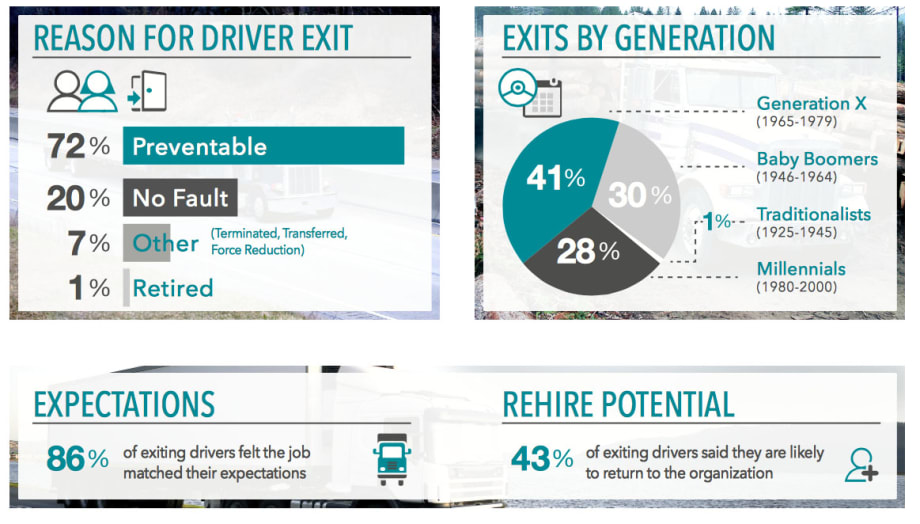
“At the end of the day, 72% of the exits are saying the company could have done something different to keep those who left,” says Green. “There is clearly a lot of room for improvement across the industry.”

Courtesy Strategic Programs Inc.
Compensation issues were a problem for all three groups of drivers.
“Managing perceptions of pay will continue to be an issue,” Green says. ”At the end of the day, fleets need to communicate pay better, make it easier to understand, make it consistent to obtain, continually make sure they are competitive with pay and that drivers know it, and provide regular pay reviews and coaching on how to make more money.”
Younkin notes that some of these low scores could be missed perceptions that need managed, and some are issues that need to be fixed or addressed. “Either way, these are all actionable items that can lead to organizational improvements.”
Green recommends that fleets looking to make improvements look at the top four actions that impact engagement as determined by Strategic Programs’ research:
My manager understands the problems employees face.
My suggestions for change are given consideration
Leadership follows through on commitments
I am satisfied with the opportunities available to make more money (bonuses, raises, etc.)
These items, he explains are a key driver analysis across all data from current drivers that show us what items directly correlate with an improvement on engagement.
More Drivers

EEOC Sues Texas Trucking Company Over Driver Age Limits
The agency says Trancasa USA rejected applicants over 65 and applied tougher driving-record standards to those over 60.
Read More →
Nussbaum, Roehl Announce Second Driver Pay Increase This Year
This year has seen a swath of major truck driver pay increases as freight capacity has tightened.
Read More →
From One Generation to the Next: How Mentorship Builds Safer Truck Drivers
After three decades in trucking, Harold Perry shares what he's learned about driver safety, mentorship, and helping the next generation build confidence behind the wheel.
Read More →
Truck Drivers Need More Than Another Alert
Fleets have more visibility into truck health, safety events, and driver activity than ever. The next challenge is turning all that information into useful guidance for the person who has to decide what to do next.
Read More →
FMCSA Removes 110 Truck Driver Training Schools from Certified ELDT List
Federal regulators also are targeting more than 160 additional training providers and launching a nationwide audit of third-party CDL skills testers as part of a broader crackdown on trucking fraud.
Read More →
Hours of Service Pilot Programs: FMCSA Readies for 2027 Rollout
Two pilot programs could eventually reshape hours-of-service rules, giving truck drivers options to pause their 14-hour clock or use longer split sleeper rest periods.
Read More →
Medical Cards, English Proficiency Reshape Roadcheck Violations
Medical-card violations jumped to the top of the driver out-of-service list during CVSA’s 2026 International Roadcheck, while English-language proficiency violations appeared among the leading violations for the first time.
Read More →
Driver Trust Can Make or Break the Success of Fleet Safety Technology
New Teletrac Navman research suggests that onboarding, transparency about driver data, and positive feedback can play a significant role in how commercial drivers respond to safety and coaching technology.
Read More →
EEOC Sues KLLM Over Alleged Sex Discrimination in Driver Training
KLLM is facing a federal sex-discrimination lawsuit over policies the EEOC alleges put female truck driver trainees at a disadvantage.
Read More →
FMCSA Moves to Codify English Language Requirements for Commercial Drivers
By changing regulations on English-language proficiency requirements for commercial drivers, rather than relying on a guidance memo, the FMCSA said future administrations won't be able to walk back the Trump administration's stricter enforcement with just a memo.
Read More →