




Related: Scenes from the Pandemic [Photos]
Trucking During a Pandemic: One Driver's View
"Those medical people on the front lines are heroes. We are the supply line," says truck driver Jeff Clark, who shares his thoughts about being on the road during the COVID-19 pandemic.
by Jeff Clark
April 14, 2020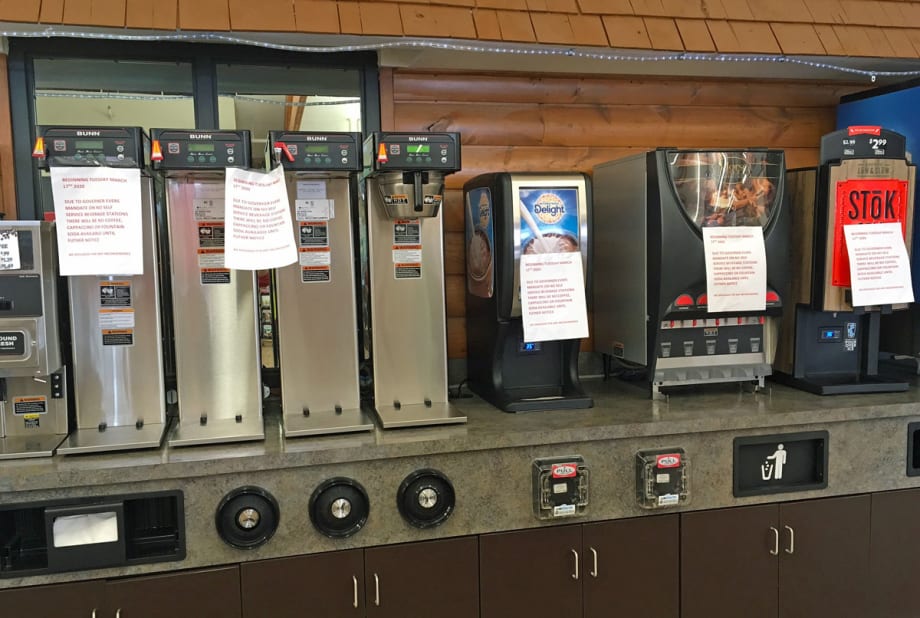
Coffee used to be taken for granted.
Photo: Jeff Clark
5 min to read
These past few weeks have been both the strangest and the scariest of my 32 years as a professional driver.
It is a blessing to be working. I am so grateful to the people who keep us moving. The people who work at the truck stops, convenience stores and food services deserve our thanks and a pay raise. They can’t work from home. They have hundreds of contacts per day – I average about five.
It is strange to be appreciated by the public. People have called us heroic. Those medical people on the front lines are heroes. We are the supply line.
It is confusing. We don’t know when this will end. But the public sentiment does help. There is an electronic billboard thanking truckers that I pass twice a week. That’s nice. Once last week, I went to pay for a snack and the truck stop wouldn’t take my money. Someone had left $100 to pay for truckers’ food. This tough old dog trucker had to wipe his eyes. Thank you.

Jeff Clark is a longtime owner-operator and truck driver.
Photo: Courtesy Jeff Clark
We can keep the store shelves stocked. There is no need to panic buy. That screws up the system. The system is built to handle what you need. The infrastructure of the logistics industry isn’t built for huge surges.
Your grocery store does not have a storage room in the back to handle a truckload of toilet paper. That has to go through a distribution center. A 53-foot trailer can hold up to 28 pallets of toilet paper. Your store might stock four or five.
Most truckloads of toilet paper at these distribution centers are drop loads. We drop a full trailer and grab an empty one to get the next load. These centers can only unload a specified number of trailers per day. They only have so much space, doors, equipment and personnel. We can deliver more loads there, but they can not unload them.
The Hours of Service Exemption for COVID-19 Relief
Hours of service (HOS) are there to protect the drivers and the public. Basically we are allowed to drive up to 11 hours. We have up to a 14-hour work day. Say we start at 7 a.m. We can not drive after 9 p.m. We also can not drive without a 30-minute break after eight hours.
In the 7-9 scenario, we would want to take that 30 minute break between 12:30 and 3 p.m. At the end of our shift we have to take a 10-hour break. An exemption from HOS [for drivers hauling defined "relief" loads] would allow us to wait longer hours at the distribution centers (usually for no pay) and keep driving. It is a bad idea. What you get are tired drivers. Not only does that mean tired drivers on the road, it means less healthy drivers, as the lack of sleep will weaken our immune systems.
My philosophy is simple. Don’t run into sh*t. If what you are doing makes it more likely to run into sh*t, don’t do it. If what you are doing makes it less likely to run into shit, do that. The HOS exemptions make it more likely that we will. When exemptions are necessary, they should be narrowly defined.
Many companies have decided to stay compliant. That includes Paper Transport of De Pere, Wisconsin. That is where I have worked for over 13 years. That is the right decision. Paper Transport is also donating half of our April profits to local food banks along with other local companies that are also stepping up.
This is tiring. A month ago my job was gravy. It is rare for me to bump up against HOS maximums. I average about 52 hours per week. That is enough for me. It allows me to take better care of myself.
Up until a few weeks ago, I was running three times per week and going to the gym twice a week. This was to train to run a half marathon in Green Bay on May 17. Now the gym is closed. Our Saturday morning group training runs have been canceled. The actual race has given us the option of deferring to next year, or do it virtually. I am still going through the motions of training, but the stress is getting to me.
My greatest fear is getting my wife, or someone I love sick. When I come home, I socially distance myself from my wife. The grandchildren are not coming over. We are blessed. We have some land, so I can go outside and work. We have a big garage that always needs cleaning. Some drivers are not that lucky. Many are just not going home.
Taking Coffee for Granted
We are figuring it out; it has become the new normal.

Truck stops have stopped offering self service. Most have had to close dine-in restaurants, as well.
Photo: Jeff Clark
Coffee used to be taken for granted. The coffee was always on and available. It was self serve. We filled up our mug or thermos. Now, self service is gone [because of social distancing guidance or government orders]. But many of our stops have stepped up. They have someone pouring it for us. Some just don’t have the personnel to cover it. That is especially true of the small independents. Business is down. They can not afford the extra expense and have either limited coffee hours, or stopped serving it. We have started a Facebook group to help us find coffee.
My scariest moment during this pandemic came while waiting in line for coffee. A fellow driver standing too close to me declared that no driver has this virus and none of us will get it. He believed it. He is wrong. Our driving force is aging. Many of us suffer from underlying conditions from obesity related diseases. Truckers will die.
This is an amazing country. Businesses are stepping up to make ventilators and PPE for the medical professionals. My wife and others are sewing masks at home. I am moving freight.
Every time I get back in my truck I am cleaning my hands and steering wheel with disinfectant. Really smart people are studying this virus, and they are learning more and more about it every day. We will get through this.
Jeff Clark, a professional driver for 31 years, has been both a company driver and an owner-operator. He previously wrote for Freightliner's Team Run Smart and now drives as a company driver for Paper Transport as he tries to ease into retirement. Along the way he helped start the Truckin’ Runners Facebook group, which has grown to almost 1,000 members.
Originally published on Smerconish.com. Used with permission of Smerconish and the author.
Subscribe to Our Newsletter
More Blog Posts

Fragmented AI: Why Trucking Must Take Security More Seriously
As AI becomes embedded throughout transportation operations, the result can be a tech environment that looks more advanced on paper, but isn't necessarily more efficient, secure, or manageable in practice.
Read More →
We've Been Thinking About Truck Uptime Backward
The truck repair operations that minimize downtime aren’t necessarily the ones with the fastest technicians. They’re the ones who have the part.
Read More →
The Real Cost of Trailer Tires: Why It's Not Just a Maintenance Problem Anymore
Tire wear isn't random. The trucking fleet with a tire program that knows which trailers, positions, and routes are punishing tires the hardest is the one that buys fewer of them.
Read More →
A New Argument for Electrification: Managing Fuel Volatility
As oil prices surge amid Middle East conflict and a blocked Strait of Hormuz, fleets are feeling the squeeze in real time. In this guest column, Geotab's Neil Cawse argues electrification is no longer just about sustainability or ROI — it’s about insulating operations from what he calls a "volatility tax."
Read More →
The Time is Now to Expand Longer Combination Vehicles [Opinion]
The reauthorization of the federal highway bill offers a rare chance to advance double 53-foot LCVs. Industry leaders shouldn’t miss it, says a longtime trailer industry professional in this Guest Voices blog post.
Read More →
The Hidden Costs of 'Free' Smart Trailer Tech Installations [Commentary]
Free installation of smart trailer technologies may sound good on paper, but you could end up paying down the road.
Read More →
Protecting Small Trucking Fleets from Scammers: Lessons from the Insurance Frontlines
Hijacked DOT numbers, fake invoices, and high-tech cargo theft are on the rise. A veteran trucking insurance broker shares how to spot trouble early — and why a trusted advisor may be your strongest defense.
Read More →
Tire Retreading Makes Sense for Trucking Fleets. H.R. 3401 Could Make It Even Smarter.
Retreaded tires offer trucking fleets cost savings, sustainability gains, and supply chain security. New legislation, H.R. 3401, could make retreads even more attractive and support U.S. jobs.
Read More →
Hydrogen Fuel Cell Trucks Are Ready for the Long Haul. Now Policymakers Must Act
Accelerating the growth of hydrogen-fuel-cell-truck adoption would help make zero-emission trucking is not only possible, but practical and profitable, argues the Center for Transportation and the Environment in this Guest Voices blog.
Read More →
A New Definition for Long-Haul Heavy-Duty Trucking
Understanding the various routes that make up long haul is important as we move through trucking’s Messy Middle — a time when fleets have a variety of powertrain solutions to choose from, writes NACFE's Mike Roeth.
Read More →