




Pay Attention. Drive Well. The Life You Save May Be Your Own.
There is a simple rule: When doing two things at once and one could be fatal, pay attention to the one that could be fatal, writes truck driver Jeff Clark in this In this Guest Voices blog post about distracted driving.
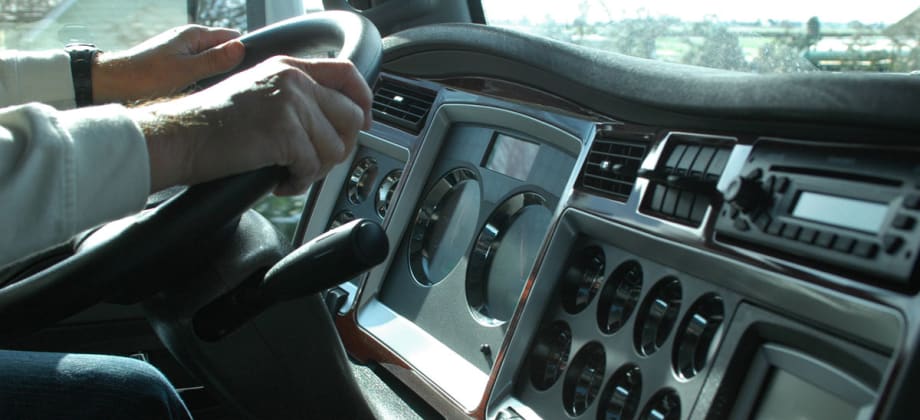
Professional truck drivers must always be on the lookout for vehicles behavioring erratically due to driver distraction.
Photo by Jim Park
There is a simple rule: When doing two things at once and one could be fatal, pay attention to the one that could be fatal.
Distracted driving is nothing new, and 30 years ago, cell phones were rare. One night on Interstate 865 north of Indianapolis, it was dusk and raining. Visibility was bad. Traffic was light. Something was wrong in the distance. I saw something nobody wants to see: the bottom side of a tanker across the left lane. I put my flashers on. My fear was seeing a dead driver in the cab. The dome light came on, and the driver climbed out of the cab. I helped him down.
The driver had dropped his cigarette and was reaching for it when his truck went into the median and rolled over.

Jeff Clark is easing into retirement but has trucking wisdom to share
Photo courtesy Jeff Clark
The new safety technology is incredible. My wife has a 2015 Buick Encore, not a car famous for its spectacular handling. One evening on a county highway when we were moving at about 55 mph, a deer jumped out in front of us. My inner gearhead awoke and I hit the brakes hard. You could feel and hear them pumping. I was able to steer the car around the deer. My wife thought that I was going to wreck her brand-new car. I was amazed at how well that Buick handled.
But if the handling technology hadn’t worked, and we had hit the deer, the Buick would have immediately sprung into action to save us. The seat belts would have locked, air bags would have deployed, and the car would have crumpled in a way that sacrifices itself to save the occupants. The engineering that goes into saving occupants during a crash is as impressive as the engineering that goes into avoiding the crash.
The safety technology that goes into semi-trucks is just as impressive. About five years ago, my truck was reading 34 degrees. It was raining, and my trailer was empty. I was driving up Illinois Route 47 just south of Lake Geneva, Wisconsin. The road curved. The drive tires started coming out from under the trailer. I did what I was supposed to do – and so did the truck. Within 20 feet, we were straight. My 2013 Freightliner Cascadia was amazing.
I am currently driving a 2019 Freightliner New Cascadia. It is equipped with a suite of Detroit safety assurance technology. If I hit the left-hand marker without my turn signal on, a loud irritating noise comes out from my left stereo speaker. If I hit the right marker, it comes from my right speaker. It has radar technology to tell me how far a vehicle is in front of me, how fast it is going, and how many seconds I am behind it.
The cruise control can adapt to the speed of the vehicle in front of me. It can apply the brakes, if I don’t apply them in time. The system is my first indicator that the road is beginning to freeze. The old school thing was to watch your mirrors and brackets. Now, if the radar gets blocked, the system tells me so and shuts itself down because it can no longer “see.”
Even with all of this technology, we still manage to kill each other on the highways. According to the Insurance Institute of Highway Safety, over 42,000 people died in 37,000 crashes in 1997. Twenty years later, 37,000 died in 34,000 crashes. With commercial vehicles, in 1997, 4,809 people were killed in commercial vehicle involved crashes. Twenty years later in 2017, 4,410 people died in crashes involving commercial vehicles.
We should be getting a lot safer. We aren’t. Safety technology is locked in a battle with communications technology. Too many drivers are paying attention to communications technology and relying on safety technology to bail them out.
There are some disturbing numbers out there. In 2017, 683 truck drivers were killed on the job. 128 police officers were killed in the same year. There are about 3 million professional CDL drivers out there and about 724,000 officers, meaning the odds of a professional driver and an officer not making it through their shift are about the same. More than a third of officers killed in the line of duty died in traffic accidents, often struck while assisting motorists on the side of the road.
We aren’t paying attention. Every once in a while, I will count the number of drivers of cars and trucks using an electronic device, and usually find about 1 in 5 are paying attention to some sort of device. Those devices are not limited to smartphones. I see people using computers. People are using devices to watch movies or videos while driving down the road.
Paying attention to devices takes attention away from our anticipation. Drivers who are on devices don’t drive well. My truck is governed at 65 mph. I generally drive at 62. It frustrates me to come up on a car doing 58 mph; as I pass them, they are up to 65, I can’t get around them, and they have a phone in their hand. They must have finished dialing.
You also will see drivers who just see directly in front of them because they are distracted. They don’t see what is next to them or behind them. This does not always lead to fatally bad decisions, but it leads to less than ideal decisions.
As a professional driver, I was taught to look out a mile ahead. Plan ahead for 15 seconds and keep a seven-second following distance. At the beginning of every day, my goal is to not run into stuff. It is getting harder. It isn’t getting harder because my age has increased and my physical skills have declined – my experience and anticipatory skills more than make up for that. I can tell which drivers around me are paying attention and which aren’t. I can usually anticipate their next move.
At some point, we have lost the desire to drive well as a society. There is a satisfaction to driving well. The better you drive, the more satisfying it becomes. We don’t have as much drivers’ education in schools anymore. Today’s vehicles have cruise control and automated transmissions. It is easier to not be as involved with the driving process.
In some ways, maybe more technology is the answer. My truck has an inward and outward facing camera. It is “triggered” by an event such as a hard brake. The camera shows the truth. I see videos of drivers being distracted, and crashes happen as a result. I also see videos proving that the driver did the exact right thing.
Maybe we need laws similar to impaired driving laws. If you are involved in an accident, the officer can “search” your phone under the same circumstances as giving a breathalyzer.
Another way to improve driving across the board? We should all spend some time on a motorcycle. When I am on my bike, I am hyper-aware of what traffic is doing around me. It frightens me. Even if you never touch a bike in your life, imaging you are on a motorcycle while driving. Pay attention as if you were not surrounded by four walls of steel. Enjoy the simple pleasure of driving well.
Most of all: Remember when you are doing two things at once and one could be fatal, pay attention to the one that could be fatal.
Jeff Clark, a professional driver for 31 years, has been both a company driver and an owner-operator. He previously wrote for Freightliner's Team Run Smart and now drives as a company driver for Paper Transport as he tries to ease into retirement. Along the way he helped start the Truckin’ Runners Facebook group, which has grown to almost 1,000 members. Originally published on Smerconish.com. Used with permission of Smerconish and the author.
More Blog Posts

Fragmented AI: Why Trucking Must Take Security More Seriously
As AI becomes embedded throughout transportation operations, the result can be a tech environment that looks more advanced on paper, but isn't necessarily more efficient, secure, or manageable in practice.
Read More →
We've Been Thinking About Truck Uptime Backward
The truck repair operations that minimize downtime aren’t necessarily the ones with the fastest technicians. They’re the ones who have the part.
Read More →
The Real Cost of Trailer Tires: Why It's Not Just a Maintenance Problem Anymore
Tire wear isn't random. The trucking fleet with a tire program that knows which trailers, positions, and routes are punishing tires the hardest is the one that buys fewer of them.
Read More →
A New Argument for Electrification: Managing Fuel Volatility
As oil prices surge amid Middle East conflict and a blocked Strait of Hormuz, fleets are feeling the squeeze in real time. In this guest column, Geotab's Neil Cawse argues electrification is no longer just about sustainability or ROI — it’s about insulating operations from what he calls a "volatility tax."
Read More →
The Time is Now to Expand Longer Combination Vehicles [Opinion]
The reauthorization of the federal highway bill offers a rare chance to advance double 53-foot LCVs. Industry leaders shouldn’t miss it, says a longtime trailer industry professional in this Guest Voices blog post.
Read More →
The Hidden Costs of 'Free' Smart Trailer Tech Installations [Commentary]
Free installation of smart trailer technologies may sound good on paper, but you could end up paying down the road.
Read More →
Protecting Small Trucking Fleets from Scammers: Lessons from the Insurance Frontlines
Hijacked DOT numbers, fake invoices, and high-tech cargo theft are on the rise. A veteran trucking insurance broker shares how to spot trouble early — and why a trusted advisor may be your strongest defense.
Read More →
Tire Retreading Makes Sense for Trucking Fleets. H.R. 3401 Could Make It Even Smarter.
Retreaded tires offer trucking fleets cost savings, sustainability gains, and supply chain security. New legislation, H.R. 3401, could make retreads even more attractive and support U.S. jobs.
Read More →
Hydrogen Fuel Cell Trucks Are Ready for the Long Haul. Now Policymakers Must Act
Accelerating the growth of hydrogen-fuel-cell-truck adoption would help make zero-emission trucking is not only possible, but practical and profitable, argues the Center for Transportation and the Environment in this Guest Voices blog.
Read More →
A New Definition for Long-Haul Heavy-Duty Trucking
Understanding the various routes that make up long haul is important as we move through trucking’s Messy Middle — a time when fleets have a variety of powertrain solutions to choose from, writes NACFE's Mike Roeth.
Read More →