





Related: How Nikola Plans to Make Hydrogen the Truck Fuel of the Future
Nikola Going Public, Expects U.S. Electric Truck Production to Start Next Year
Electric-truck maker Nikola Motor Co. said it’s ready for the next chapter in its growth, with a March 3 announcement that it’s going public by merging with VectoIQ Acquisition Corp., a publicly traded special purpose acquisition company.
March 3, 2020
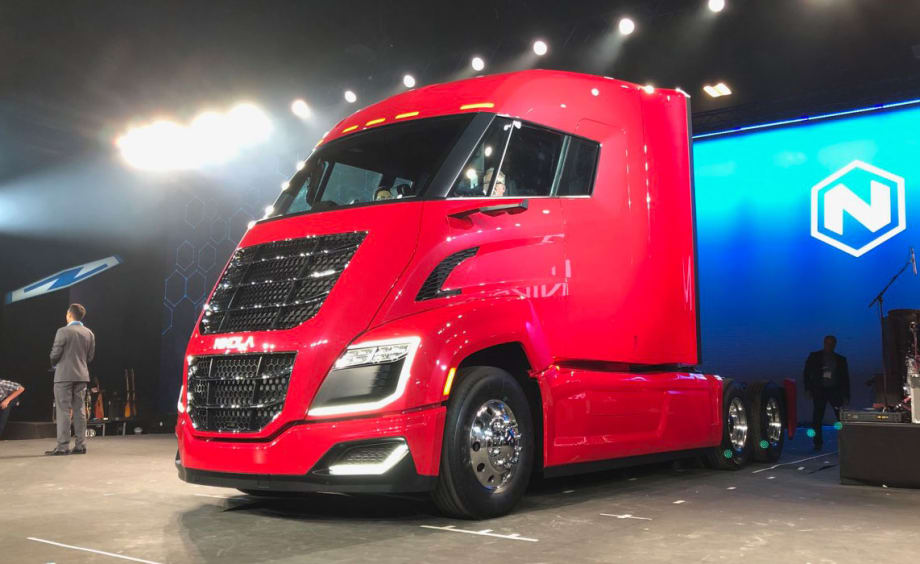
The Nikola 2 hydrogen-electric truck during last year's Nikola World event.
Photo: HDT Staff
4 min to read
Electric-truck maker Nikola Motor Co. said it’s ready for the next chapter in its growth, with a March 3 announcement that it’s going public by merging with VectoIQ Acquisition Corp., a publicly traded special purpose acquisition company.
In a prerecorded conference call, Nikola execs said moves such as its deal in Europe with Iveco and the introduction of the Badger pickup truck, combined with the funding made available with this merger, will help it ramp up production of its battery-electric truck next year and its fuel-cell electric truck in 2023.
VectoIQ Acquisition Corp. went public in May 2018, with the purpose of seeking “business combinations” with one or more companies in the industrial technology, transportation and smart mobility industries.
The two companies will create a company focused on the development of next-generation smart transportation. The combined company, valued at $3.3 billion, will be named Nikola Corp. and is expected to remain NASDAQ-listed under the new ticker symbol NKLA. The transaction will be funded through a combination of VectoIQ’s cash in trust and a $525-million private placement of common stock at $10 per share.
The management team of the new company will be headed by Trevor Milton (currently CEO of Nikola) as executive chairman and Mark Russell (currently Nikola president) as president and CEO.
Since it went public in 2018, VectoIQ has been working to identify the right target, said Steve Girsky, CEO. He noted that Nikola is producing not only two different powertrain options of electric trucks (battery-electric and hydrogen fuel-cell electric), but also that it is in the refueling and energy storage business. “The current fuel cell electric reservations, which have committed over $10 billion, are proof of how badly the market is seeking a solution like Nikola,” GIrsky said. This deal will help Nikola move to the next level, he said, not only with capital, but also with “decades of automotive expertise” at VectoIQ.
Nikola’s Next Chapter
Milton said the deal will help fuel the “next chapter of Nikola’s growth,” noting that the Investors “share our vision of a zero emission future in transportation.”
“I founded the company to completely disrupt the energy and transportation market,” he said. When he introduced the Nikola One in 2016, it was to great skepticism.
“I knew that Nikola would not be successful if it only sold vehicles like other manufacturers do,” Milton said. “Much like Amazon, we knew vertical integration was key…. From day one our goal was to integrate the truck and the energy it consumes into a single solution or lease payment. We can now offer an all-in lease rate that can fix the total cost of ownership for seven years. By signing long-term green energy contracts, we can produce green energy – hydrogen – resulting in a zero emission business model from production to consumption, something no other OEM has been able to achieve.”
Milton also said last month’s announcement of the Nikola Badger electric pickup truck will help it accelerate its efforts to get its electric semis in production.
“The Badger will help drive down the cost of our hydrogen fuel cells and other components for our semi truck program,” Milton said. “Most automotive suppliers charge a premium on parts for trucks due to lower volumes. But with the Badger, we can combine parts to drive down the cost of each component when possible.”
Russell pointed to the recently announced joint venture with CNH Industrial (parent company of Iveco) in Europe. “Our partnership with CNH and Iveco has enabled us to significantly accelerate our go-to-market timelines.”
Last month, the companies announced that Nikola Tre battery-electric truck production will take place at an Iveco plant in Ulm, Germany.
Russell said during the conference call that North American production of the Tre battery electric vehicle is scheduled to begin in a new facility in Coolidge, Arizona, in 2022, followed by start of production of Nikola 2 fuel-cell electric vehicle estimated in 2023.
He also noted that the company’s strategy of partnering with companies with longtime exertise in the trucking industry, such as Bosch, Meritor, Wabco, and others, has helped it mitigate the risks in developing the technology and ramping up for production.
In addition, he said, “our bundled leasing model… allows us to solve the chicken and egg challenge that’s hindered the growth of hydrogen-electric vehicle markets.”
Nikola is initially working with customers with dedicated long-haul routes and building hydrogen stations to serve their needs. “What we offer these dedicated route customers is essentially freight as a service, with a single price for a solution that includes the truck, maintenance and the fuel, locked in for the life of the lease, with a refueling station rollout plan that addresses concerns about access to fuel,” all at a price competitive with their existing diesel fleets, he said.
The company noted it already has $10 billion worth of reservations for its fuel-cell electric trucks. Although it has not yet disclosed any battery-electric truck reservations, the company said negotiations are entering final stages for “large binding orders” for battery-electric trucks. The company said it expects to go from $150 million of projected revenue in 2021 to over $3 billion by 2024. That’s assuming 600 battery-electric trucks in 2021, and 7,000 battery-electric and 5,000 fuel-cell-electric trucks in 2024.
More Equipment

How Volvo Updated Its D13 for EPA 2027 [Watch]
Volvo’s updated D13 promises lower emissions without sacrificing performance or fuel economy. Take a closer look at what changed inside the engine in this HDT Spotlight video.
Read More →
Michelin Tire Improves Efficiency and Durability for Regional Fleets
The Michelin X Multi Energy D2 is a regional haul drive tire engineered to help fleets improve fuel efficiency, durability and traction in demanding stop-and-go operations.
Read More →
ZF Expands Commercial Vehicle Push in North America
ZF is expanding its North American commercial-vehicle presence with new transmission applications, electrification, trailer technology and autonomous-driving systems.
Read More →
Tesla Wants a Self-Driving Semi. Are Cameras Enough?
Could Tesla’s camera-only autonomous driving technology work on an 80,000-pound Semi? In this commentary, HDT's Deborah Lockridge takes a look at Tesla, Cybercab, and how autonomous trucks see the road.
Read More →
Kodiak: Driverless Long-Haul Truck Launch on Track for 2026
Kodiak AI says its driverless long-haul safety case is 93% complete and it remains on track to begin commercial operations by year-end 2026.
Read More →
What DOT’s Automated Vehicle Strategy Means for Trucking
The U.S. Department of Transportation issued a new automated-vehicle strategy that outlines plans for driverless-truck regulations, cross-state freight corridors, and federal safety standards.
Read More →
East Coast Port Launches $45M Electric Truck Push
The Port Authority of New York and New Jersey announced millions in incentives for zero-emission drayage trucks, yard tractors, and new charging hubs near the port.
Read More →
PlusAI Going Public to Fund Autonomous Truck Launch
A SPAC deal could provide PlusAI with up to $300 million as it works toward a 2027 commercial launch of factory-built autonomous trucks.
Read More →
NHTSA Moves to Rewrite Truck Fuel-Economy Rules
The National Highway Traffic Safety Administration says it lacks authority to regulate medium- and heavy-duty truck engines separately from complete vehicles, but the existing standards have not yet been eliminated.
Read More →
Detroit Opens Orders for EPA 2027 Engines
Detroit isn’t starting from scratch to meet EPA 2027 diesel emissions standards. Its Gen 6 DD13 and DD15 engines keep much of today’s platform while updating the fuel and aftertreatment systems.
Read More →