




How Data Is Changing Predictive Maintenance
The term predictive maintenance has been around for decades. Today, it’s mostly data-driven compared with yesterday’s more seat-of-the-pants approach.

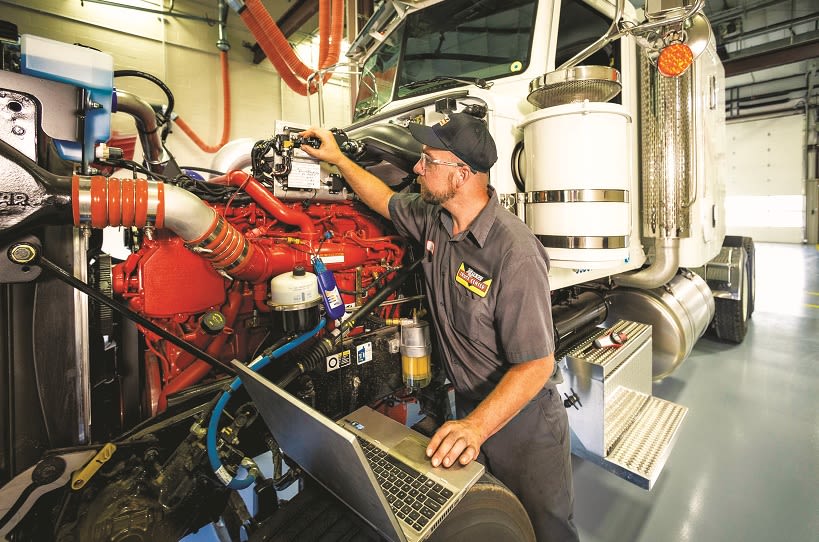
Previous fault codes and historical data can inform and develop effective preventive maintenance programs that keep you ahead of the problems.
Photo: Rush Truck Centers
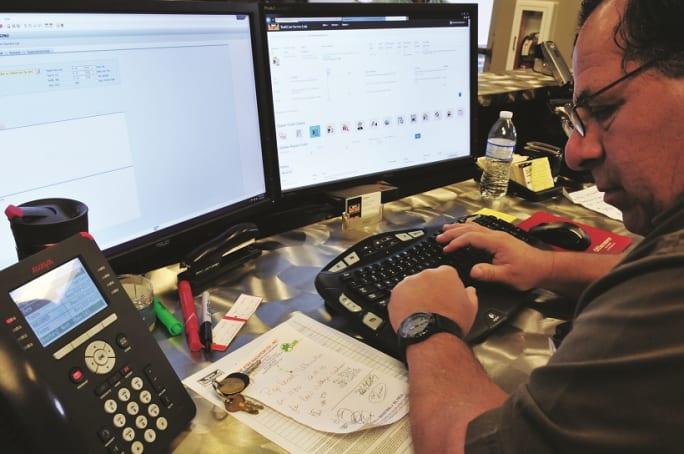
Dealership service writers will know what the problem is before the truck drives onto the lot. Predictive analytics can help with parts inventory and technician training programs to keep the service process moving faster.
Photo: Jim Park
Predictive maintenance, like perpetual motion, would be a great idea if it we could make it work. The prospect of predicting when a component might fail so it could be replaced just before it causes some inconvenience or calamity has had fleet maintenance managers salivating for decades. Some say with sophisticated electronics and complex analytic algorithms, we’re closer to the dream today than ever before. Others shrug and say, “been there, tried that.”
In a sense, both trains of thought are legitimate. The end game is the same, but the tools have changed. Can today’s tools get us any closer than 75 or 80% accuracy?
“Predictive maintenance does have a place in transportation,” says Joe Puff, vice president of truck technology and maintenance at NationaLease. “The question is, where and when is it practical for a fleet? In order for it to be fully effective, at least one of two criteria have to be met: scientific evidence or conclusive historical data.”
The data that we get today is extremely powerful, but the science behind a failure is extremely difficult to prove, because there are so many contributing factors, such as evolving truck technology and different applications and duty cycles.
For example, Puff says we can predict when we’ll need to clean or change a diesel particulate filter or predict certain injector failures by measuring how much fuel goes through an engine under what duty cycles. “On the other hand, some failures are related to metallurgy or manufacturing or one-off anomalies,” he says. “It’s very difficult to see them coming – at least the first of them – because we don’t have the historical record of previous failures.”
Even the value of that historical data is debatable because some technology evolves so quickly. “Parts are constantly changing, so it’s very difficult to say new components will perform the same way old components did,” Puff adds.
If historical data on component lifecycles is no longer a reliable predictor of impending failure, then what we have left is scientific evidence, he says – which isn’t hard to come by with today’s technology.
Recent-vintage trucks produce about four gigabytes of data in a single day. Much of that is related to the condition and operation of the hundreds of onboard systems and components. Capturing meaningful bits of information that contain clues about a potential problem is the new science of predictive maintenance – or predictive analytics.
It’s not predictive in the old sense, where we wanted to know at what mileage a part would fail so we could pull it in advance. This is more about identifying problems on the fly and formulating correct responses to the problem.
“The proliferation of sensors and the data they produce, combined with our data science capability, helps a fleet to know what is likely to fail well before it does,” says Keith Mader, vice president, transportation analytics, Trimble Inc., which brings together the talents of TMW and PeopleNet. “Fleets aren’t doing just preventive maintenance, which is important for all the usual reasons; now they have predictive capabilities. They can determine the implications of the impending problem and take the appropriate steps while there is still time to plan.”
Mader says it’s not usually a go/no-go proposition (though that can be the case with critical failures), but rather a probability situation. The system sorts through a collection of fault codes and determines that when certain conditions are present, a particular failure will result 75-80% of the time. “We are giving you enough information to imply the likelihood of an occurrence,” he says.
Determining the appropriate course of action may still require a little troubleshooting by the maintenance department. Jarit Cornelius, vice president of maintenance and compliance at Ethridge, Tennessee-based Sharp Transport, has been studying the fault codes and probable-failure messages and has developed a proactive and evolving preventive maintenance program based on what’s going wrong in the field.
“With the data, I can incorporate a proactive fix, or at least add certain inspection points, into the PM,” he says. “Aftertreatment is still the four-letter word of truck maintenance, but I have to say we don’t find it a big problem. Because of the previous codes we’ve seen, we have been able to build a pretty robust aftertreatment service program into our PM process. We are constantly flushing out DPFs, cleaning doser valves, and pressure testing EGR coolers, all at 30,000- to 50,000-mile service intervals. I rarely get aftertreatment system codes anymore.”
Sharp’s program pulls together the history and science of truck maintenance. Cornelius used the codes to foretell of a problem, and the historical data from previous failures to prevent reoccurrences.
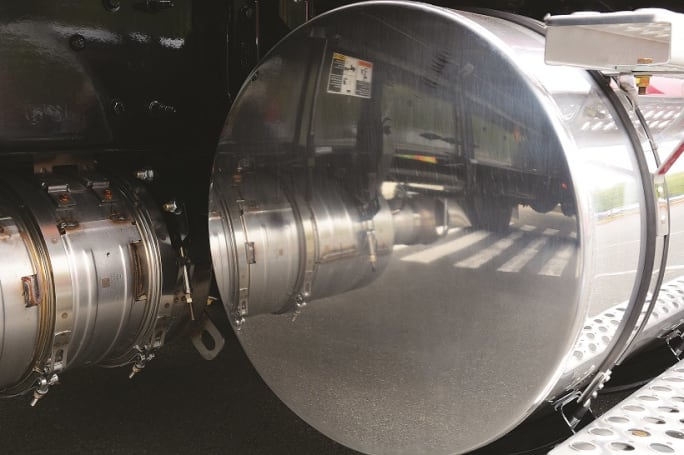
While aftertreatment system faults are amply represented in the data, they are supplemented with additional background information that can help identify the source of the problem.
Photo: Jim Park
To Pull or Not to Pull?
Fleets can now use the benefits of analytics and historical data to decide whether they should pull a part before it fails in order to prevent an in-service failure that might lead to unscheduled downtime.
Thermo King’s senior manager of digital analytics, Scott Stark, says the benefits of doing that proactive service can often be hard to quantify.
“The cost of pre-emptive replacement needs to be balanced with the benefits from reduction of in-service failures,” he says. “For example, what is the cost to your business of missing a delivery window for a new customer? We do know that customers who participate in our preventative maintenance programs see a 30% average decrease in the total number of unscheduled downtime events. Part of that program involves the identification of parts that might fail and recommendations on early replacement, dependent on each customer’s operation.”
But if you replace a part before it fails, is it eligible for warranty?
Usually not, we’re told. But if you wait for it to fail, you’ll have other indirect costs – opportunity costs, towing, inconvenience, customer dissatisfaction, unhappy drivers ... Depending on the cost of the part, it might be much less expensive to give up the warranty. However, data might reveal a pattern to the failures than can help settle a claim with an OEM if it can be shown to be a repeated failure, as Cornelius did recently.
“Through good documentation from my technicians and VMRS coding, I saw that we had surge tanks that were cracking at exactly the same spot at the same mileage,” he says. “I was able to get with the OE, discuss the problem, and get replacement tanks in so they could be installed on the next PM. I got about 75% of my costs back from the manufacturer because I paid attention to the data.”
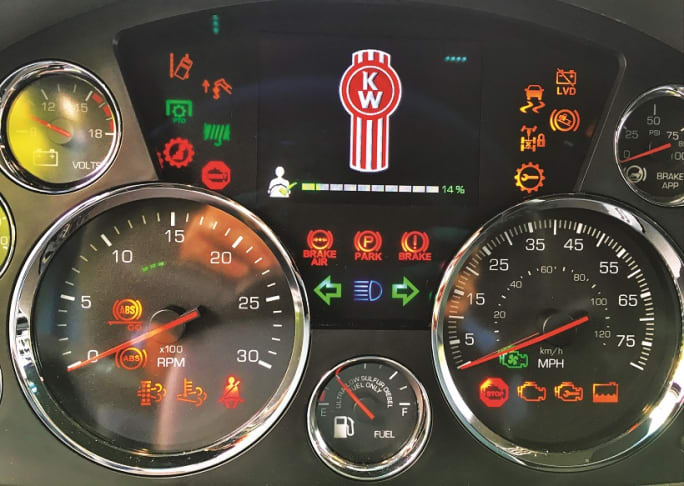
Drivers needn’t fear the red and yellow dash lamps. The fleet and the OEM probably already know what the problem is before the light even comes on.
Photo: Jim Park
Cross-Platform Visibility
Fleets have all this data streaming at them; what do they do with it? Many fleets operate trucks from a variety of manufacturers, which imposes its own maintenance hurdles, but how do they manage to sort diagnostic data from different sources? A cross-platform solution such as TripVision from Noregon permits the fleet to monitor all its trucks without switching between applications.
“Even fleets with a single make and model of vehicle benefit from the ability to monitor more than just a single component within their remote diagnostic platform,” says Dave Covington, chief technology officer for Noregon. “A multi-platform tool empowers the user to detect faults on every major component while alerting [them] to the severity level of the entire vehicle based on the collective faults from each component.”
On top of that, a fleet manager with a single consolidated portal can view the status of all the equipment, its maintenance history, current faults, and where those assets are and when they will be returned to service.
“A single-point service and maintenance management solution can provide a much better audit trail on all warranty items and OEM performance,” says Mark Wasilko, vice president, heavy equipment and industrial markets at Decisiv. “It’s also easy to make comparisons between OEMs or individual components to see where the costs are. Maybe the cost of ownership was lower with OEM A because they have a more efficient service process, a better communications process and a more efficient service operation than OEM B.”
There’s no doubt that on-board diagnostics and predictive analytics have brought more certainty to the preventive maintenance process, but some seasoned maintenance specialists insist there’s a need to “understand the iron,” too.
“Data-based forecasting is fine for components with sensors, but what about hardware without sensors, like brakes, water pumps and turbochargers?” asks Darry Stuart, a fleet maintenance consultant and frequent moderator at the Fleet Talk and Fleet Forum sessions at the American Trucking Associations’ Technology & Maintenance Council meetings. “My predictive maintenance plan goes out only as far as the next PM. If the component can’t make it to the next PM, it’s time to change it. Truck maintenance will always be a bit of a gamble, but it’s really like a game of horseshoes; you can still win by just being close.”
More Maintenance

Color Match Smarter: Tools That Restore & Perform
For fleet managers and collision repair professionals keeping heavy-duty trucks on the road, getting the color right the first time isn't just about appearance — it's about efficiency, turnaround time, and bottom-line results. Discover how today's digital color tools are transforming the repair process from guesswork to precision.
Read More →
Wrong Repair Prompts Recall of Freightliner, Western Star 4x2 Trucks
DTNA is recalling more than 2,400 trucks that received an incompatible software fix instead of the hardware repair required to address brake valve corrosion.
Read More →
Truck Drivers Need More Than Another Alert
Fleets have more visibility into truck health, safety events, and driver activity than ever. The next challenge is turning all that information into useful guidance for the person who has to decide what to do next.
Read More →
The Maintenance Checks Trucking Fleets Should Prioritize Before Fall Freight Picks Up
Making it through August isn’t the same as being ready for the next several months of operation. Find out what systems may have suffered from summer heat and need to be checked out before fall.
Read More →
What Three Fleets Are Doing Differently When Buying Truck Parts in 2026
With freight improving but costs still climbing, fleet maintenance executives explain how they're balancing price, quality, and supplier relationships.
Read More →
Paccar Recalls 2027 Trucks Built This Summer for Possible Electrical Problem
The nearly 6,000 Kenworth and Peterbilt trucks in the recall could potentially lose engine power, among other things.
Read More →
Will API PC-12 Oil Change Trucking Fleet Maintenance?
The new API PC-12 heavy-duty engine oil category reflects the changing demands of modern diesel engines. But fleets like Foodliner are looking to getting their own data before making decisions on adopting the new oils and questions such as extending oil drain intervals.
Read More →
Brake Safety Week to Focus on Drums and Rotors
Commercial vehicle inspectors are focusing on truck brakes during CVSA's Brake Safety Week, August 23-29.
Read More →Possible Battery-Cable Fires Prompt Recall of 15,000+ International MV and HV Trucks
On the recalled vehicles, manufacturing variations can cause the battery interconnect cable to contact the auxiliary stud and hold down the bracket.
Read More →
Rush, MCT Team Up to Grow Refrigeration Service Network
The joint venture will operate MCT's network of Carrier Transicold dealerships and mobile service locations, with the companies promising greater service capacity and uptime for refrigerated fleets.
Read More →