




Daimler Trucks North America Targets Ambitious Uptime, Truck Parts Goals
“Tell me more, tell me sooner, and fix my truck faster.” That’s what customers want, according to Stefan Kurschner, Daimler Trucks North America's senior vice president, aftermarket, talking to reporters at a DTNA press event in Yountville, Calif.

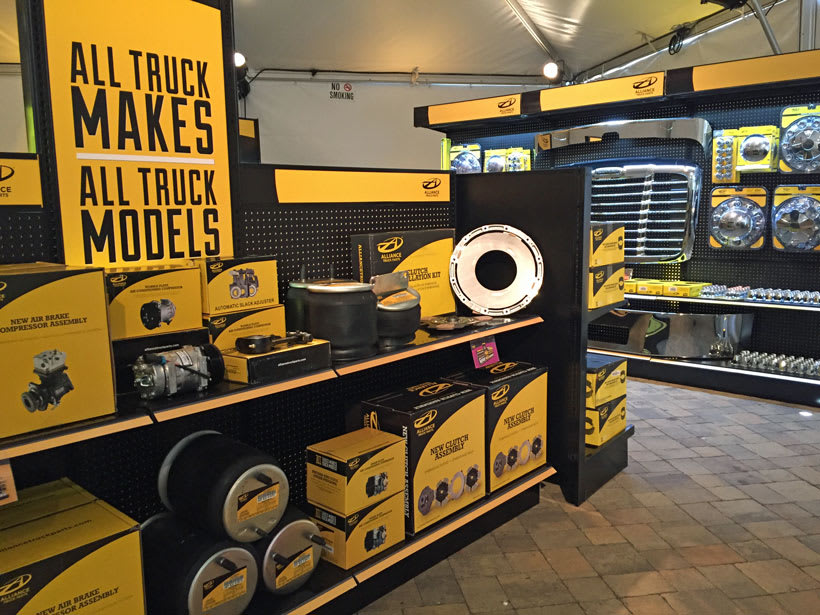
Alliance Truck Parts officials showed reporters a sample of what their new retail setup looks like. Note the accessories in the back -- like candy at the register, these are items that customers are more likely to buy if they see them on display.
Photo by Deborah Lockridge
Daimler Trucks North America announced that it’s working toward a goal of 24-hour turnaround service times at its dealers, as well as a significant expansion of its Alliance Truck Parts business.
“Tell me more, tell me sooner, and fix my truck faster.” That’s what customers want, according to Stefan Kurschner, DTNA senior vice president, aftermarket, talking to reporters at a DTNA press event in Yountville, California. He announced enhanced digital solutions and a new parts distribution center to help make that happen.
Better, Faster Truck Repairs
Recently, DTNA’s Elite Support network – which has more than 280-certified dealers – spearheaded an effort to narrow the repair-time window to 24 hours, and DTNA wants to make that happen across its dealer network. Today about 56% of our dealerships are achieving that. And 80% in Elite Support network.
When asked if that 24-hour turnaround would be backed by some sort of guarantee, Kurschner said that expectations will be outlined for what types of repairs fall into this arena. “Obviously if you have a big accident. we’re not going to rebuild your truck in 24 hours. It’s not engine rebuilds or collision repair. But if you have a regular service event we’re going to make it happen.”
One way it’s doing that is through expanded digital tools and communications. The new DTNA Service Tracker is a web-based, mobile application that lets customers track the status of their truck service or repair in real time, on demand. Customers can opt to receive notifications about the repair status of their vehicle, review and approve estimates, and communicate in real time with the service location.
Marty Kubiak, DTNA manager, service systems, noted that Service Tracker allows for easy communication between the customer and dealer, rather than wasting time on the phone (or more likely, on hold.) And if you do have to call in to the dealer, he says, everyone has access to the same information.
Service Tracker is a new addition to DTNA’s suite of uptime management tools that streamline communications between customers and the dealer network. This suite of products already allows service writers to connect to the truck via a tablet when the truck comes in and quickly process a repair order, helps technicians through the diagnostic and repair process, and integrates with dealer management software.
Currently, Service Tracker is running as a pilot with five fleets. It’s scheduled to be rolled out in September.
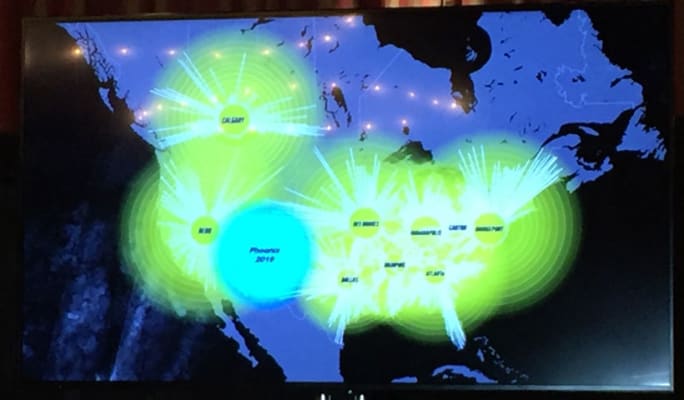
A 10th parts distribution center will mean 90% next-day parts availability.
Photo by Deborah Lockridge
To help make sure dealers can get the parts they need to fix trucks quickly, in early 2019, DTNA will open its 10th parts distribution center. With the addition of the new PDC in Maricopa County, which encompasses the greater Phoenix area, next-day delivery of parts will be available to more than 90% of DTNA’s U.S. dealers. DTNA’s existing network already reaches more than 80% of the U.S.
The facility in Phoenix will be the fourth parts distribution center opened by DTNA in just over two years. DTNA has also recently opened new parts distribution center in Des Moines, Indianapolis and Dallas.
Alliance Truck Parts: Aiming to be the Market Leader
Of course not all service and repairs take place at the dealer or use OE parts. That’s why DTNA is making a major push in its all-makes and value truck parts business, with a renewed focus on its Alliance Truck Parts brand and a team dedicated to that effort.
“We understand we need to substantially up our game in the value side of truck parts,” Kurschner said. While Alliance Truck Parts is a recognized brand name, he said, the company now aims to make it the leading brand in the value parts market.
Noting that the parts business is a $30 billion plus market, according to MacKay & Company, John Finn, DTNA director of aftermarket marketing, explained that the company sees the opportunity to go after the entire parts business, not just the OE parts market.
“We want to be the one-stop parts solution,” Finn said.
To help with that goal, Alliance Truck Parts is growing its product lines from the current 52 to more than 80. More than 15 new product lines from Alliance Truck Parts are scheduled to launch over the next several months, such as collision-repair parts, shocks, and filters. This is on top of 10 product lines already added in the past year, such as steel wheels, as well as Alliance Powertrain by Mascot remanufactured powertrain parts.
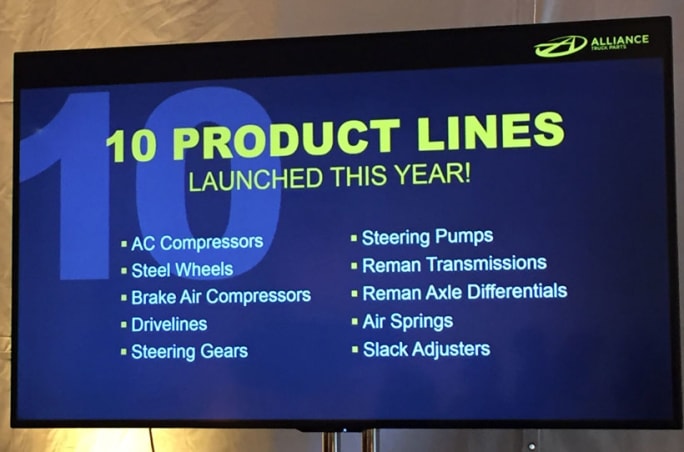
Alliance Truck Parts has been busy adding product lines and plans to offer at least 80.
Photo by Deborah Lockridge
In addition, working with its dealers, Alliance is opening new retail locations, both as a store-within-a-store in dealerships and at stand-alone locations. Daimler execs explained that there are some customers who simply don’t look to dealerships for their parts. And stand-alone retail locations make sense in areas where customers need parts but there’s not enough demand for a full service dealership. There are three of these stand-alone stores open so far, and another dozen in the works.
To help give customers the best experience buying Alliance truck parts, DTNA partnered with experts in retail sales to develop these new stores.
Also in the works at Alliance Truck Parts for next year are new digital tools –“a new emphasis on digital like I haven’t seen in my 24 years,” Finn said, including a new retail-focused website that will give customers easy access to information on things like dimensions, weight, and useful life of a part. In addition, parts salespeople at dealers will have easy digital access to 1-page product guides giving them information they need to answer customer questions, and a new mobile app coming out later this year that also will offer information on Alliance parts.
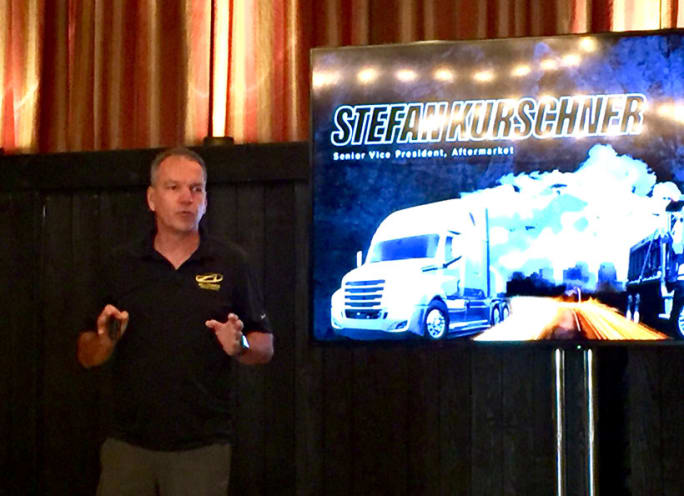
DTNA aftermarket chief Stefan Kurschner explains the company's parts and service initiatives to reporters in California.
Photo by Deborah Lockridge
Kurschner explained that value parts provide a good value for the price for customers that may not want or need a part that’s going to last 10 years. And not only is there the traditional competition to consider, but also increasing competition from online parts sales – although right now, more than half of truck parts sales are still conducted over the phone, he said.
But when asked about current market share position vs. its goals, Kurschner explained that those numbers are complicated – there’s no central repository like there is for truck sales. “I I can tell you we are not number one, that we know. We know we have room to grow.” He also explained that it’s not just about wanting to be number one; with DTNA holding the lion’s share of the Class 8 market in the U.S., he noted, “we have the obligation to bring parts and service to our customers.”
Related: DTNA Predicts Year of High Truck Sales, Technology Advancements
More Maintenance

Color Match Smarter: Tools That Restore & Perform
For fleet managers and collision repair professionals keeping heavy-duty trucks on the road, getting the color right the first time isn't just about appearance — it's about efficiency, turnaround time, and bottom-line results. Discover how today's digital color tools are transforming the repair process from guesswork to precision.
Read More →
Wrong Repair Prompts Recall of Freightliner, Western Star 4x2 Trucks
DTNA is recalling more than 2,400 trucks that received an incompatible software fix instead of the hardware repair required to address brake valve corrosion.
Read More →
Truck Drivers Need More Than Another Alert
Fleets have more visibility into truck health, safety events, and driver activity than ever. The next challenge is turning all that information into useful guidance for the person who has to decide what to do next.
Read More →
The Maintenance Checks Trucking Fleets Should Prioritize Before Fall Freight Picks Up
Making it through August isn’t the same as being ready for the next several months of operation. Find out what systems may have suffered from summer heat and need to be checked out before fall.
Read More →
What Three Fleets Are Doing Differently When Buying Truck Parts in 2026
With freight improving but costs still climbing, fleet maintenance executives explain how they're balancing price, quality, and supplier relationships.
Read More →
Paccar Recalls 2027 Trucks Built This Summer for Possible Electrical Problem
The nearly 6,000 Kenworth and Peterbilt trucks in the recall could potentially lose engine power, among other things.
Read More →
Will API PC-12 Oil Change Trucking Fleet Maintenance?
The new API PC-12 heavy-duty engine oil category reflects the changing demands of modern diesel engines. But fleets like Foodliner are looking to getting their own data before making decisions on adopting the new oils and questions such as extending oil drain intervals.
Read More →
Brake Safety Week to Focus on Drums and Rotors
Commercial vehicle inspectors are focusing on truck brakes during CVSA's Brake Safety Week, August 23-29.
Read More →
Possible Battery-Cable Fires Prompt Recall of 15,000+ International MV and HV Trucks
On the recalled vehicles, manufacturing variations can cause the battery interconnect cable to contact the auxiliary stud and hold down the bracket.
Read More →
Rush, MCT Team Up to Grow Refrigeration Service Network
The joint venture will operate MCT's network of Carrier Transicold dealerships and mobile service locations, with the companies promising greater service capacity and uptime for refrigerated fleets.
Read More →