





Related: On the Spot: First Impressions of Volvo's SuperTruck [Video]
Driving Volvo’s SuperTruck
What you can see of Volvo’s SuperTruck vehicle is pretty spectacular, though fairly plain at heart. It’s what you can’t see that stirs the imagination. Equipment Editor Jim Park explains in this first-person Test Drive.
April 27, 2017
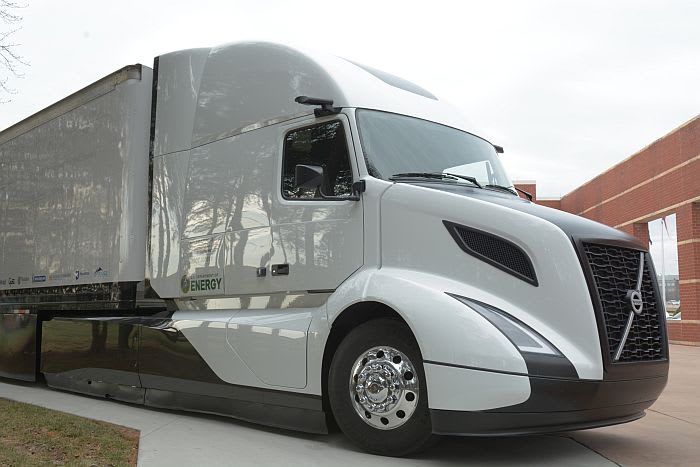
Volvo’s SuperTruck uses advanced engine programming to reduce energy consumption and old-fashioned aerodynamics to reduce drag. Photos: Jim Park
6 min to read
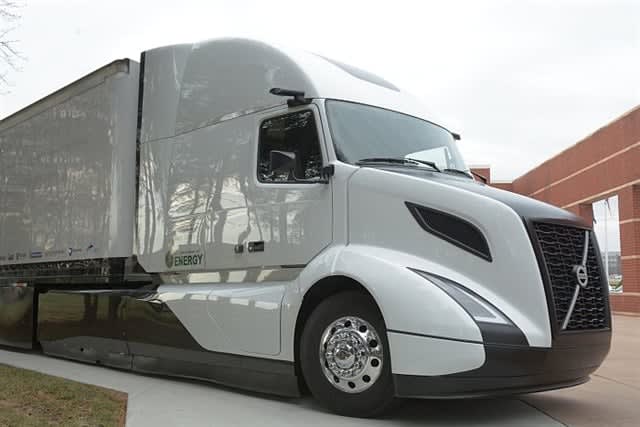
Volvo’s SuperTruck uses advanced engine programming to reduce energy consumption and old-fashioned aerodynamics to reduce drag. Photos: Jim Park
What you can see of Volvo’s SuperTruck vehicle is pretty spectacular, though fairly plain at heart. It’s what you can’t see that stirs the imagination.
Volvo opened the doors to its SuperTruck to journalists for the first time in February, and my colleague, Senior Editor Jack Roberts, and I were the first two through the door. This was an usual test drive experience in that we weren’t evaluating steering and braking and cab noise or even driver comfort. This drive was about experiencing the advanced technology born of the Department of Energy matching funding and getting a glimpse of what you could be driving two to five years from now.
The dashboard, driver area and sleeper interior are stock Volvo VNL 780. Our tour guide, Keith Brantley, senior project manager for the complete vehicle, says the design team saw no point in revamping the interior because it made no direct contribution to the goals of the project.
However, the exterior of the cab is brand new.
Designers optimized the roofline and the frontal profile of the truck to minimize aerodynamic drag. The cab is 3 inches taller and 8 inches longer than a standard VNL, and narrower at the front than at the back. The custom-made windshield is steeply raked and dramatically curved to match the cab and hood profile. The hood is so severely sloped that it was impossible to see from the driver’s seat. It was like driving a cabover.
The trailer is fitted with a boat tail on the back, a gap-reduction device on the nose, and full-length and full-height skirts on the sides. Those skirts were widely criticized, as they have been on other SuperTruck projects, as being completely impractical in the real world. I get it, and Volvo does too.
The designers were not trying to sell fleets on the idea of full-length and full-height skirts; their goal was to push a Class 8 tractor trailer loaded to 65,000 pounds – the U.S. DOT-acknowledged average weight of a loaded tractor-trailer – down the road using the least possible fuel. Volvo’s truck officially clocked better than 12 mpg, with several test runs exceeding 13 mpg.
This truck is a rolling laboratory, a technology test-bed, a mobile proving ground, if you will. It’s not available for sale and it never will be. So, yes, some elements of the design are impractical now. But if the day comes when fuel tops 5 bucks a gallon, clever engineers will figure out ways to make the full-height skirts practical for fleet use — because they work. SuperTruck proves it.
Because of all of that aero cladding and the steps taken to reduce rolling resistance and mechanical drag within the drivetrain, the truck requires 35% less energy than the baseline 2014 Volvo VNL (120 hp vs. 188 hp) to maintain 65 mph on flat ground. The 10.8L D11 engine under the hood produces 425 hp and a surprising (for the displacement) 1,700 lb-ft of torque. The engine features common-rail fuel injection, the new “wave” piston design, a newly designed cooling package and fan shroud, low-viscosity oils, and turbo-compounding, among other interesting technologies.
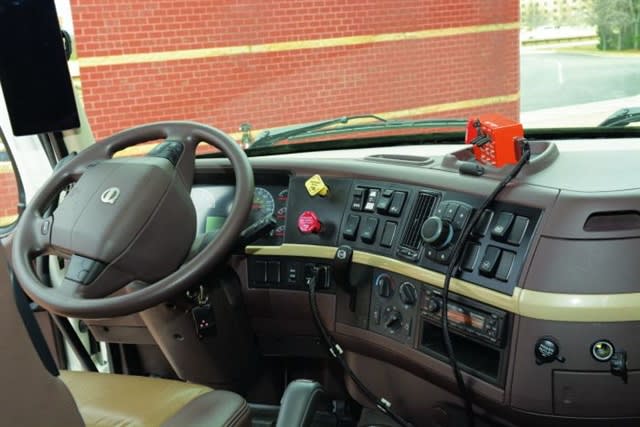
Engineers decided it made no sense to spruce up the interior of the truck because that would not further the efforts to improve freight efficiency. It’s a standard VNL 780 cab with a few switches dedicated to the project.
Advanced technology
So what’s it like to drive? It’s a bit nerve-wracking messing with traffic on a public highway in a virtually irreplaceable truck that’s worth more than $2 million. Having said that, it’s not all that different from any other VNL I’ve driven in the past five years.
The two big surprises were the near-complete lack of wind noise and how easily it rolls on a downhill grade — owing to the lower mechanical rolling resistance and the massive reduction in aerodynamic drag. It feels like you’re pouring on the power, but the driver display reveals the transmission is in neutral and the engine is idling at 700 rpm.
Buried deep in the programming are two systems basically invisible to the driver that provide significant energy savings. One programs the air compressor to cycle on only when the truck is coasting, thereby using no fuel to charge the brake system (under normal circumstances). The other is the electrical charging system: two 48-volt, 250-amp alternators that, again, cycle on only when the truck is coasting. The net effect is that all the energy required by those systems comes from vehicle momentum rather than from burning fuel.
The other notable feature was what I’ll call a predictive cruise control system. Brantley was reluctant to relate the SuperTruck’s cruise system to Volvo’s currently available I-See, so I have to assume it was not I-See or even an advanced version of it. However, the system does use GPS terrain maps, it has a look-ahead feature, and it uses some really interesting fuel mapping and shifting strategies to achieve optimum power for the terrain.
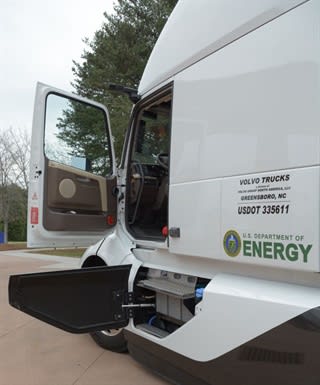
Even the driver and passenger access steps are covered for better drag reduction. That’s impractical at the moment, but an idea worth further exploration.
Brantley told me the engine produces 1,700 lb-ft of torque from 900-1,300 rpm. With a 2.47:1 axle ratio and an overdrive I-Shift transmission, the truck cruises at 65 mph at 1,050 rpm. That’s fairly low on the torque curve, so when approaching a hill the truck frequently downshifted to 11th gear at about 1,300 (top of the peak-torque range) and strolled up the hill at maximum torque and minimum fuel consumption – but one gear down.
It also gave up a few mph on the upgrade, knowing in advance that it would make up the loss when coasting down the other side. The controllers backed off the throttle close to the top of the hill, and sometimes — not always, which surprised me — dropped into neutral. Brantley assured me the system was functioning as designed.
All I could conclude from the pattern was that the system saw some savings opportunity that I didn’t. If it were up to me, I would have shifted to neutral. Instead, the truck stayed in gear some of the time, and by virtue of its look-ahead capacity readied us for the next hill. It’s clearly smarter than I am. And that’s half the battle with this new technology.
If drivers are to take full advantage of it, they really should let the truck do its thing. Many, however, won’t like the idea of giving up a little road speed when climbing a hill in order to ease the load on the engine. That’s where a good chunk of the fuel savings come, I think.
Volvo has proven with its SuperTruck project that an 11-liter engine works just fine in most line-haul, truckload applications with gross weights below 80,000 pounds. This downsizing of the powertrain opens doors to huge fuel savings, and along with the highly advanced power management strategies we’re seeing from Volvo’s and other OEs’ SuperTruck projects, I think the truck of the future will be quite different in many ways from what we’re driving today, even if they don’t look that different.
Subscribe to Our Newsletter
More Equipment

How Volvo Updated Its D13 for EPA 2027 [Watch]
Volvo’s updated D13 promises lower emissions without sacrificing performance or fuel economy. Take a closer look at what changed inside the engine in this HDT Spotlight video.
Read More →
Michelin Tire Improves Efficiency and Durability for Regional Fleets
The Michelin X Multi Energy D2 is a regional haul drive tire engineered to help fleets improve fuel efficiency, durability and traction in demanding stop-and-go operations.
Read More →
ZF Expands Commercial Vehicle Push in North America
ZF is expanding its North American commercial-vehicle presence with new transmission applications, electrification, trailer technology and autonomous-driving systems.
Read More →
Tesla Wants a Self-Driving Semi. Are Cameras Enough?
Could Tesla’s camera-only autonomous driving technology work on an 80,000-pound Semi? In this commentary, HDT's Deborah Lockridge takes a look at Tesla, Cybercab, and how autonomous trucks see the road.
Read More →
Kodiak: Driverless Long-Haul Truck Launch on Track for 2026
Kodiak AI says its driverless long-haul safety case is 93% complete and it remains on track to begin commercial operations by year-end 2026.
Read More →
What DOT’s Automated Vehicle Strategy Means for Trucking
The U.S. Department of Transportation issued a new automated-vehicle strategy that outlines plans for driverless-truck regulations, cross-state freight corridors, and federal safety standards.
Read More →
East Coast Port Launches $45M Electric Truck Push
The Port Authority of New York and New Jersey announced millions in incentives for zero-emission drayage trucks, yard tractors, and new charging hubs near the port.
Read More →
PlusAI Going Public to Fund Autonomous Truck Launch
A SPAC deal could provide PlusAI with up to $300 million as it works toward a 2027 commercial launch of factory-built autonomous trucks.
Read More →
NHTSA Moves to Rewrite Truck Fuel-Economy Rules
The National Highway Traffic Safety Administration says it lacks authority to regulate medium- and heavy-duty truck engines separately from complete vehicles, but the existing standards have not yet been eliminated.
Read More →
Detroit Opens Orders for EPA 2027 Engines
Detroit isn’t starting from scratch to meet EPA 2027 diesel emissions standards. Its Gen 6 DD13 and DD15 engines keep much of today’s platform while updating the fuel and aftertreatment systems.
Read More →