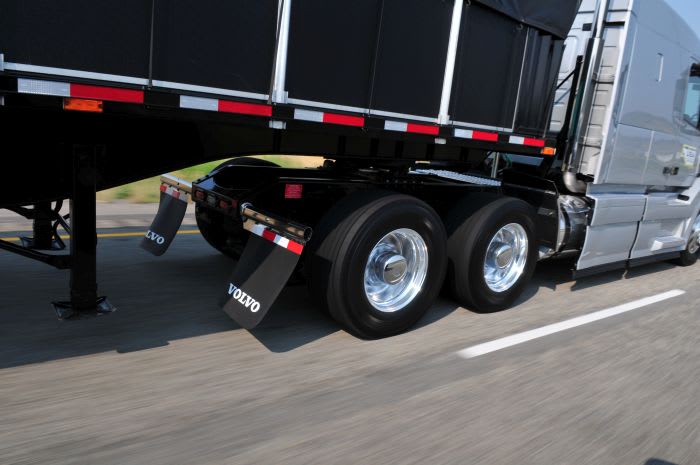
Putting all the engine torque through the tires on a single drive axle stresses the tires and can cause rapid tire wear.Photos: Jim Park
8 min to read
Putting all the engine torque through the tires on a single drive axle stresses the tires and can cause rapid tire wear. Photos: Jim Park
If I were a tire, the last place I’d want to be is a drive tire on a 6x2. The North American Council on Freight Efficiency’s Confidence Report on 6x2s, released in January 2014, noted that operators can expect drastically diminished life from tires used on 6x2 drive axles.
Ad Loading...
“Data from tire manufacturers and several fleets indicates that the usable tire life on a 6x2 drive axle is actually about one-third that of 6x4 drive tires,” the report states. One-third. That’s a lot of tire life to forfeit in pursuit of improved fuel mileage.
What kills 6x2 drive tires? Mostly, it’s torque. But it doesn’t have to be that way.
Ad Loading...
“On the driven axle of a 6x2, the torque will all go through one axle as opposed to two axles on a 6x4,” explains Paul Crehan, director of product marketing at Michelin Americas Truck Tires. “Fleets should operate a drive tire that can handle the tractive forces that will be transmitted through one axle as opposed to two in a 6x4 setup. As well, some tread designs may handle the torque of a 6x2 better than other designs.”
In reality, a 6x2 behaves much the same as a 4x2 — a single drive-axle tractor. There are tires designed for those applications, such as Goodyear’s G572 1AD, but they aren’t as common as typical long-haul drive tires found on most 6x4 tractors.
Michelin says it offers several tires well suited for single-axle applications that would perform well as 6x2 drive tires, such as the Michelin X Line Energy D or the Michelin X Multi Energy D for optimum fuel efficiency, the XDN2 for better traction or the XDS2 for extreme snow or mud conditions.
A couple of other factors compound the wear problem on 6x2s. The drive tires can suffer tread damage if the drive wheels on the tag-type 6x2 see a lot of slippage in gravel or other rough surfaces.
Tires on the non-driving axle can suffer too. They will see wear symptoms typical of a free-rolling tire, such as river/erosion wear, diagonal wear (from lightly loaded conditions), shoulder step/chamfer wear and shoulder wear (from tight turns). Interestingly, because the non-driving tire does not experience the torque-related scrubbing, its wear rates might actually be quite slow, but free-rolling type wear may appear sooner than expected.
Ad Loading...
Many fleets run trailer tires on the non-driving axle to reduce costs. Using a lower cost tire at this position can partially offset the increased drive tire costs associated with the faster wear rates.
“Since traction is not as much of a factor for the dead axle, a rib will suffice as long as it still fits the application,” says Rick Phillips, vice president of sales for Yokohama Tire Corp.
Randy McGregor, fleet manager of Transway Inc., a long-haul truckload carrier based in Holland, Mich., runs a regional steer tire on his tag axles. He says the forces acting on the tag axle tires resemble the forces acting on a steer tires more than a drive tire.
“A drive tire is designed to wear properly under torque loads, not scrub loads,” he says. “The rear axle has no torque on it, but it’s constantly scrubbing, getting dragged around turns. The wear is closer to that of a steer axle.”
McGregor has been playing with tires on his 6x2s for several years now, and has seen the best combination of wear, fuel economy and tire life from a regional type of drive tire rather than a long-haul drive. “Regional drives are designed for lots of starting and stopping and high torque loads,” he notes. “A SmartWay-verified regional tire still does well on fuel economy, but I find it wears better than a really fuel-efficient drive tire.”
Ad Loading...
These tires are on one of Ploger’s 6x2 tractors. Both have about 70,000 miles on them. The tire on the left is a drive tire, with shoulder grooves at 23/32 and center grooves at 25/32 (27/32 when new). The tire on the right is on the lift axle. All grooves are at 17/32 (when new).
Tag or pusher?
The tire-wear discussion is further complicated by the presence of two types of 6x2s: the tag- and the pusher-type axles. Most 6x2 offerings are the tag-type, with Volvo being the only OEM currently offering a pusher — and a liftable pusher at that. Hendrickson offers a 6x2 suspension with a liftable axle in a rear-drive configuration now called OptiMaax. It’s currently available as an aftermarket upfit or installation at an OEM modification center, but Hendrickson is working with OEMs to make this system available as a production option.
While NAFCE’s 6x2 report made no distinction between pusher and tag axles with respect to tire wear (pushers were not widely available when the report was published), anecdotally we hear there can be significant differences.
Volvo’s Adaptive Loading option lifts the non-driving axle when it’s not required. This obviously increases the lifespan of the tires on the liftable axle, and there appear to be benefits to the drive tires as well.
Gene Brice, the co-owner of Idaho Milk Transport, a food-grade liquid bulk fleet based in Burley, Idaho, says while running empty, which is about half the time for IMT, there’s about 10,000 pounds spread between the four wheel positions. By lifting the non-driving axle, the weight on the drive tires doubles and wear is significantly reduced.
“We’re putting about 5,000 pounds on each of the wide-single drive tires when the lift axle is up instead of about 2,500 pounds when empty with all four wheels on the ground,” Brice says. “We’ve seen a real increase in tire life and a reduction in maintenance costs since we started using liftable axles.”
Ad Loading...
However, warns one tire expert, don’t overlook the importance of tire maintenance.
”When you lift a dead axle off the ground in order to improve traction, you concentrate all of the truck’s load on the drive axle alone,” says Brian Buckham, general manager of product marketing at Goodyear. “Because the truck’s load is concentrated on the drive axle, even for a short amount of time, it is important to adhere to established tire maintenance practices, including running with correct inflation pressure.”
Winter traction is critical for 6x2s. Tire specs need to balance fuel efficiency with traction for safety and driver acceptance. Unfortunately, 6x2s seem to be particularly hard on drive tires with aggressive tread.
Does inflation pressure matter?
We saved the controversial part for last. Most fleets, we hear, continue to run 100 psi in their 6x2 drive tires because that’s the way they have always done it. But a 6x2 isn’t a 6x4 and may require a fresh look at inflation pressure. There’s a small, 30-truck fleet called Ploger Transportation based in Bellevue, Ohio, that is doing something really out of the box and getting some amazing results. These are self-reported, I should stress, and we haven’t verified the claims except to see the photos of the tires.
Ploger runs several Volvo 6x2s with the Adaptive Loading system. It uses a pusher-type axle that lifts when not needed. The rest of the time, Volvo uses a load-biasing algorithm to keep more weight on the driving axle than the pusher axle for optimum traction. Weights usually vary in a 50/50 to 60/40 split but can go as high as 70/30 when extra traction is needed. It’s all automatic.
Ploger’s director of research and development, Joel Morrow, is a driver who is out on the road every day, turning 115,000 miles a year or more. It’s his job to monitor the performance of the trucks, and in this case, the tires. He gets all the test trucks and the test tires too. Ploger has been testing a Yokohama tire package for several months now on three trucks:
Ad Loading...
Drive tire: Yokohama 902L — 445/50/22.5, 20-ply load range L @ 15,000 lbs average axle load, 85 psi inflation
Non-driving tire: Yokohama RY407 — 445/50/22.5, 20-ply load range L @ 15,000 lbs average axle load, 85 psi inflation
Steer tire: Yokohama 104ZR Spec II — 315/80/22.5, 22-ply load range L @ 12,500 lbs average axle load, 80 psi inflation
You’re reading that right, 85 psi in the tandem axle tires and 80 psi in the steer tires.
Drive tires in tests now are getting an astonishing 30,000 miles or more per 32nd of rubber in the center grooves of the tire. The tires on the lift axle are getting slightly less than the drive tires. Both are tracking to run 400,000 miles if nothing happens to them.
“I’m absolutely convinced the lower-than-normal but manufacturer-recommended inflation pressure makes a huge difference,” Morrow says. “At 80 or 85 psi, the footprint is the way the manufacturer designed it to run. It’s huge, and the traction is fantastic, but it doesn’t seem to be hurting our fuel economy.”
Morrow reports his fuel economy from December 1 through March while running at 70 mph with idle time figured in is 7.0 mpg. During the summer he says it climbs to 8.2 mpg at the same speed, and he’s running with no aerodynamic treatment on the trailer and limited additional aero on the truck.
Ad Loading...
For the record, the 104ZR Spec II, 315/80/22.5, is marketed by Yokohama as a regional and longhaul tour bus/motor coach tire. Morrow says because the air chamber of the tire is so much larger than a standard 11R22.5 tire, running only 80 psi meets the load and inflation table minimums for the weight (13,500 lb) and provides a very smooth ride. More remarkable is the wear – or lack of it. Morrow also fully expects to see more than 200,000 miles out of the steer tires.
It’s clear that the 6x2 axle configuration has an impact on tires, but it may not be that alone that chews them up. There’s compelling evidence that limiting torque (see sidebar) can improve tire wear, and that inflation pressure and tire choice can also influence wear rates.
The 6x2 is a different critter from a 6x4; there’s no reason to assume that everything else ought to be the same.
The evolution of the modern truck was a long, slow affair. But perhaps no other company did more to establish the template for what a modern truck should be, and how it should perform, than REO.
Western Star has expanded its operator-focused Star Nation competition and outreach to spotlight skill, attract new drivers, and strengthen industry ties.
The all-new Volvo VNR is jam-packed with advanced safety features. Join HDT for a first-hand look at how Volvo is keeping drivers safer and productive on the road.
At Volvo’s New River Valley customer center, the all-new VNR proves that maneuverability, safety, and driver confidence can coexist in a regional-haul workhorse.
March trailer orders posted an unexpected monthly jump, but demand still trails historical norms as fleets prioritize power units over trailing equipment.
A new autonomous truck startup company is targeting yard, port, and short-haul freight with a lighter, fully autonomous platform designed for dock-to-dock moves.
Kenworth has released a factory-installed reinforced front frame option for T880 models, designed to simplify upfits, cut costs, and speed time to service.
Stoughton’s new refrigerated trailer platform delivers double-digit efficiency gains while a next-generation rear impact guard exceeds current crash standards.
Watch to learn how Deflecktor's new wheel cover design is taking a simpler approach to aerodynamics, with an eye toward making it more practical for both trucks and trailers.