Heavy Duty Trucking Logo
MenuMENU
SearchSEARCH

Reduce Your Maintenance Burden With Air Disc Brakes

When you look at the reduced and simplified maintenance requirements of air disc brakes, better stopping power becomes the icing on the cake.

Jim Park
Jim ParkFormer HDT Equipment Editor
Read Jim's Posts
December 21, 2015
Reduce Your Maintenance Burden With Air Disc Brakes

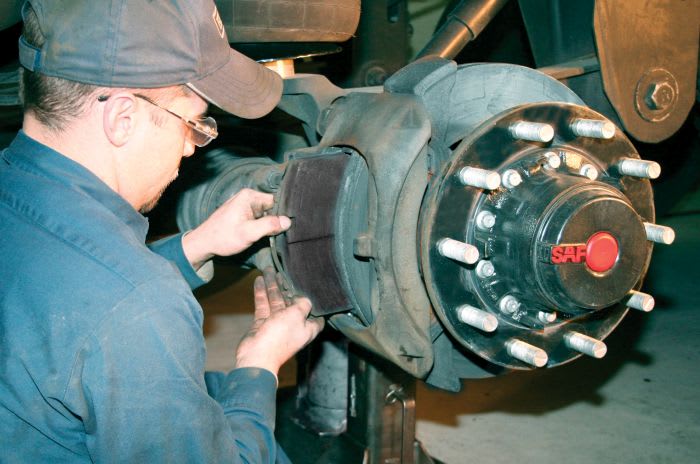
Air disc brakes require minimal routine maintenance. Most of the moving parts are
internal. Brake pads will often last for the first life of a tractor. Photos: Jim Park

4 min to read


Air disc brakes require minimal routine maintenance. Most of the moving parts are internal. Brake pads will often last for the first life of a tractor. Photos: Jim Park

Better stopping power is probably the most oft-touted advantage of air disc brakes, but advanced drum brakes easily meet the requirements, too. However, when you look at the reduced and simplified maintenance requirements of ADBs, better stopping power becomes the icing on the cake.

Ad Loading...

In a typical longhaul application, fleet technicians may never need to put a wrench to an ADB over the life of a tractor. A trailer, sure, but they tend to be kept a little longer and run fewer miles annually. With rotor life in the 700,000-mile range and pads going out to 400,000 and more, for many fleets, the right ADB spec could put an end to regular brake maintenance other than inspections.

Ad Loading...

“The normal maintenance cycle for disc brakes is not quite double that of drum brakes in a typical application,” says Gopi Krishnan, Meritor’s director of brakes for North America. “The pads in a disc brake system should go out to 500,000 or 600,000 miles. The rotors can be expected to last up to 1 million miles. As long as you don’t have to change the rotors, you will most likely see lower maintenance costs and therefore lower overall cost of ownership.”

Krishnan notes that the routine service of drum brakes, such as a reline, can take an hour or more per wheel-end.

“A pad change on a disc system can take as little as 20 minutes, in some cases without removing the wheel,” he says, “Rotor or drum changes can both be somewhat more complicated, but it’s likely that the first owner of the truck would never need to change a rotor.”

In fact, aside from a pad change, most disc brake systems in linehaul fleets following typical fleet trade-in cycles would likely be traded in without ever requiring any serious brake maintenance.

The same could be said for the premium drum brake installations, but there are other parts to such systems that do require periodic inspection. Brake adjusters need periodic lubrication, clevis pins need to be checked for free movement and linings and drums need to be inspected for cracking, expansion of the linings, oil contamination, etc. And of course proper brake stroke length need to be checked regularly, as even automatic brake adjusters don’t guarantee the brakes will not go out of adjustment.

Ad Loading...

All that is almost eliminated with ADBs. 

Due to their exposed position, rotors can be damaged by sand and grit from off-road conditions and winter road-clearing materials.

One fleet we spoke with had seen some water intrusion around the piston seals on the calipers, which prompted them to increase the frequency of their ADB inspections and to consider replacing the seals at certain intervals. Apparently ADBs are not totally trouble-free, but they are certainly less of a maintenance burden than traditional drum brakes.

Drum brakes, as reliable as they are, are still regularly put out of service at rates approaching 20%. Most of the OOS events are adjustment-related. With disc brakes, that problem basically disappears.

“Today there is not a good way to do a roadside inspection of a disc brake, although that could change in the future,” says Gary Ganaway, director of Original Equipment & Technical Sales at Bendix Commercial Vehicle Systems. “The disc brake adjustment mechanism is internal to the brake, and not as susceptible to manual adjustment. Provided the caliper is working as prescribed, there’s not much risk of a failed brake inspection.”

Which means fewer chances for dings on a fleet’s score under the U.S. DOT’s Compliance, Safety and Accountability (CSA) program.

Ad Loading...
Pad wear is easy to measure, and pads are easy to replace. The adjustment mechanism is internal and requires no lubrication or regular maintenance in most cases.

Severe Service Improves ROI

Even for fleets that keep trucks longer, simplicity of service and inspection and a significant reduction in downtime helps build the maintenance case for ADBs, especially in applications where brakes are chewed up quickly, like refuse and city P&D.

“Disc brake repairs are significantly faster than drum brake repairs,” notes Tony Ryan, technical services and training manager for SAF-Holland. “And disc pad reline takes only a few minutes per wheel to complete once the wheels are off.”

Routine brake inspections and minor service events also can be completed in less time than with drum brakes, further building the ROI case.

“There is significantly less maintenance on disc brakes when compared to drum brakes because there are fewer components.” Ryan says. “In addition, there are no grease points on the caliper and no chamber strokes to measure on air disc brakes, simplifying DOT inspections.”

In less severe but longer-life applications, like the 10-year trailers used in longhaul service, maintenance costs can be the tipping point in the ROI calculation says John Thomson, North American sales manager at TMD friction.

Ad Loading...

“Look at the servicing costs and lining change costs both in terms of costs as well as the time it takes to change them,” he says. “On long-life vehicles like trailers you could look at saving multiple brake changes during the life of the vehicle.”

That’s certainly something to consider when doing the ROI on ADB. And don’t forget the downtime savings or the fact that you might never get another citation for brake adjustment.

Maintenance tips for air disc brakes

Each air disc brake manufacturer has specific maintenance requirements you should follow, but this will give you an idea of how painless it can be.

SAF-Holland recommends a visual brake pad wear inspection every three months or 20,000 miles. A more thorough inspection is recommended at six months or 50,000 miles.

There’s no need to remove the wheels, because this is easily done by checking the wear indicators on the brake caliper with a flashlight, says Tony Ryan, technical services and training manager, SAF-Holland. The six-month/50,000-mile service includes inspecting caliper slides, inspecting for damaged caliper boots, and visual checks of the rotors to make sure there are no cracks or wear issues.

“Other than taking the wheels off and pads out to check the caliper slides, most of the service inspection requires no tools other than a flashlight,” Ryan says.

Additional maintenance points:

Check the sliding calipers for free movement on the pins or guide sleeves. Check for even wear on both pads. If it binds or there’s evidence of uneven clearance or pad wear, a wheels-off inspection should be made.

Check the rotors for scoring, cracking and other surface damage. Some cracking is tolerated, so check with the manufacturer for guidelines. Rust on the contact surface of the rotor indicates there’s no pad contact, so determine why the caliper is not functioning. 

“As with any new product, it’s important to conduct technician training to make sure they have a thorough understanding of the maintenance practices,” says Gary Ganaway, director of original equipment and technical sales at Bendix Commercial Vehicle Systems.
Subscribe to Our Newsletter

More Maintenance

Illustration of predictive maintenance
Maintenanceby News/Media ReleaseMarch 31, 2026

Fullbay Acquires Pitstop to Strengthen AI-Powered Predictive Maintenance

Pitstop AI will use Fullbay's extensive shop data to drive predictive maintenance for trucking fleets and repair shops.

Read More →
Collage of Top 20 Product award ceremonies
EquipmentMarch 31, 2026

HDT Honors the Best New Products of 2025 at TMC [Photos]

Heavy Duty Trucking's Top 20 Products awards recognize the best new products and technologies. Check out the award presentations at the 2026 Technology & Maintenance Council annual meeting.

Read More →
freightliner whitepaper
SponsoredMarch 31, 2026

Detroit Engines: Trusted Performance, Built for What's Next

The Detroit® Gen 6 engine platform proves that real progress doesn’t require a complete redesign. Built on 20 years of trusted technology, these engines are designed for efficiency, stronger performance, and greater reliability than before. And they do it all while complying with 2027 EPA standards on every mile.

Read More →
Ad Loading...
Illustration showing diesel exhaust fluid pump sign and EPA headquarters
Equipmentby Deborah LockridgeMarch 30, 2026

EPA Targets DEF Sensor Failures Behind Truck Derates

New guidance allows engine makers to replace problematic DEF sensors with NOx-based systems, aiming to reduce unnecessary derates and downtime caused by failures in the sensors designed to monitor diesel exhaust fluid on trucks.

Read More →
Goodyear steer tire on display at booth
Maintenanceby Deborah LockridgeMarch 25, 2026

Goodyear Targets ‘Super-Regional’ Sweet Spot with New Steer Tire

Goodyear is preparing to roll out a new steer tire designed to bridge the gap between regional and linehaul for trucking fleets.

Read More →
Hendrickson TireMaax Pro Watchman
Maintenanceby Jack RobertsMarch 25, 2026

Hendrickson Unveils Watchman Smart Wheel-End System at TMC

Hendrickson’s new sensor platform integrates with its TireMaax system to deliver real-time tire and wheel-end insights, targeting uptime and cost savings.

Read More →
Ad Loading...
Volvo VNL.
Maintenanceby Jack RobertsMarch 24, 2026

Over-the-Air Updates and the Modern Powertrain Explained

Over-the-air updates are moving beyond recalls, and expanding how fleets manage performance, compliance, and uptime.

Read More →
SKF TraX wheel monitoring system.
Maintenanceby Jack RobertsMarch 24, 2026

SKF, TMC Expand Hands-On Training to Boost Technician Skills at Annual Meeting

A new partnership between SFK and TMC brings certified, on-site instruction focused on wheel-end reliability and maintenance best practices.

Read More →
Graphic illustrating recruiting concept
Maintenanceby Deborah LockridgeMarch 23, 2026

Why Higher Pay Isn’t Fixing the Heavy-Duty Technician Shortage

Hiring heavy-duty truck technicians has become a bidding war, but shops that focus on culture, training, and career paths are gaining an edge. That's the takeaway from a TMC panel discussion.

Read More →
Ad Loading...
Tesla Semi electric truck
EquipmentMarch 23, 2026

Technology & Maintenance Council 2026 Annual Meeting [Photos]

Couldn't make it to Nashville for TMC's 2026 annual meeting? Check out these images.

Read More →