





Related: Focus On ... Peterbilt Autonomous Technology [VIDEO]
Kenworth's Predictive Cruise Control Looks Ahead to Save Fuel
Predictive cruise control uses terrain mapping and GPS satellite locating to manage the engine and transmission for efficient operation on up- and downgrades.
November 25, 2015
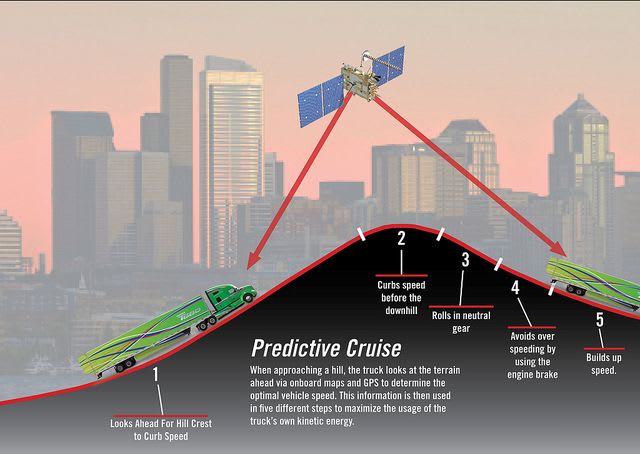
Predictive cruise control uses terrain mapping and GPS satellite locating to manage the engine and transmission for efficient operation on up- and downgrades. It can be a multi-step procedure, and a driver might or might not notice them all. In rolling terrain, the system can save 1% to 2% in fuel, Kenworth says. Image: Kenworth
3 min to read
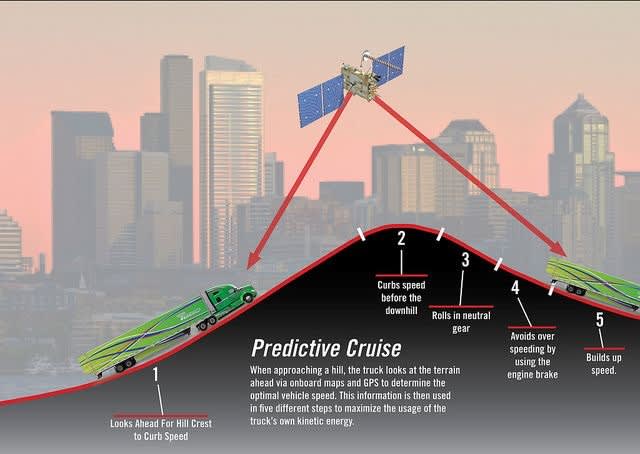
Predictive cruise control uses terrain mapping and GPS satellite locating to manage the engine and transmission for efficient operation on up- and downgrades. It can be a multi-step procedure, and a driver might or might not notice them all. In rolling terrain, the system can save 1% to 2% in fuel, Kenworth says.Image: Kenworth
Adaptive cruise control has been offered on cars and some trucks for several years. It keeps a vehicle at the set road speed and adjusts it according to what it sees in traffic just ahead, slowing and accelerating as needed.
Predictive cruise control is the next step. Using a GPS locator function and programmed-in terrain mapping, it knows exactly where the vehicle is and what geographical conditions it will encounter. Of primary concern are up- and downgrades, and predictive cruise sees them coming and manipulates the powertrain accordingly.
During a recent visit to Kenworth’s research and development center in Renton, Wash., I drove a T680 tractor equipped with the builder’s predictive cruise control. It was developed under Paccar auspices to complement the MX-13 diesel and is available in T680s and T880s with that engine.(It’s also offered by sister company Peterbilt in certain models.)
My driving experience was primarily on eastbound Interstate 90, which climbs out of the Puget Sound area toward the Cascade mountains inland of Seattle-Tacoma. The tractor pulled a van trailer ballasted for a gross combination weight of about 70,000 pounds, and the 455-hp MX-13 and Eaton Fuller Advantage automated 10-speed transmission handled the rig well.
You might think that when a rig is approaching an upgrade, because the system knows the hill’s coming, it would order the engine to make more power and torque before the vehicle begins slowing on the hill. If so, you would think wrong.
Kenworth engineers found through testing that doing that actually uses extra fuel. That goes against its primary purpose, which is to save fuel, Marketing Director Kurt Swihart later explained. So the T680 climbed grades like a normal cruise control, reacting to a slowdown and pouring on the coals.
The look-ahead capability comes into play further up the hill. As the truck nears a crest, fuel is cut back slightly and speed tapers off as momentum carries it over the top — exactly what a conscientious driver would do to save fuel. Predictive cruise control does this almost imperceptibly, Swihart said. Indeed, I didn’t notice it. (A separate function, “neutral coast,” where the transmission temporarily shifts to neutral, could be programmed in to reduce rolling friction and let gravity have a greater pull on the truck. But this truck didn’t have that feature.)
Meanwhile, predictive cruise also knows what’s on the other side of the hill — something a driver new to a route doesn’t — and uses the powertrain to try to maintain the set cruise speed. As we topped one long 3 or 4% grade and rolled over the crest, the transmission was in 9th and the engine spun at about 2,000 rpm. The power eased off and I expected the tranny to upshift. But it stayed right there, the engine still busy up near the redline.
It stayed in gear because predictive cruise control knew from its terrain map that the grade was a long one. It decided to keep revs high so the engine brake could help control our descent. I had to touch the service-brake pedal only a couple of times to keep both engine and road speed in check. As we reached the grade’s bottom the transmission upshifted, revs fell, and we proceeded on our way.
Fleet managers whose trucks are using predictive cruise in rolling terrain see a 1% to 2% fuel economy improvement, Swihart said. Those bent on controlling fuel costs can appreciate that. And “seeing” over the hills adds a safety margin, especially in an irregular-route operation where drivers might not know what’s over the next summit and beyond.
Subscribe to Our Newsletter
More Drivers

Truck Drivers Need More Than Another Alert
Fleets have more visibility into truck health, safety events, and driver activity than ever. The next challenge is turning all that information into useful guidance for the person who has to decide what to do next.
Read More →
FMCSA Removes 110 Truck Driver Training Schools from Certified ELDT List
Federal regulators also are targeting more than 160 additional training providers and launching a nationwide audit of third-party CDL skills testers as part of a broader crackdown on trucking fraud.
Read More →
Hours of Service Pilot Programs: FMCSA Readies for 2027 Rollout
Two pilot programs could eventually reshape hours-of-service rules, giving truck drivers options to pause their 14-hour clock or use longer split sleeper rest periods.
Read More →
Medical Cards, English Proficiency Reshape Roadcheck Violations
Medical-card violations jumped to the top of the driver out-of-service list during CVSA’s 2026 International Roadcheck, while English-language proficiency violations appeared among the leading violations for the first time.
Read More →
Driver Trust Can Make or Break the Success of Fleet Safety Technology
New Teletrac Navman research suggests that onboarding, transparency about driver data, and positive feedback can play a significant role in how commercial drivers respond to safety and coaching technology.
Read More →
EEOC Sues KLLM Over Alleged Sex Discrimination in Driver Training
KLLM is facing a federal sex-discrimination lawsuit over policies the EEOC alleges put female truck driver trainees at a disadvantage.
Read More →
FMCSA Moves to Codify English Language Requirements for Commercial Drivers
By changing regulations on English-language proficiency requirements for commercial drivers, rather than relying on a guidance memo, the FMCSA said future administrations won't be able to walk back the Trump administration's stricter enforcement with just a memo.
Read More →
Drivers Put Western Star Trucks to the Test at Star Nation Experience
Watch to get an inside look at the Western Star trucks, technology, and community behind the Star Nation Experience 2026!
Read More →
Trump Administration Looks to Put More Veterans Behind the Wheel
The Freedom Haulers program pulls together existing and expanded programs at several federal agencies to recruit veterans to drive commercial heavy-duty trucks and cut the red tape for them to get a CDL, training, and employment.
Read More →
Putting Mack’s Command Steer to the Test
A test drive of Mack’s Command Steer active steering system evaluates how it can make truck driving easier and less tiring.
Read More →