





Related: Looking for Durable Trailer Skirts
Spec'ing Trailer Doors and Floors
Freight goes through and on these components, and are among the details to carefully consider when spec’ing dry-van truck bodies and trailers.
July 27, 2015
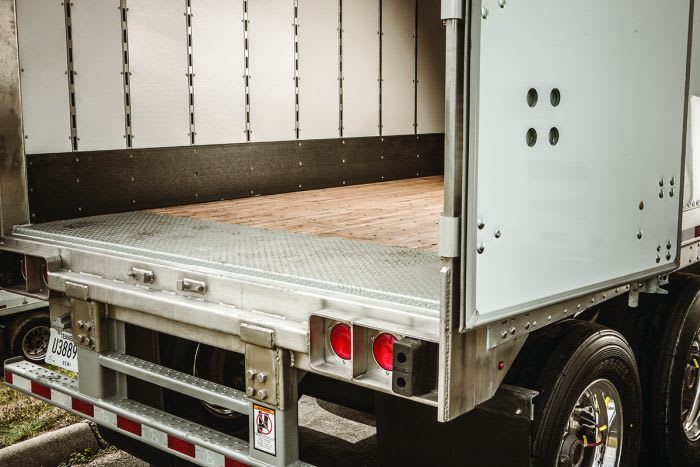
Most vans get swing doors, which are comparatively simple and, when locked shut, help stiffen the trailer’s body structure. And rugged yet economical laminated hardwood floors go in 95% of dry-freight vans.
6 min to read
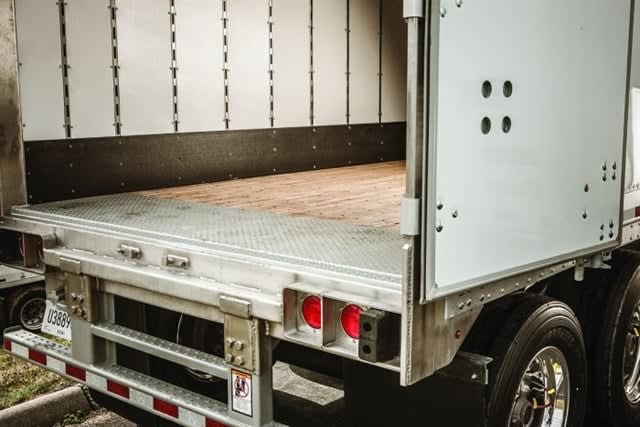
Most vans get swing doors, which are comparatively simple and, when locked shut, help stiffen the trailer’s body structure. And rugged yet economical laminated hardwood floors go in 95% of dry-freight vans.
Freight goes through a trailer’s doors and lies on the floor – preferably, properly secured so it doesn’t spill all over — a subject in itself. For now, let’s look at doors and floors to see what goes into them and how they can be spec’d to do an efficient job and provide long life.
Each of the two basic rear door types, swing and overhead, has advantages and disadvantages, says Fleet Engineers, a maker of both kinds. Swing doors are comparatively simple and leave the entire interior available for cargo loading. When securely closed with their racking rods, the doors add stiffness to the entire trailer structure. However, the driver must stop and get out of the cab to open swing doors and hook them against the sidewalls before backing into a loading dock; then after handling the cargo, he pulls out a ways and again leaves the cab to close them. And during street deliveries, the doors can be obstructed by poles, trees, cars and anything else alongside.
Overhead, or roll-up, doors can be quickly opened and closed while the trailer is against a dock, and without bumping against any side obstructions in a street. And, adds Todco, another major supplier, drivers can get to their loads fast, so the time saved on each delivery can add up. Overhead doors can be used on the rear and sides, though single-panel swing doors are usually found on a trailer or truck body’s side walls. But overheads take up some space at the rear of the trailer and along the ceiling, and have many parts. It’s important that all the parts of an overhead door be regularly inspected, lubed, adjusted, and repaired or replaced as needed, and before the truck or trailer goes out on a route.
Both types of doors can be built from a number of materials, with an aim for low cost, durability, long life, lightweight, and low cost, but seldom with all of those attributes. Stoughton Trailer notes that in the past 10 years, plate doors have been replacing ply-metal doors as the industry standard because they are more durable. The Technology & Maintenance Council of the American Trucking Associations addresses balancing cost and durability in its Recommended Practices.
Overhead doors
TMC’s RP 710A states that door panels should be made of seven-ply, ¾-inch APA Group 1, Structure 1 plywood (APA used to mean American Plywood Association, but the group is now called APA – the Engineered Wood Association). Alternative materials, including foam core-with-metal skin “sandwiches” used in plate doors, should have similar strength and performance characteristics. Each panel should be 11 to 15.5 inches in height, with the top panel a minimum of 9 inches. Width should be that of the door opening plus 2.25 inches.
Swing-type van doors
For swing doors, TMC’s RP 711 says panels must be able to withstand interior forces of up 10,000 pounds uniformly spread across a pair of closed and locked doors to simulate cargo falling against them. Sandwich-type panels should be faced inside and out with metal treated with a 12-year-life coating that meets ASTM standards. Steel panels should be zinc-coated and properly painted, and aluminum should be properly painted and of sufficient thickness and strength to meet the force standard and anticipated impacts and salt spraying at the trailer’s rear.
Floors
Look inside a dry-van trailer and you’re most likely to find a laminated hardwood floor – in fact, some 95%. That’s because it provides a good combination of strength, durability and long life at reasonable cost, says John Carr, vice president, sales and marketing at Havco. Hardwood’s flexibility allows it to bend slightly with the trailer’s structure as it moves along a road.
There are other options. Aluminum is sometimes spec’d by operators for use in regions where rain is frequent, like the Pacific Northwest. Steel is occasionally used for especially high strength. Composite floors that combine hardwood with a synthetic material are gaining attention because they shrug off moisture and road salts, and are lighter in weight than straight hardwood.
“Laminated hardwood is made from 100% oak, which is dried for 90 to 100 days – just like baking a cake,” Carr says. “You can’t do it too fast or too slow. It’s a series of sticks cut to take out defects that naturally are found in wood. It’s cut to 1- to 1-1/4-inch-wide sticks that are glued together. The glue is charged by electricity, and panels come out 8 feet wide by 48 feet long. Then they’re cut into individual boards and machined to the style the customer wants.”
Shiplap joints with step-like grooves fit together on the sides so they transfer loads among them, then they’re cut along the edge to mate with the side rail of the trailer. Boards are bolted to crossmembers positioned every 12 inches or less.
Havco’s Fusion composite floor has an oak-laminate top and an epoxy-fiberglass material adhered to the bottom with polyurethane resin, machine-pressed and electrically cured, Carr says. It’s considerably stronger and weighs 16% less than a straight-hardwood floor of the same size, partly because the wood portion can be thinner. For a 53-foot van, the saving would be about 300 pounds.
An application of tough undercoating can provide protection but without the weight savings, and Havco offers one as an option. Prolam uses what it calls P.u.R undercoating, a hot-melt polyurethane material that it says stood up to eight years of assault by road salts in the Northeast with very little degradation.
The most common hardwood-laminate floor thickness is 1-3/8 inch, and 1-5/16 and 1-1/2 inches are also used. All aim to support given forklift loadings, based on weight on the two wheels of its forward axle. A 24,000-pound rating is rather substantial, but ratings of 30,000 pounds and more can be had.
“Dry and wet shear testing are what I expect a good floor manufacturer to do,” says Charlie Fetz of Great Dane Trailer.
Trailer manufacturers, he says, test the floor for forklift loading and frequency of loading – once a day or several times a day. Providing the right information to a trailer maker on a fleet’s specific operation will lead to the proper floor. The more information the trailer company can get, the better they can help the customer.
When spec’ing trailer floors, the application — what it will carry, where it will run, and how often it will be loaded and unloaded in a typical day – is very important. Those details will determine the floor thickness and number of crossmembers that support it, among other things. “The most important factor in extending the life of the floor is making sure you spec the floor for the application it’s most used for,” says Stoughton spokesman Scott Nachreiner. “If a higher floor rating is needed, you will need a thicker floor, and narrower crossmember spacing.” Stoughton offers a chart with the options and what ratings those options will give.
For instance, explains Great Dane’s Fetz, “The long-haul drop and hook guy will buy steel crossmembers on 12-inch centers and 1-3/8-inch laminated flooring with posts on 12-inch centers, with sheet-and-post walls, or composite sides. For a shuttle operation hauling 7,000-pound rolls of paper, the axle weight of the forklift approaches 30,000 pounds and he’s loading the trailer eight times a day. So we spec steel crossmembers on 6-inch centers and a 1-1/2-inch floor. But you have to make sure the wall can hold the floor up. We put posts on 8-inch centers. Less frequent loading would require less heavy-duty specs.”
Vans built for leasing companies are general-purpose, more like the long-haul trailer, he adds. But the leasing company may ask for a certain spec for a particular operation.
“Keep in mind that the floor is a system,” says TMC’s Recommended Practice 723A, “and that load requirements and recommendations should be fully examined with the help of your trailer manufacturer and flooring supplier.”
Subscribe to Our Newsletter
More Equipment

How Volvo Updated Its D13 for EPA 2027 [Watch]
Volvo’s updated D13 promises lower emissions without sacrificing performance or fuel economy. Take a closer look at what changed inside the engine in this HDT Spotlight video.
Read More →
Michelin Tire Improves Efficiency and Durability for Regional Fleets
The Michelin X Multi Energy D2 is a regional haul drive tire engineered to help fleets improve fuel efficiency, durability and traction in demanding stop-and-go operations.
Read More →
ZF Expands Commercial Vehicle Push in North America
ZF is expanding its North American commercial-vehicle presence with new transmission applications, electrification, trailer technology and autonomous-driving systems.
Read More →
Tesla Wants a Self-Driving Semi. Are Cameras Enough?
Could Tesla’s camera-only autonomous driving technology work on an 80,000-pound Semi? In this commentary, HDT's Deborah Lockridge takes a look at Tesla, Cybercab, and how autonomous trucks see the road.
Read More →
Kodiak: Driverless Long-Haul Truck Launch on Track for 2026
Kodiak AI says its driverless long-haul safety case is 93% complete and it remains on track to begin commercial operations by year-end 2026.
Read More →
What DOT’s Automated Vehicle Strategy Means for Trucking
The U.S. Department of Transportation issued a new automated-vehicle strategy that outlines plans for driverless-truck regulations, cross-state freight corridors, and federal safety standards.
Read More →
East Coast Port Launches $45M Electric Truck Push
The Port Authority of New York and New Jersey announced millions in incentives for zero-emission drayage trucks, yard tractors, and new charging hubs near the port.
Read More →
PlusAI Going Public to Fund Autonomous Truck Launch
A SPAC deal could provide PlusAI with up to $300 million as it works toward a 2027 commercial launch of factory-built autonomous trucks.
Read More →
NHTSA Moves to Rewrite Truck Fuel-Economy Rules
The National Highway Traffic Safety Administration says it lacks authority to regulate medium- and heavy-duty truck engines separately from complete vehicles, but the existing standards have not yet been eliminated.
Read More →
Detroit Opens Orders for EPA 2027 Engines
Detroit isn’t starting from scratch to meet EPA 2027 diesel emissions standards. Its Gen 6 DD13 and DD15 engines keep much of today’s platform while updating the fuel and aftertreatment systems.
Read More →