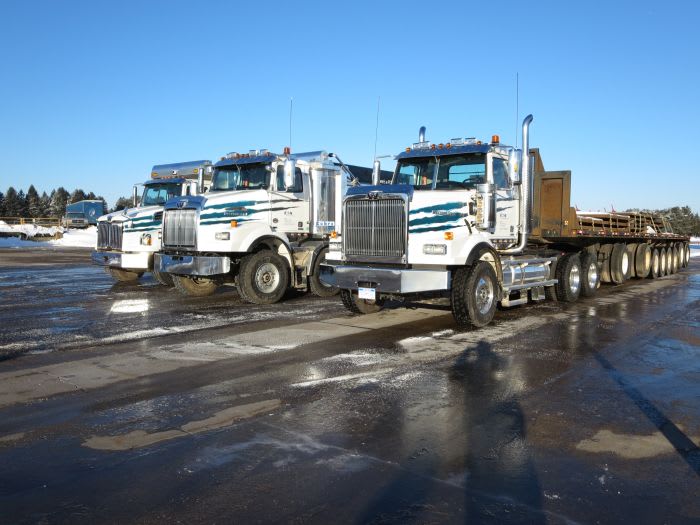
Western Star stations three vehicles at Eaton’s proving grounds at Marshall, Mich., for demonstrations. From left: 4700SB 10-wheel dump, 4800SB twin-steer 8x4 dump, and 4900SB tractor. Photo: Tom Berg
6 min to read
Western Star stations three vehicles at Eaton’s proving grounds at Marshall, Mich., for demonstrations. From left: 4700SB 10-wheel dump, 4800SB twin-steer 8x4 dump, and 4900SB tractor. Photo: Tom Berg
If you’ve been to Michigan you’ve seen multi-axle “trains” trundling up and down the highways. With gross weights of up to 76 tons, they’re lessons in productivity that many other states could learn from. I’ve always wanted to drive one and now I have, thanks to Western Star Trucks, which stations a 4900 heavy-haul tractor at Eaton’s proving grounds near Marshall.
Ad Loading...
Also domiciled there are two dump trucks: a 4800 twin-steer and a 4700 10-wheeler, which I also drove. Having them at the sprawling facility is useful because some prospective customers are not experienced drivers, but they can safely sample the vehicles’ capabilities without venturing onto public roads, explained Peter Schimunek, Western Star’s marketing manager.
Ad Loading...
And I do mean safely. During my stints with the trucks, the paved oval track and off-road courses were cleared of all other test vehicles, and we radioed our entry into each area to absolutely preclude any collisions.
Prospective customers needn’t be double-clutchers, either, because each truck had an Eaton UltraShift Plus automated mechanical transmission. They usually shift themselves accurately and smoothly. At very low speeds with the big twin-steer truck and the hefty tractor, shifts were sometimes (but not always) clunky, and while starting on upgrades, the controls had to occasionally think about the situation before choosing a ratio other than the usual 2nd gear, then getting on with the exercise. The lighter 4700’s tranny shifted smoothly in every gear, so maybe the UltraShift controls in the heavier vehicles needed some fine-tuning. Clutch engagement, though, was always very smooth with very little slipping — far better than I could’ve done with a manual transmission and clutch.
Schimunek was my main host, and several Eaton people also assisted. We assembled on a brisk but sunny mid-January morning, with freshly fallen snow blanketing the entire place — what we Northerners bravely call “a beautiful winter day” — and the three bright-white ’Stars would’ve been camouflaged except for blazing headlamps and splashy graphics on their flanks. Did I say brisk? It was 8 degrees above zero Fahrenheit as we climbed into the burly tractor.
Big tires, many axles
The long-nose 4900SB had a setback steer axle, shod with wide wheels and 385-series tires and suspended on 20,000-pound-capacity taperleaf springs. Maximum loading under Michigan train weight regulations is 18,000 pounds (less when frost restrictions are in effect), while 15,400 would be the usual amount, according to a state DOT chart. Its tandem drive axles were equipped with 14-ply 11R22.5 rubber and rated at 46,000 pounds; however, the regs limit the tandem to 32,000 pounds for a train. Each following axle is restricted to just 13,000 pounds.
Ad Loading...
Turbo-compounding helps the big DD16 make big power, but it had to use many of the automated transmission’s 18 ratios and work hard to move the heavy, multi-axle rig.
The old steel flatbed trailer was of uncertain parentage because its name and data plate had long been painted over. On it were chained-down stacks of thick plate steel and under it were eight axles, four lifted and four whose tires were permanently on the pavement. The latter were supported by a stiff steel-spring suspension. The allowable gross combination weight is 151,400 pounds for this type of 11-axle vehicle. An Eaton supervisor said our rig weighed about 130,000 pounds, though with four axles raised we’d have been 28,000 pounds overweight on public roads. Anyway, it was a rather heavy rig.
Under the long hood was a DD16, Detroit Diesel’s largest on-highway truck engine with its strongest rating of 600 hp and 2,050 lb-ft. Even with all that and 18 ratios in the UltraShift tranny, the big diesel had to labor to get us up to speed on the paved track and keep working to make 60 mph. That’s because the power-to-weight ratio was 1 hp to 216.7 pounds vs. 1 to 168.4 for a five-axle 80,000-pound semi with a 475-hp diesel. Sixty was about as fast as I could reach in road speed because I had to slow to about 50 mph for the two curves. I used part of the banked portion or I would have slowed even more.
Strap-mounted lower rungs ease the first step up, but break the 1-2-3 rhythm of the climb into the cab. Exterior grab handles are well placed, and visibility is good all-around.
Testing startability
Twice I pulled off the track and into a test area with uphill grades as steep as 20%. Here I checked the tractor’s ability to start the load from a dead stop on 10-15% upgrades. It always did so rather ably, though sometimes with a bit of hesitation as the UltraShift’s controls considered inputs from chassis sensors and determined that 1st gear was better than the usual 2nd. Still, it managed to get us moving in 2nd gear more than once.
Of course, I could’ve switched to Manual and engaged the lower gear, or, as Schimunek pointed out, simply pressed the Down arrow while in Drive. M is meant to let the driver choose and hold a gear, such as while climbing a steep grade and not wanting a power interruption, or when heading downhill and using the engine brake. Other useful features with an UltraShift Plus are Hill Hold, where the ABS controls are ordered to keep brakes applied for three seconds with no pedal input, making upgrade restarts easy, and Creep Mode, which keeps a truck moving at just over idle speed with no accelerator input.
Ad Loading...
The transmission can also limit downhill speed in Reverse, if allowed to. I should’ve remembered that while driving the twin-steer dump truck on a snowy 15% upgrade where the drive tires began spinning just before the crest. The first time I punched Neutral and let it drift back down, and the second time I locked the brakes and slid down. I can still feel my face flushing in embarrassment. I should’ve punched Reverse and let the transmission and engine control the retreat back down the hill.
Premium interior features bright-metal trim around the 17 gauges, including speedo and tach, faux-wood applique on the dash, and leather-covered seats. Paddle-type UltraShift Plus selector is at driver’s right, near the floor (lower-center of photo).
Tight, roomy cab
Western Star’s Constellation cab, adopted in the mid-1990s, is fairly wide with plenty of space for a hefty driver and another big guy. It’s made of galvanealed steel to resist corrosion. I remember when Western Star used the old Autocar cab that was narrow enough for the driver to reach over and roll down the right-side window, or maybe open and slam the door closed if it was rattling. This tractor had power windows and the doors were tight.
The cab’s interior had attractive trim, with faux wood applique across the dash and bright-metal bezels around the instruments — 18 condition gauges of various sorts and of course the centrally mounted speedometer and tachometer, which were a bit small but still readable. National air-ride seats were leather-covered and comfy, and filtered out much of the road-induced jouncing.
In Daimler Trucks’ galaxy of heavy-duty products for North America, Western Star is the premium brand, and every one of them shows it in apparent top-notch build quality. Here’s a little-known fact: The chassis of all other Class 8 trucks I know of begin assembly upside down, have axles, suspensions and other equipment bolted on, then are turned over. But Western Star frames begin their trip down the line right-side up. That’s how it was done in Kelowna, B.C., where the brand was born in 1967, and that’s how it’s done in Portland, Ore., where ’Stars are now built. The early engineers believed that it was less confusing for workers, and they’d build a better truck. If a Western Star is better than anything else on the market, that’s part of the reason why.
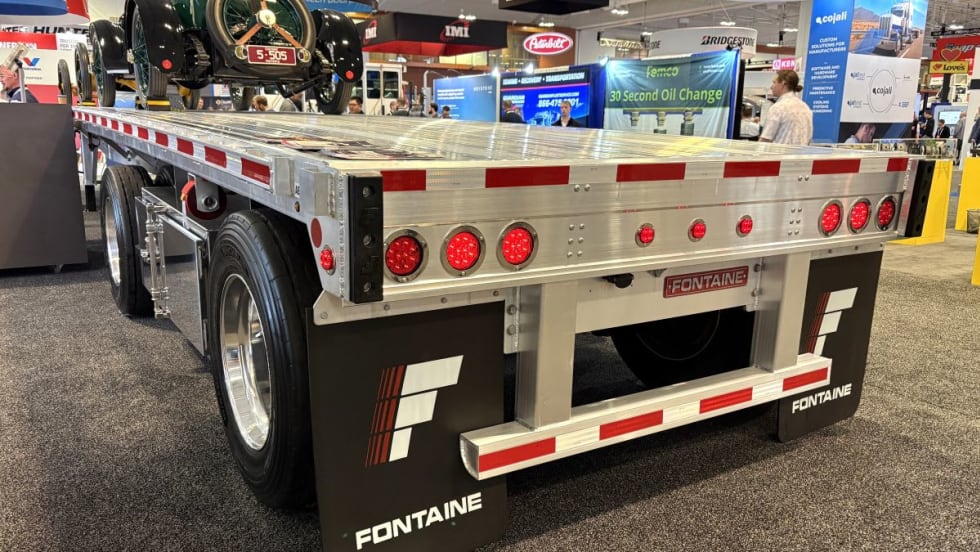
Fontaine is broadening its flatbed lineup with new models aimed at fleets, including a lightweight aluminum trailer expected in 2027 that emphasizes durability, repairability, and lower cost.
A new prototype from Fontaine Trailer focuses on what fleets say they need most: easier repairs, lower maintenance costs, and practical, service-friendly design.
The new Hyundai Translead production sites will improve trailer and body delivery to customers by reducing lead times and leveraging a growing dealer network.
Heavy Duty Trucking's Top 20 Products awards recognize the best new products and technologies. Check out the award presentations at the 2026 Technology & Maintenance Council annual meeting.
The Detroit® Gen 6 engine platform proves that real progress doesn’t require a complete redesign. Built on 20 years of trusted technology, these engines are designed for efficiency, stronger performance, and greater reliability than before. And they do it all while complying with 2027 EPA standards on every mile.
New guidance allows engine makers to replace problematic DEF sensors with NOx-based systems, aiming to reduce unnecessary derates and downtime caused by failures in the sensors designed to monitor diesel exhaust fluid on trucks.
From advanced connectivity to AI-powered cameras and next-gen fuel filtration, Clarience companies outlined a roadmap for safer, more connected trailers at TMC’s Annual Meeting.