Penske Truck Leasing buys thousands of trailers every year to serve thousands of customers, so fleet managers might learn something from their spec’ing practices.
4 min to read
Penske Truck Leasing buys thousands of trailers every year to serve thousands of customers, so fleet managers might learn something from their spec’ing practices.
Take a look at a truckstop parking lot and you’ll see more dry vans than any other type of trailer – but each one might differ significantly from the one next to it.
Application — which includes the type of cargo to be carried, nature of the operation, and climate — can affect how it’s designed and built. So can corporate organization, management philosophy and cost: Does one department buy the vehicles and another maintain them, putting them at odds? Do managers want trailers to look good and last a long time, or is that secondary? And do executives want the lowest possible price, or are they willing to pay for features that will save operating and maintenance money and boost corporate image?
Ad Loading...
A leasing company supplies vans for a wide variety of customers and faces such considerations in negotiating deals. But the lessor continues to own the vehicles and in many cases must keep them serviceable, and eventually sell them. Thus reliability, longevity and residual value remain concerns.
So from a lessor’s point of view, what are the best specifications for van trailers? Penske Truck Leasing, based in Reading, Pa., owns about 55,000 trailers at any one time, of which 70% are dry-freight vans, says Paul Rosa, senior vice president of procurement and fleet planning. Penske acquires them from four major manufacturers: Utility, Great Dane, Wabash National and Hyundai. Which one gets an order depends on pricing, time of year, line capacity and other factors.
“We buy thousands of trailers every year to serve thousands of customers,” Rosa says. “We buy about 5,000 annually on average, although that goes with industry cycles.” Penske’s base standard is 12-inch centers for side posts, which leads to long life. Rental trailers may be closer to the manufacturer’s typical wider-based standard, he says, because they usually see less use.
“Sidewalls vary by application,” he says. “There’s a huge movement away from plywood. It’s higher priced and hard to get, so we’re moving away from sheet-and-post and to plate walls.” Penske has used plastic and composite liners instead of plywood. The number of cross members is seldom altered.
Penske’s targeted life for its vans is eight to 12 years, depending on application and where it runs, Rose says. Translucent roofs are spec’d for interior illumination in some areas. Aluminum roofs, which keep interiors a little cooler, will go to trailers in the warmer areas.
Ad Loading...
Steel-spring suspensions go on about 60% of Penske’s trailers. Rosa says that compares to an industry average of 70%.
“In many cases, the type of cargo they’re hauling might not need air-ride,” he said. “Those that need it would be computers, computer chips, TVs, and glass items – that sort of thing. Builders say they’re 70% on steel spring.”
In the early 2000s, he says, Penske was supplying air-ride on nearly all its trailers, but then took a closer look and reconsidered whether the several-thousand-dollar upcharge was worth it. “In the used market, it’s not a question that comes up as a required spec, so it’s hard to justify the extra cost,” he says, only returning a quarter to half of its original value. And in the last decade, steel-spring suspensions have gotten lighter and more durable, Rosa explains.
Don’t steel springs rust? “Oh God, yeah,” Rosa says. “We’re fanatical on corrosion, what with the salts on the roads. We do comparisons year to year — galvanized metal, the various underbody coatings the OEMs use.”
Penske encourages “anyone and everyone to do galvanizing of metal. That’s an investment that really pays off,” he says. On the underside, crossmembers are sufficiently protected by sprays, some of them rubberized.
Ad Loading...
Trailer makers each have their own standard corrosion-protection coatings. “They love telling you about their one-, two- and three-year results,” he says. “Well, trailers run a lot longer than that. I need longer results.” Accelerated salt-spray testing provides better indications of long-term corrosion resistance for treated components, he says.
Because of corrosion, Penske also specs sealed wiring harnesses and light-fixture connectors.
Penske encourages customers wanting distinctive colors to vinyl-wrap their trailers instead of insisting on custom wall colors.
Wheels are powder-coated steel unless the customer is willing to pay extra for lighter weight and extra cargo capacity, Rosa says.
Penske buys SmartWay-certified trailers when customers need them. Side skirts and low-rolling-resistance tires spec’d are the manufacturers’ standard offerings. The extra cost of these items pays off in saved fuel if such trailers run enough miles at highway speeds, he says.
Sidewall and door color is mostly white because resale is strong. “It could be thousands of dollars different, white compared to yellow or black or some other color,” Rosa says. “For a 10-year-old trailer, it’ll be worth $7,000 for white compared to $3,000 for a custom color. We just don’t get requests for a used red or yellow or black trailer, so they’ll end up sitting around a while until we can find buyers for them, and that adds to our costs.”
Ad Loading...
Instead of custom paint, Penske encourages customers to do a decal wrap. Although sometimes the wrap is damaged or deteriorates and customers have to do a second or third wrap, affecting the cost equation, generally the vinyl wrap usually satisfies a customer’s desire to promote itself or its products. And at turn-in time it can be removed, baring the white that almost everybody else prefers.
In today’s cost-conscious market, fleets are finding new ways to get more value from every truck on the road. See how smarter maintenance strategies can boost uptime, control costs and drive stronger long-term returns.
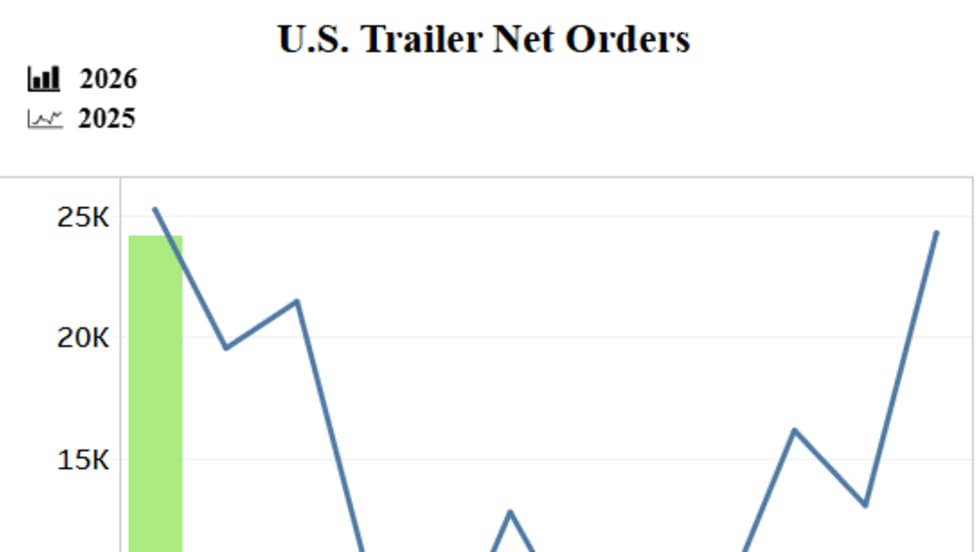
FTR said preliminary Class 8 truck orders jumped 47% month over month and 159% year over year as improving freight conditions and clearer regulatory outlook boost fleet confidence.
The new extreme-duty vocational truck replaces the long-running C500 and is designed for the most demanding off-highway applications, with production scheduled to begin in 2027.
America’s Service Line adopted Link’s SmartValve and ROI Cabmate systems to address whole-body vibration, repetitive strain, and driver turnover. The trucking fleet is already seeing measurable results.
Detroit's DD13, DD15, and DD16 engines get a pre-SCR boost, 3% fuel-efficiency gains, and familiar service intervals as Daimler prepares for trucking's next emissions era.