




LEDs Light the Way
If you were in trucking about 30 years ago, you might remember the switch from incandescent sealed-beam headlamps to halogens, which were so much better that some truck operators stopped using auxiliary fog and driving lights. A more recent step up was projector-beam lamps, whose optics better aim the lumens from halogen bulbs and even more effectively light the way for drivers.

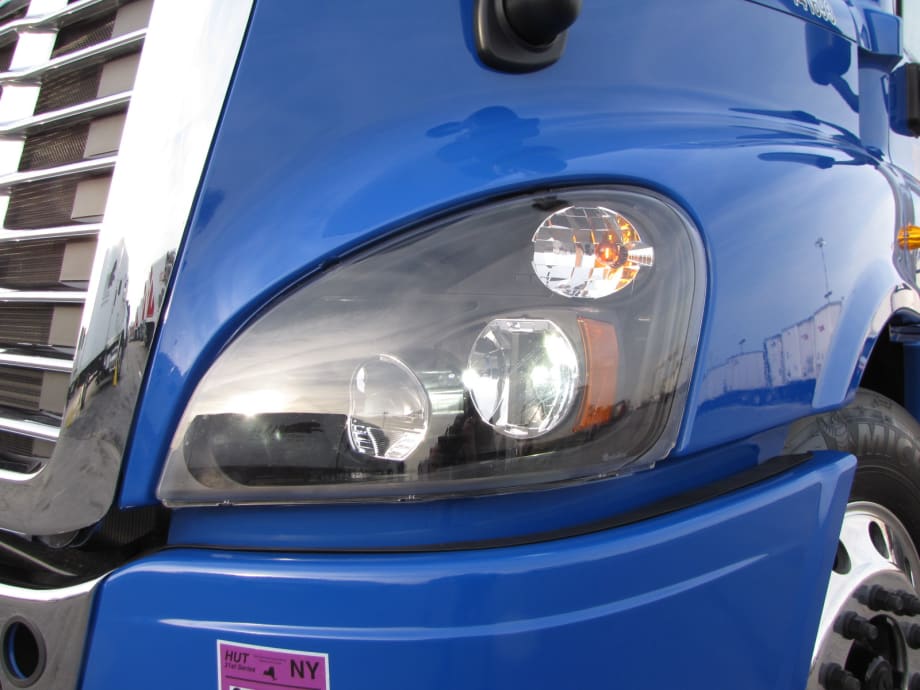
Freightliner’s Cascadia is standard with custom-fit LED lamps. Truck-Lite is also making LEDs for International’s ProStar and Volvo’s VNL.
If you were in trucking about 30 years ago, you might remember the switch from incandescent sealed-beam headlamps to halogens, which were so much better that some truck operators stopped using auxiliary fog and driving lights. A more recent step up was projector-beam lamps, whose optics better aim the lumens from halogen bulbs and even more effectively light the way for drivers.
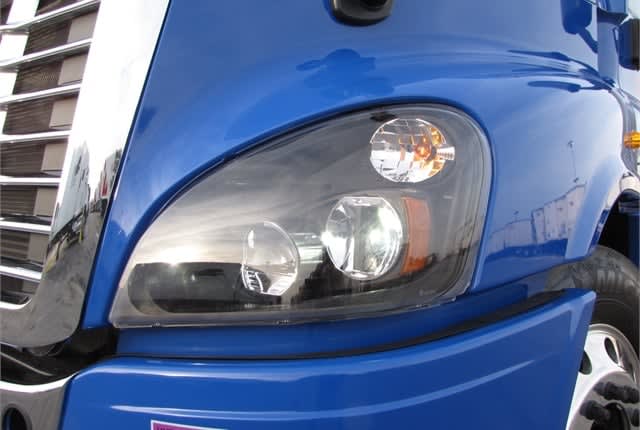
Freightliner’s Cascadia is standard with custom-fit LED lamps. Truck-Lite is also making LEDs for International’s ProStar and Volvo’s VNL.
Now we have the light-emitting diode headlamp, which dramatically eclipses the halogen. Like now-common LED markers that Grote first marketed more than 20 years ago, LED headlamps cost considerably more than older designs but provide greater safety. They also offer much longer service life and lower maintenance costs.
Truck-Lite originated the LED headlight with a 7-inch-round size for military trucks during the Iraq and Afghanistan wars, replacing the technologically ancient incandescent sealed-beam headlights that had been used since World War II. The LED head- and auxiliary lights saved lives allowing soldiers and marines to spot threats like roadside bombs.
LED headlamps have now migrated to the civilian world. Truck-Lite began selling the round LEDs as replacements for existing lights and other suppliers soon followed with other offerings.
“We haven’t heard a single negative thing about the LED headlamps we have out there, and we have 10,000 pairs out there,” reports Brad Van Riper, Truck-Lite’s chief technology officer. “Drivers are saying, ‘I can see better. There’s better glare control.’ That’s a pretty difficult deal, putting more light on the road without blinding oncoming traffic. We use a sophisticated optical software package to design the lenses. They’re shock- and vibration-resistant, have low current-draw, and are much longer lasting.”
At its plant in upstate New York, the company is now making custom products for several heavy commercial tractors. They’ve recently become standard on Freightliner’s Cascadia and International’s ProStar, and have just become optional on Volvo’s VNL and VNX. Those truck builders all cite safety and long life in explaining why they went standard with the LEDs, and say they’re working to incorporate LED headlamps on additional models.
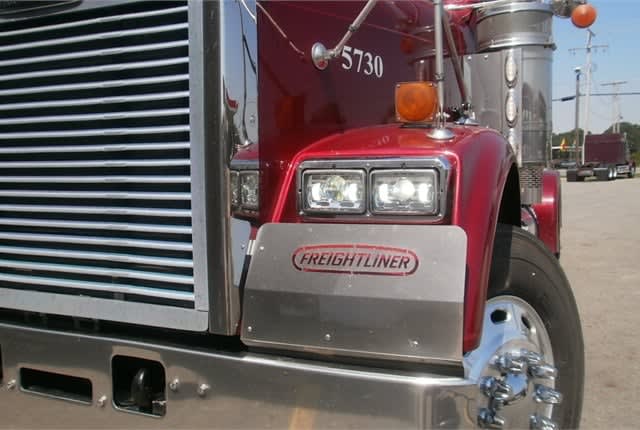
J.W. Speaker’s replacement round and rectangular LED lamps are finding buyers among owners of custom and vocational trucks.
Builders, fleets buying
“LED lights create a more natural light, which leads to improved object recognition at night as well as a beam pattern that reduces eye-strain for the driver,” says Steve Gilligan, vice president, product planning and information, at Navistar International.
“We want to provide our customers the latest in technology and performance, and the Truck-Lite high-visibility LED headlamps offer superior nighttime visibility, durability in extreme weather conditions, and are up to 50 times longer lasting than conventional halogen technology,” says Mary Aufdemberg, director of product marketing at Freightliner.
In late 2012, Penske Truck Leasing announced that 5,000 Freightliner Cascadia tractors in its commercial rental fleet would be retrofitted with LED headlights, and that LEDs would be a standard specification for all new tractors.
Other fleets are also adopting them. One is Maverick Transportation, which is including them on 200 Cascadia tractors recently ordered.
“We tested them for better part of a year and we’re ready to go with them,” says Mike Jeffress, vice president of maintenance. “Drivers feel like they have better night visibility. [The lights] seem to be brighter, pierce fog better, and you can see the shoulders better. Drivers can see as well on low-beam as they can on high with the halogens.
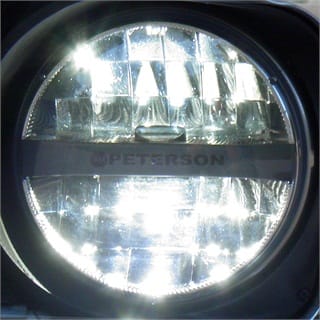
Prices of some replacement LED lamps have come down 30% in the last 12 to 18 months, Peterson says.
“On top of that, I am expecting the life cycle to be better than the original halogens. I’m hoping to keep the truck now without having to replace the headlights, which is something I haven’t been able to do before.”
Tractors with current halogen bulbs typically have two headlights replaced every year at a cost of $20 to $25 a piece, plus labor if the driver doesn’t replace them himself. One disadvantage to LEDs is that pulling out a bad halogen bulb and popping in a new one is easy, while the new LED design encompasses an entire assembly. Jeffress understands that replacing a new light fixture will be more expensive. But the lamps are covered under warranty, the first year by Freightliner and the second and third years by Truck-Lite.
LED headlamps are a delete option, and while Freightliner doesn’t advertise how much credit a buyer would get if he opts for older-style halogens or incandescents, Jeffress figures it’s about $600. He thinks that will be more than paid for if the LEDs last the planned life-cycle of four to five years.
Retrofit options
Existing trucks can also benefit from LED headlamps. J.W. Speaker, Optronics International and Peterson sell several styles of round and rectangular replacement lamps. Thanks partly to competition, prices have come down.
“Go on the Internet and some are selling for about $180 per light, down from $235, so that’s a 30% reduction in last 12 to 18 months,” says Steve Meaher, Peterson’s product marketing manager. “For us, it’s our first forward-lighting project. There’s lots of interest from custom shops and off-road racing people. The market for commercial trucks is retrofitting, into ready mix and dump trucks, and refuse.”
J.W. Speaker’s big seller is a 4- by 6-inch rectangular lamp that’s common on several truck models, like Freightliner’s FLD Classic and Kenworth’s W900 and T800. Speaker also has 5-by-7 rectangular and 5.75-inch round LEDs.
Marketing Manager Ryan Mayrand adds that they are getting popular among commercial-truck operators, “especially in Canada, because I think it’s a little darker there, longer, so there’s more value there for better illumination.”
Optronics’ Opti-Brite 7-inch round LEDs draws under 2 amps each (generally a fraction of a halogen’s current draw) and produce whiter light than halogens. Van Riper at Truck-Lite says LED light’s color is akin to sunlight at high noon, when human eyes can see best. Halogen (and tungsten) light is more yellow, as at sunrise and sundown.

Single-diode red tail-stop-turn and amber turn-signal lamps will cost less than multi-diode lights and not much more than incandescents, Optronics says. Oblong versions are also part of the series.
Lower-cost tail/stop/turn LEDs
New single-diode tail-stop-turn signal lamps are just being announced by Optronics International, which says they’re the first economically viable alternative to incandescent lamps and will make them obsolete.
Advancements in diode technology and pricing allowed Optronics to design the low-cost single-diode series, which includes 4-inch round and 6-inch oval sizes, says Brett Johnson, president and CEO. Combination tail-stop-signal lamps come in red and turn-signal lamps are in amber. They meet all federal photometric requirements for visibility and safety.
Lenses and housings are made of tough polycarbonate material that is sonically welded, and each lamp comes with a lifetime warranty. The lamps use a solid-state, surface-mount design that protects their electronics against moisture, shock and vibration.

The red and amber lamps look like incandescents, cost a little more, but last a lot longer, Johnson says. And they’ll cost considerably less than multi-diode red LEDs now on the market.
More Equipment

How Volvo Updated Its D13 for EPA 2027 [Watch]
Volvo’s updated D13 promises lower emissions without sacrificing performance or fuel economy. Take a closer look at what changed inside the engine in this HDT Spotlight video.
Read More →
Michelin Tire Improves Efficiency and Durability for Regional Fleets
The Michelin X Multi Energy D2 is a regional haul drive tire engineered to help fleets improve fuel efficiency, durability and traction in demanding stop-and-go operations.
Read More →
ZF Expands Commercial Vehicle Push in North America
ZF is expanding its North American commercial-vehicle presence with new transmission applications, electrification, trailer technology and autonomous-driving systems.
Read More →
Tesla Wants a Self-Driving Semi. Are Cameras Enough?
Could Tesla’s camera-only autonomous driving technology work on an 80,000-pound Semi? In this commentary, HDT's Deborah Lockridge takes a look at Tesla, Cybercab, and how autonomous trucks see the road.
Read More →
Kodiak: Driverless Long-Haul Truck Launch on Track for 2026
Kodiak AI says its driverless long-haul safety case is 93% complete and it remains on track to begin commercial operations by year-end 2026.
Read More →
What DOT’s Automated Vehicle Strategy Means for Trucking
The U.S. Department of Transportation issued a new automated-vehicle strategy that outlines plans for driverless-truck regulations, cross-state freight corridors, and federal safety standards.
Read More →
East Coast Port Launches $45M Electric Truck Push
The Port Authority of New York and New Jersey announced millions in incentives for zero-emission drayage trucks, yard tractors, and new charging hubs near the port.
Read More →
PlusAI Going Public to Fund Autonomous Truck Launch
A SPAC deal could provide PlusAI with up to $300 million as it works toward a 2027 commercial launch of factory-built autonomous trucks.
Read More →
NHTSA Moves to Rewrite Truck Fuel-Economy Rules
The National Highway Traffic Safety Administration says it lacks authority to regulate medium- and heavy-duty truck engines separately from complete vehicles, but the existing standards have not yet been eliminated.
Read More →
Detroit Opens Orders for EPA 2027 Engines
Detroit isn’t starting from scratch to meet EPA 2027 diesel emissions standards. Its Gen 6 DD13 and DD15 engines keep much of today’s platform while updating the fuel and aftertreatment systems.
Read More →